


















Lesson 2 of 46 · Getting Started
What Is Pathology? Disease, Diagnosis and the Pathologist
Learn what pathology is, how general and systemic, anatomic and clinical pathology differ, and why abnormal does not always mean diseased.
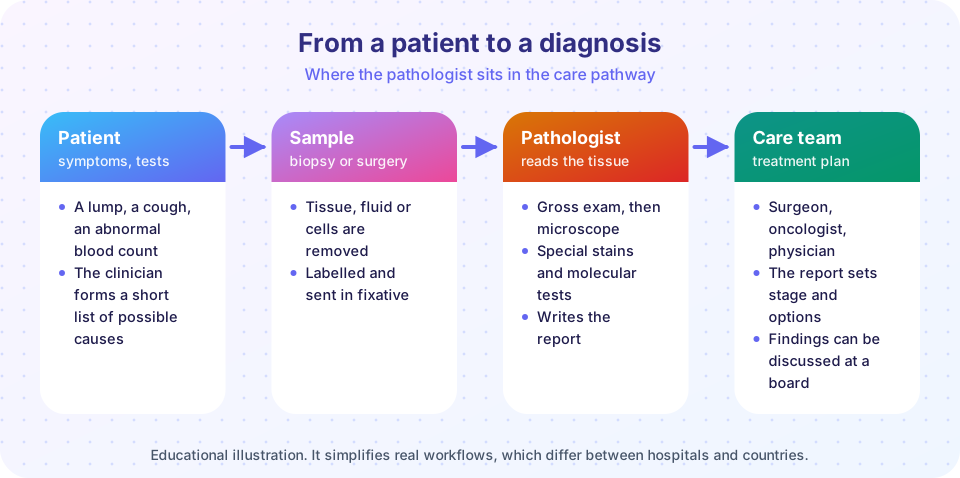
The word pathology comes from the Greek pathos (suffering) and logos (study). In practice it has two meanings. First, it is the scientific discipline that studies the causes, mechanisms and structural effects of disease. Second, it is a medical specialty: pathologists are physicians who examine tissue, fluids and cells to establish diagnoses. A surgeon removes a lump, but it is a pathologist who tells everyone whether it is a harmless cyst or a cancer, how far it has grown, and which features predict how it will behave.
This lesson places the field on the map. You will meet its history, its main branches, the vocabulary doctors use for the same event seen from different angles, and one idea that surprises almost every beginner: why a result outside the normal range is not the same thing as disease.
What you will learn
- The origin of pathology as a science, from Morgagni to Virchow.
- The difference between general and systemic pathology, and between anatomic and clinical pathology.
- The vocabulary of disease: sign, symptom, syndrome, lesion, diagnosis, prognosis.
- Why a normal range cannot sort people neatly into healthy and diseased.
Key terms
General pathology: the basic reactions of cells and tissues to injury (cell injury, inflammation, repair, blood-flow disorders, neoplasia).
Systemic pathology: the specific diseases of each organ system, such as the heart, lung or kidney.
Anatomic pathology: diagnosis from tissue and cells: surgical pathology, cytology and autopsy.
Clinical pathology: diagnosis from laboratory analysis of blood, urine and other fluids.
Reference range: the interval that contains the results of most healthy people, usually the central 95 percent.
A short history in three steps
Early physicians described diseases by their symptoms. Disease was often explained as an imbalance of bodily fluids, an idea that lasted for centuries. The turn to structure came in 1761, when the Italian anatomist Giovanni Battista Morgagni published a large work linking patients' symptoms in life to what he found inside their bodies at autopsy. The central idea was simple and revolutionary: diseases have seats, specific organs where something is physically wrong.
In the nineteenth century the focus narrowed from organs to tissues, and then to cells. Rudolf Virchow, a German physician, argued in the 1850s that disease is a disturbance of cells and that every cell arises from a pre-existing cell. His book Cellular Pathology (1858) is a landmark, and "cellular pathology" is still the backbone of the subject. The twentieth century added electron microscopy, immunology and biochemistry. Today molecular pathology reads DNA, RNA and proteins in a tumor to guide treatment. The scale has changed from organ to cell to molecule, but the question is the same: what is wrong, and why?
General and systemic pathology
Teachers split the subject in two so that the learner does not drown.
General pathology covers the reactions that any tissue can show. A cell can be injured and die. A tissue can be inflamed and then heal. Blood can clot where it should not. A cell can start dividing without control. These four or five themes appear in every organ. They are the content of chapters 2 to 5 of this course.
Systemic pathology applies those themes to a specific organ system. Atherosclerosis is cell injury and inflammation in an artery wall. Glomerulonephritis is inflammation in a kidney filter. Studying them one by one is chapters 6 to 8. If you master general pathology first, systemic pathology reads like a series of variations rather than a thousand unrelated facts.
Anatomic and clinical pathology
As a medical specialty, pathology has two big halves.
| Branch | What is examined | Typical question |
|---|---|---|
| Anatomic pathology | Tissue (surgical specimens, biopsies), cells (smears, fine-needle samples) and, at autopsy, whole bodies | Is this lump benign or malignant? What killed this person? |
| Clinical pathology (laboratory medicine) | Blood, urine, other fluids, microbes | Is the blood count normal? Which bacterium is growing? Is the blood type compatible? |
Within these halves sit many subspecialties: hematopathology (blood and bone marrow), neuropathology, dermatopathology, forensic pathology (deaths with legal questions), and molecular genetic pathology. The common thread is that a pathologist rarely meets the patient but influences nearly every serious diagnosis. It is an old joke that the pathologist is the doctor behind the doctors.
A myth worth clearing early: pathologists do not only perform autopsies. In most hospitals, living patients' biopsies and surgical specimens are the bulk of the work. Autopsies, when done, answer questions that no test during life could and also help doctors learn from their own diagnoses.
The vocabulary of disease
Clinicians and pathologists use precise words because the same situation can be described at different levels.
- A symptom is something the patient reports: pain, nausea, tiredness. It is subjective.
- A sign is something an examiner observes or measures: a fever of 39 °C, a heart murmur, a swollen ankle.
- A syndrome is a recurring group of signs and symptoms that travel together, often with more than one possible cause.
- A lesion is a visible or microscopic abnormality in a tissue.
- A diagnosis names the disease. A differential diagnosis is the short list of diseases that could explain the findings.
- A prognosis is the expected course and outcome. Prevalence is how common a condition is in a population; incidence is how many new cases arise in a period.
Notice that these words describe the same patient from several points of view. A person with chest pain (symptom) and an abnormal heart tracing (sign) may have a blocked artery (diagnosis), dead heart muscle (lesion) and a high chance of recovery with treatment (prognosis).
Is abnormal the same as diseased?
Here is the idea that surprises beginners. A blood test result is compared with a reference range, typically the interval that includes the central 95 percent of results in a healthy reference group. That means, by definition, about 1 in 20 perfectly healthy people falls outside the range for any single test. If a laboratory runs many tests at once, the chance that a healthy person has at least one flagged result becomes large.
For independent tests, the probability of at least one out-of-range value is 1 - 0.95^n, where n is the number of tests. With 20 tests that is about 64 percent. Real tests are not perfectly independent, so the exact figure differs, but the lesson is robust: a lone slightly abnormal value is a prompt to look further, not a diagnosis. Doctors interpret a result in context: the patient, the trend over time and other findings.
Common misconceptions
- "Abnormal means disease." No. Normal ranges are statistical. Healthy people can fall outside them, and sick people can fall inside them.
- "Pathologists only do autopsies." Most work involves living patients' samples.
- "A pathology report is a certainty." Reports are expert judgments about what the tissue shows. They carry uncertainty, and difficult cases are often reviewed by a second pathologist.
Try it
The first block simulates blood tests on healthy people to show how often at least one result is flagged. It is a demonstration of the statistics, not of any real test.
Press Run (or Ctrl + Enter) to see the result here.
Program input · what you'd type while the program runs
Type the answers before you press Run, one per line. Each time the program reads a line (with input()), it gets the next line from this box.
The second block sorts statements into the vocabulary above. Change the list and see how you would classify new statements.
Press Run (or Ctrl + Enter) to see the console output here.
No output.
Check your understanding
Quick check · 5 questions
of 5 answered You scored / 5 · perfect!
-
1. Which pioneer argued in the 1850s that disease is a disturbance of cells?
Virchow's Cellular Pathology (1858) made the cell the unit of disease. Morgagni, a century earlier, linked disease to organs. -
2. Which branch of pathology mainly examines blood, urine and microbes in the laboratory?
Clinical pathology, or laboratory medicine, analyzes fluids and microbes. Anatomic pathology examines tissue and cells. -
3. A patient says they feel tired and nauseated. These are examples of what?
Symptoms are subjective experiences reported by the patient. Signs are observed or measured by an examiner. -
4. Why can a healthy person have one result outside the reference range?
The range is statistical. A healthy person has about a 5 percent chance of being flagged on any single test. -
5. How does general pathology differ from systemic pathology?
General pathology teaches the shared themes; systemic pathology applies them organ by organ.
Summary
- Pathology is both a science of disease and a medical specialty that reads tissue, cells and fluids.
- Morgagni tied disease to organs, Virchow tied it to cells, and modern pathology adds molecules.
- General pathology covers the shared reactions; systemic pathology covers organ-specific diseases.
- Anatomic pathology studies tissue; clinical pathology studies fluids and microbes.
- Know the words: symptom, sign, syndrome, lesion, diagnosis, prognosis.
- Reference ranges are statistical, so abnormal does not automatically mean diseased.
Track your progress
Create a free account to tick off lessons and pick up where you left off on any device.
of Pathology lessons completed