


















Lesson 44 of 46 · Projects and Practice
Glossary of pathology terms (chapters 5 to 8)
A plain-language glossary of more than sixty pathology terms from neoplasia, cardiovascular, respiratory, gut, kidney, endocrine, infectious and neurological disease.
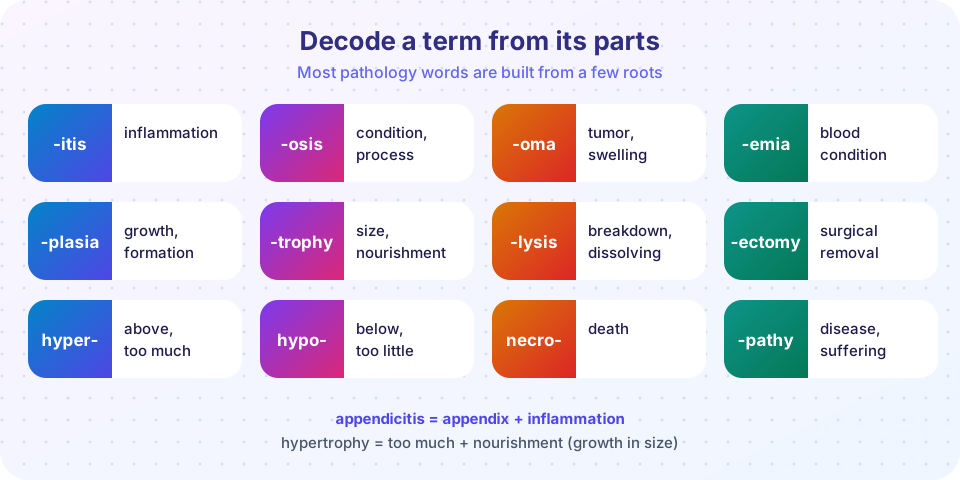
Pathology has its own vocabulary, and much of it is built from a few Greek and Latin roots. Once you know the roots (shown in the picture below), unfamiliar words stop being walls and become puzzles you can solve. This glossary gathers the key terms of chapters 5 to 8, with a one-sentence meaning and a link to the lesson that explains each in context. Use it for quick reference, and use the search widget to quiz yourself.
What you will learn
- The common roots, prefixes and suffixes used in pathology
- Short, precise definitions for the course's key terms
- Where to find the full explanation of each term
Key terms
Root / prefix / suffix: the building blocks of medical words. Eponym: a disease named after a person, such as Crohn disease. Lesion: any area of abnormal tissue.
Word parts that unlock many terms
| Part | Meaning | Examples |
|---|---|---|
| -itis | inflammation | hepatitis, meningitis, pancreatitis |
| -osis | a condition or process | fibrosis, cirrhosis, sclerosis, necrosis |
| -oma | tumor or swelling | adenoma, lymphoma, hematoma |
| -emia | a condition of the blood | anemia, septicemia, hyperglycemia |
| -plasia | formation, growth | hyperplasia, dysplasia, metaplasia |
| -trophy | size, nourishment | hypertrophy, atrophy |
| -lysis | breakdown | hemolysis, dialysis, lysis of a clot |
| -ectomy | surgical removal | appendectomy |
| hyper- / hypo- | above or too much / below or too little | hypertension, hypothyroidism |
| necro- | death | necrosis |
| -pathy | disease | nephropathy, cardiomyopathy |
The glossary
A to C
| Term | Meaning | Lesson |
|---|---|---|
| Abscess | A localized collection of pus walled off by tissue. | Host response |
| Adenocarcinoma | A malignant tumor of glandular epithelium. | Names and growth |
| Alpha-1 antitrypsin | A protein that protects lung tissue from enzyme damage; its deficiency causes panacinar emphysema. | Lung disease |
| Amyloid | An abnormal protein that aggregates in tissue; in Alzheimer disease, beta-amyloid forms plaques. | Stroke and dementia |
| Anaplasia | Loss of differentiation, with pleomorphic, dark nuclei; a sign of malignancy. | Names and growth |
| Angina | Chest pain from reversible heart muscle ischemia. | Atherosclerosis |
| Apoptosis | Programmed, orderly cell death. | Carcinogenesis |
| Atherosclerosis | Thickening of the artery intima by a plaque of lipid, cells and scar. | Atherosclerosis |
| Azotemia | A rise of urea and creatinine in the blood from reduced kidney function. | Kidney disease |
| Basement membrane | A thin layer under epithelium; carcinoma in situ has not crossed it. | Names and growth |
| Benign | Not invasive and not spreading, though still capable of harm by pressure or hormones. | Names and growth |
| Berry aneurysm | A small saccular bulge at an artery branch in the brain; rupture causes subarachnoid hemorrhage. | Stroke and dementia |
| Cachexia | Wasting with weight and muscle loss in chronic disease such as cancer. | Grading and staging |
| Carcinoma | A malignant tumor of epithelium. | Names and growth |
| Carcinoma in situ | Full-thickness dysplasia with the basement membrane intact. | Names and growth |
| Caseous necrosis | Pale, cheese-like dead tissue, typical of tuberculosis. | Host response |
| Cirrhosis | Diffuse liver scarring with regenerative nodules. | Gut, liver and pancreas |
| Coagulative necrosis | Tissue death in which the outline stays for a while; typical of infarcts in heart and kidney. | Atherosclerosis |
| Consolidation | Lung tissue filled with fluid or cells, so that it is solid. | Lung disease |
D to H
| Term | Meaning | Lesson |
|---|---|---|
| Dementia | An acquired, usually progressive decline in thinking that affects daily life. | Stroke and dementia |
| Differentiation | How closely tumor cells resemble their tissue of origin. | Names and growth |
| Dysplasia | Disordered epithelial growth with abnormal cells; premalignant. | Names and growth |
| Embolus | A detached mass (clot, fat, air, plaque) that travels in blood and lodges elsewhere. | Stroke and dementia |
| Emphysema | Permanent enlargement of air spaces with destruction of their walls. | Lung disease |
| Epithelioid cell | An activated macrophage with pink cytoplasm that forms granulomas. | Host response |
| Fibrosis | Scarring with excess collagen. | Gut, liver and pancreas |
| Foam cell | A macrophage swollen with engulfed lipid. | Atherosclerosis |
| Glioma | A tumor of glial cells in the brain. | CNS infection and tumors |
| Glomerulonephritis | Inflammation of the kidney's filtering units. | Kidney disease |
| Grade | How abnormal tumor cells look. | Grading and staging |
| Granuloma | An aggregate of activated macrophages walling off a persistent agent. | Host response |
| Hamartoma | A disorganized mass of tissue native to the site. | Names and growth |
| Hyperplasia | An increase in cell number in response to a stimulus. | Names and growth |
| Hypertrophy | An increase in cell size, as in a pressure-loaded heart. | Hypertension and heart failure |
I to N
| Term | Meaning | Lesson |
|---|---|---|
| Infarct | An area of tissue death caused by ischemia. | Atherosclerosis |
| Ischemia | Too little blood flow for the tissue's needs. | Atherosclerosis |
| Jaundice | Yellow discoloration from excess bilirubin. | Gut, liver and pancreas |
| Liquefactive necrosis | Tissue death in which dead cells dissolve into liquid; typical of brain infarcts and abscesses. | Stroke and dementia |
| Malignant | Invasive and able to metastasize. | Names and growth |
| Metaplasia | Replacement of one mature cell type by another. | Names and growth |
| Metastasis | A secondary tumor at a site distant from the primary. | Names and growth |
| Monro-Kellie doctrine | The fixed volume inside the skull means added volume raises pressure. | CNS infection and tumors |
| Myelin | The fatty insulation of axons; lost in multiple sclerosis. | CNS infection and tumors |
| Necrosis | Death of cells in a living tissue with inflammation. | Host response |
| Neoplasm | An autonomous growth that persists after the stimulus is gone. | Overview |
| Nephritic syndrome | Glomerular inflammation with hematuria, hypertension and reduced GFR. | Kidney disease |
| Nephrotic syndrome | Heavy protein loss with low albumin, edema and high lipids. | Kidney disease |
O to Z
| Term | Meaning | Lesson |
|---|---|---|
| Oncogene | A mutated or overactive growth gene that drives cancer. | Carcinogenesis |
| Paraneoplastic syndrome | An effect of a tumor caused by substances it releases. | Grading and staging |
| Penumbra | At-risk tissue around an infarct core that might be saved. | Stroke and dementia |
| Plaque | A raised lesion; atherosclerotic plaque or a demyelinated MS plaque. | Atherosclerosis |
| Portal hypertension | Raised pressure in the portal vein, usually from cirrhosis. | Gut, liver and pancreas |
| Prion | A misfolded protein that spreads by converting normal copies. | Stroke and dementia |
| Proto-oncogene | The normal form of a growth gene. | Carcinogenesis |
| Sarcoma | A malignant tumor of mesenchymal tissue. | Names and growth |
| Sepsis | Life-threatening organ dysfunction from a dysregulated response to infection. | Host response |
| Stage | How far a tumor has spread, often by TNM. | Grading and staging |
| Steatosis | Fat accumulation in cells, as in fatty liver. | Gut, liver and pancreas |
| Stroke | Sudden loss of brain function from a blood vessel problem. | Stroke and dementia |
| Thrombus | A clot formed in a vessel or heart chamber during life. | Atherosclerosis |
| TNM | Staging system based on tumor, nodes and metastasis. | Grading and staging |
| Troponin | A heart muscle protein released into the blood when muscle cells die. | Atherosclerosis |
| Tumor suppressor gene | A gene whose protein restrains growth; both copies must be lost for cancer. | Carcinogenesis |
| Ulcer | A break in a surface lining that extends into deeper layers. | Gut, liver and pancreas |
| Varices | Enlarged veins, as in the esophagus from portal hypertension. | Gut, liver and pancreas |
| Vegetation | A mass of clot and microbes on a heart valve in endocarditis. | Hypertension and heart failure |
Try it
The widget below holds a selection of the terms. Type a few letters to filter, or press "Quiz me" to see a definition and guess the term.
Press Run (or Ctrl + Enter) to see the console output here.
No output.
Common misconceptions
- "Necrosis and apoptosis are the same." Necrosis is accidental death with inflammation; apoptosis is programmed, tidy cell death.
- "Hyperplasia and hypertrophy are the same." One means more cells; the other means bigger cells (they can occur together).
- "Metaplasia is cancer." It is a reversible adaptation, although persistent metaplasia can lead to dysplasia.
Check your understanding
Quick check · 5 questions
of 5 answered You scored / 5 · perfect!
-
1. The suffix -itis means
Hepatitis is liver inflammation. -
2. An increase in cell size is
Hypertrophy means bigger cells; hyperplasia means more cells. -
3. Which term refers to tissue around an infarct that might still be saved?
The penumbra has reduced flow but is still viable. -
4. A tumor suppressor gene typically requires
Both copies must be lost (the two-hit model). -
5. Which word describes a malignant tumor of mesenchymal tissue?
Sarcomas arise from connective tissue, muscle, fat and bone.
Summary
- Many pathology terms are built from a few roots such as -itis, -osis, -oma, -plasia and -trophy.
- The glossary defines the key terms of chapters 5 to 8 and links each to its lesson.
- Use the search and quiz widgets to practice recall.
Next: Cheat sheet
Track your progress
Create a free account to tick off lessons and pick up where you left off on any device.
of Pathology lessons completed