


















Lesson 34 of 46 · Gastrointestinal, Renal and Endocrine Pathology
Endocrine disease: diabetes, thyroid, adrenal and more
Learn the pathology of type 1 and type 2 diabetes and their complications, thyroid disease and tumors, and the main adrenal, parathyroid and pituitary disorders.
Hormones are chemical messengers released into the blood by glands. They act on distant target cells, usually in tiny amounts, and most are controlled by negative feedback loops. Endocrine disease follows from three things going wrong: a gland makes too much hormone, makes too little, or the target cells do not respond properly. A fourth cause is a tumor, which can be a gland tumor that makes hormone or a distant tumor that does so ectopically.
Diabetes mellitus is by far the most common endocrine disease and affects hundreds of millions of people, so most of this lesson concerns it. The rest looks at the thyroid and then briefly at the adrenal, parathyroid and pituitary glands.
What you will learn
- The mechanisms that separate type 1 from type 2 diabetes
- The acute and chronic complications of diabetes
- The main thyroid diseases: Graves, Hashimoto, goiter and tumors
- The logic of adrenal, parathyroid and pituitary disorders
Key terms
Insulin: a hormone from pancreatic beta cells that lowers blood glucose.
Insulin resistance: reduced response of tissues to insulin.
HbA1c: a blood test reflecting average glucose over about 2 to 3 months.
Goiter: an enlarged thyroid.
Negative feedback: a high hormone level suppresses its own production.
Diabetes mellitus
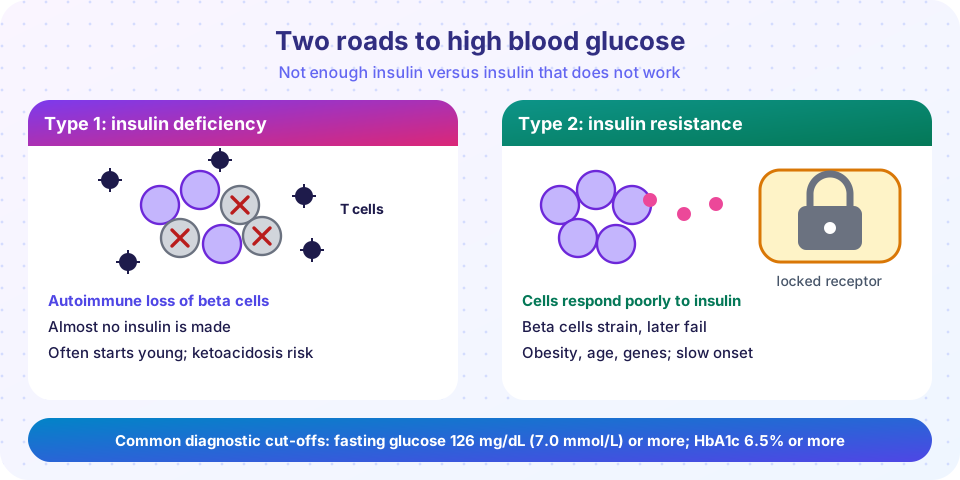
After a meal, glucose rises, beta cells in the pancreatic islets release insulin, and insulin tells muscle, fat and liver to take up glucose and store it, and tells the liver to stop making more. In diabetes, this fails, and blood glucose stays high (hyperglycemia). Diagnostic criteria used by many guidelines include a fasting glucose of 126 mg/dL (7.0 mmol/L) or more, an HbA1c of 6.5 percent or more, a 2-hour glucose of 200 mg/dL (11.1 mmol/L) or more during an oral glucose tolerance test, or a random glucose of 200 mg/dL or more with typical symptoms.
Type 1 diabetes
Type 1 is an autoimmune disease: T cells attack and destroy the pancreatic beta cells, a process called insulitis. Genes in the HLA region (especially certain HLA-DR3 and DR4 variants) raise risk, and antibodies to islet proteins such as insulin and GAD appear in the blood, sometimes years before symptoms. By the time of diagnosis, most beta cells are gone, so insulin is nearly absent, and patients depend on insulin injections. Onset is often in childhood or adolescence, with thirst, frequent urination, weight loss and, if untreated, diabetic ketoacidosis: without insulin the body breaks down fat, makes acidic ketones, and the blood becomes dangerously acidic.
Type 2 diabetes
Type 2 accounts for the great majority of cases. It begins with insulin resistance, strongly linked to obesity (especially fat in the abdomen and liver), inactivity, age and genes. For a long time the beta cells keep up by making more insulin. Eventually they fail, and glucose climbs. Islets show amyloid deposits (from a protein called amylin that is co-secreted with insulin) and loss of beta cell mass. Onset is slow, and many people are diagnosed with complications already present. A severe acute form in type 2 is the hyperosmolar hyperglycemic state, with extremely high glucose and dehydration but little ketosis.
Two other forms are worth knowing: gestational diabetes, with glucose intolerance first found in pregnancy, and diabetes caused by other diseases of the pancreas or by drugs.
Press Run (or Ctrl + Enter) to see the result here.
Program input · what you'd type while the program runs
Type the answers before you press Run, one per line. Each time the program reads a line (with input()), it gets the next line from this box.
Complications
Chronic high glucose damages blood vessels, nerves and other tissues over years. Mechanisms include advanced glycation end products (glucose sticking to proteins and stiffening them), excess activity of the polyol pathway, oxidative stress and chronic inflammation.
- Macrovascular disease: accelerated atherosclerosis causing heart attack, stroke and peripheral arterial disease, which is the main cause of death.
- Microvascular disease: thickened basement membranes of small vessels.
- Retinopathy, a leading cause of blindness in adults of working age.
- Nephropathy with Kimmelstiel-Wilson nodules, the main cause of kidney failure.
- Neuropathy, with loss of sensation in the feet and autonomic problems.
- Infection and wound healing: foot ulcers, which together with neuropathy and poor blood flow are a major cause of lower limb amputation.
- Others: cataracts, fatty liver, and cardiomyopathy.
Tight glucose control reduces the risk of microvascular complications, and managing blood pressure, cholesterol and smoking reduces the macrovascular risk.
Thyroid disease
The thyroid gland in the neck makes thyroxine (T4) and triiodothyronine (T3), which set the body's metabolic rate. The pituitary controls it through TSH (thyroid-stimulating hormone), and the thyroid hormones in turn suppress TSH by negative feedback. A consequence is a useful rule: in primary thyroid disease TSH moves in the opposite direction to T4 (low T4 with high TSH, or high T4 with low TSH).
Press Run (or Ctrl + Enter) to see the console output here.
No output.
- Graves disease is the commonest cause of hyperthyroidism. An autoantibody mimics TSH by binding to the TSH receptor and stimulating the gland nonstop. The gland is diffusely enlarged and overactive. Patients have weight loss, tremor, a fast heart rate, heat intolerance and sometimes protruding eyes (exophthalmos).
- Hashimoto thyroiditis is the commonest cause of hypothyroidism in iodine-sufficient regions. It is autoimmune: lymphocytes and plasma cells with germinal centers infiltrate the gland, and the follicular cells become Hürthle (oncocytic) cells. Antibodies to thyroid peroxidase are common. Patients have slowed metabolism, tiredness, weight gain, cold intolerance and a goiter. Untreated congenital hypothyroidism harms brain development, which is why newborns are screened.
- Goiter is thyroid enlargement. Iodine deficiency is the leading global cause. A multinodular goiter can compress the windpipe or become hyperfunctioning.
- Thyroid tumors. Most nodules are benign. Among cancers, papillary carcinoma is the commonest and has an excellent outlook: nuclei look empty ("Orphan Annie eye"), and psammoma bodies may be seen; it spreads through lymphatics and is linked to radiation exposure and BRAF or RET alterations. Follicular carcinoma is diagnosed by invasion of the capsule or vessels and spreads through blood. Medullary carcinoma arises from C cells, secretes calcitonin, and may be part of the inherited MEN 2 syndromes (RET mutation). Anaplastic carcinoma is rare, aggressive and found in older adults.
Adrenal, parathyroid and pituitary
- Cushing syndrome is the result of too much cortisol. The most common cause is taking glucocorticoid medicines. Natural causes include a pituitary ACTH-secreting tumor (Cushing disease), an adrenal tumor, or ectopic ACTH from a tumor such as small cell lung cancer. Signs include central obesity, "moon" face, purple stretch marks, high blood pressure, high glucose and thin bones.
- Adrenal insufficiency (Addison disease) is deficiency of cortisol, often with aldosterone. The commonest cause in developed countries is autoimmune destruction of the adrenal cortex, and tuberculosis was the historical cause. Signs are weakness, weight loss, low blood pressure, salt craving and darkened skin from high ACTH.
- Primary aldosteronism (excess aldosterone from an adrenal adenoma or hyperplasia) causes hypertension with low potassium. Pheochromocytoma is a tumor of the adrenal medulla that releases catecholamines and causes episodic hypertension, headache and sweating.
- Primary hyperparathyroidism is usually due to a single parathyroid adenoma. Excess parathyroid hormone raises blood calcium and causes kidney stones, bone loss and abdominal and psychological symptoms. Secondary hyperparathyroidism occurs in chronic kidney disease.
- Pituitary adenomas are benign tumors. They cause symptoms by mass effect (headache, loss of the side parts of the visual field, because they press on the optic chiasm) and by hormone excess or deficiency. Prolactinomas are the commonest. Growth hormone excess causes acromegaly in adults.
- Multiple endocrine neoplasia (MEN) syndromes are inherited tumor syndromes of several glands, such as MEN 2 with medullary thyroid cancer, pheochromocytoma and parathyroid disease.
Common misconceptions
- "Diabetes is caused by eating sugar." Type 1 is autoimmune; type 2 is linked to obesity, genes, inactivity and age; sugar intake is only one of many factors.
- "Type 2 diabetes is mild." Over years it causes major vascular, kidney, eye and nerve damage.
- "Thyroid nodules usually mean cancer." Most thyroid nodules are benign.
- "An enlarged thyroid always means an overactive thyroid." Goiters can occur with low, normal or high function.
Try it
Press Run (or Ctrl + Enter) to see the result here.
Program input · what you'd type while the program runs
Type the answers before you press Run, one per line. Each time the program reads a line (with input()), it gets the next line from this box.
Check your understanding
Quick check · 5 questions
of 5 answered You scored / 5 · perfect!
-
1. Which is characteristic of type 1 diabetes?
T cells destroy beta cells, so insulin is nearly absent. -
2. Kimmelstiel-Wilson nodules are a feature of
They are nodular expansions of the mesangium in diabetic kidney disease. -
3. In primary hypothyroidism the typical lab pattern is
The pituitary raises TSH to try to drive a failing thyroid. -
4. Graves disease is caused by
Stimulating anti-TSH-receptor antibodies drive the thyroid to make excess hormone. -
5. The most common cause of Cushing syndrome overall is
Exogenous glucocorticoids are the commonest cause; among natural causes, pituitary adenoma leads.
Summary
- Type 1 diabetes is autoimmune loss of beta cells; type 2 is insulin resistance with later beta cell failure.
- Diabetes damages large and small vessels, causing heart disease, stroke, retinopathy, nephropathy, neuropathy and foot ulcers.
- Thyroid disease follows feedback logic; Graves and Hashimoto are autoimmune; papillary carcinoma is the most common thyroid cancer.
- Adrenal, parathyroid and pituitary disorders are best understood as too much, too little or tumor.
Next: Chapter review
Track your progress
Create a free account to tick off lessons and pick up where you left off on any device.
of Pathology lessons completed