


















Lesson 6 of 46 · Cell Injury and Death
Chapter 2 Overview: Cell Injury and Cell Death
See the big picture of cell injury: causes, the adapt-or-die continuum, the four vulnerable cell systems and the lessons that follow in chapter two.
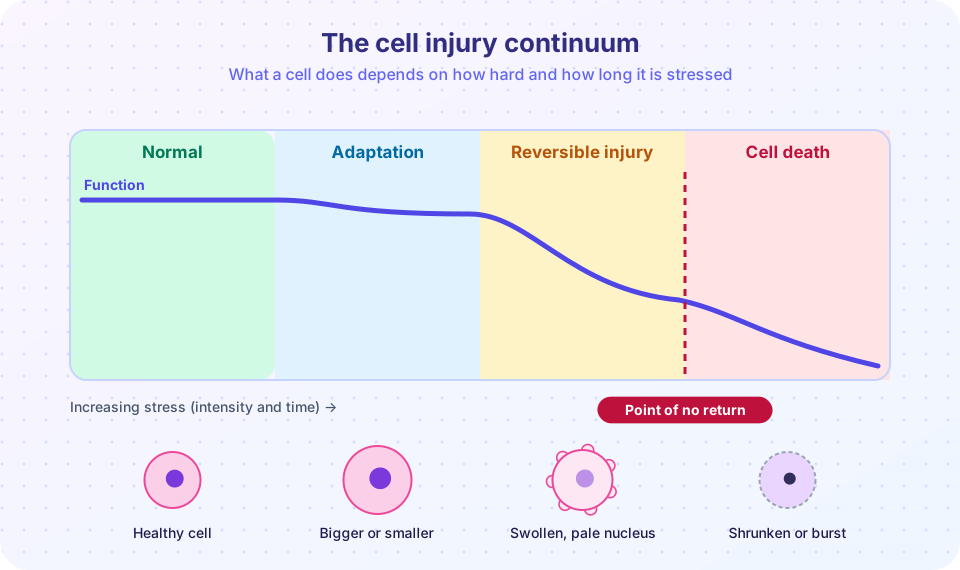
Every disease begins with cells that cannot cope. A heart muscle cell loses its blood supply. A liver cell is flooded with alcohol. A skin cell absorbs too much ultraviolet light. In each case the cell faces a stress that is greater than its normal range, and from there only a few things can happen: it adapts and carries on, it is injured but recovers, or it dies. Understanding which of these happens, and why, is the key to understanding almost everything else in pathology, because inflammation, scarring, organ failure and cancer all start as responses to injured or dying cells.
What you will learn
- The main causes of cell injury and why low oxygen leads the list.
- The adapt, injure, die continuum and what decides where a cell ends up.
- The four cell systems that injury usually attacks.
- How the lessons in this chapter fit together.
Key terms
Homeostasis: the steady internal state that cells maintain within narrow limits.
Hypoxia: too little oxygen reaching the cells. Ischemia: too little blood supply, which also removes nutrients and carries away waste.
Reversible injury: damage a cell can recover from when the stress stops.
Irreversible injury: damage past the point of no return, leading to cell death.
Necrosis and apoptosis: the two principal forms of cell death, uncontrolled and programmed.
The big picture
Stress is everywhere
Cells have options
Four weak points
What comes next
Causes of cell injury
Cells can be hurt in many ways. The common categories are:
- Oxygen deprivation. Hypoxia is the leading cause in human disease. It may arise from a blocked artery (ischemia), from too few red blood cells (anemia), from lung disease, or from poisoning such as carbon monoxide, which stops hemoglobin carrying oxygen. Ischemia is typically more damaging than simple hypoxia because it also stops the delivery of glucose and the removal of waste.
- Physical agents. Mechanical trauma, extremes of temperature, radiation, electric shock and sudden pressure changes.
- Chemical agents and drugs. Even harmless substances such as glucose or salt can injure cells in excess. Poisons, pollutants, alcohol and overdoses of ordinary medicines are classic examples.
- Infectious agents. Viruses, bacteria, fungi and parasites injure cells directly (by invading) or indirectly (through their toxins or through the host's immune response).
- Immune reactions. Defense mechanisms can be the cause: autoimmune diseases and allergies injure the body's own cells.
- Genetic derangements. An enzyme missing from birth or a misfolded protein can slowly poison a cell.
- Nutritional imbalances. Protein-calorie deficiency, vitamin lack, but also excess calories and fat.
- Aging. The accumulated effect of damage, together with decreased repair.
Why does the same stress have different results?
The response of a cell to a stress depends on three things.
- The stimulus: its type, intensity and duration. Brief low oxygen may be tolerated; prolonged low oxygen is lethal.
- The cell: its type, state and adaptability. Brain neurons are among the most oxygen-sensitive cells, and permanent injury begins within minutes of circulation stopping. Skeletal muscle and skin cells tolerate much longer oxygen shortage. The same dose of a toxin may kill a liver cell but not a bone cell, since it is the liver that handles and activates many chemicals.
- The cell's history: its nutrition, hormonal state and previous exposures. Well-nourished cells survive longer; cells that have adapted may tolerate more.
This is a recurring pattern in pathology: there is no simple dose-to-response rule, but a spectrum shaped by stimulus and cell.
The four vulnerable systems
Whatever the cause, most injury is delivered through damage to four basic cell components that depend on each other.
| System | Why it matters | What happens when it fails |
|---|---|---|
| Mitochondria and ATP supply | ATP powers pumps, protein building and repair | Pumps fail, water enters, the cell swells |
| Cell membranes | Keep ions and enzymes in the right compartments | Calcium floods in, damaging enzymes switch on |
| Protein folding and synthesis | Cells need correctly shaped proteins | Misfolded proteins accumulate and trigger stress responses |
| DNA integrity | DNA directs everything the cell makes | Severe damage can start a self-destruct program (apoptosis) |
The four are linked. Low ATP weakens the membrane pumps; leaky membranes let in calcium, which injures the mitochondria; mitochondrial damage releases signals that start apoptosis.
Where the chapter goes
- Cellular adaptations covers hypertrophy, hyperplasia, atrophy and metaplasia: the changes that let cells survive a new demand.
- Reversible and irreversible injury explains the molecular chain from low oxygen to swelling to death, and the typical changes seen under a microscope.
- Necrosis and apoptosis compares the two principal ways cells die and the patterns of necrosis.
- Chapter 2 review pulls everything into a quiz.
Common misconceptions
- "Cell death is always bad." Programmed cell death shapes embryos (the webbing between fingers disappears this way), removes old cells and eliminates dangerous ones.
- "Injury is all or nothing." Cells move along a continuum. Many injuries are reversible if the stress stops in time.
- "Hypoxia and ischemia are the same." Hypoxia is a lack of oxygen from any cause; ischemia is a lack of blood flow, which removes more than oxygen.
Try it
The first block draws the continuum as a curve. The thresholds are teaching values chosen to illustrate the idea; real cells differ widely.
Press Run (or Ctrl + Enter) to see the result here.
Program input · what you'd type while the program runs
Type the answers before you press Run, one per line. Each time the program reads a line (with input()), it gets the next line from this box.
The second block sorts causes of injury into the eight families above.
Press Run (or Ctrl + Enter) to see the console output here.
No output.
Check your understanding
Quick check · 4 questions
of 4 answered You scored / 4 · perfect!
-
1. What is the most common cause of cell injury in human disease?
Hypoxia, often from reduced blood flow, is the leading cause of cell injury. -
2. How does ischemia differ from simple hypoxia?
Ischemia is lost blood flow, so oxygen, glucose and waste removal are all affected. -
3. Which of the following is NOT one of the four vulnerable cell systems named in this lesson?
The four systems are energy supply, membranes, protein folding and synthesis, and DNA. -
4. The same toxin may kill a liver cell but not a bone cell. What does this show?
Cell type, metabolism and adaptability shape the outcome.
Summary
- Cells face stresses and can adapt, recover from reversible injury, or die.
- Low oxygen, physical, chemical, infectious, immune, genetic, nutritional and aging causes cover most injuries.
- The outcome depends on the stimulus, the cell type and its history.
- Energy supply, membranes, protein handling and DNA are the main targets of injury and affect each other.
- The next lessons study adaptation, injury and the two forms of cell death.
Next: Cellular Adaptations
Track your progress
Create a free account to tick off lessons and pick up where you left off on any device.
of Pathology lessons completed