


















Lesson 36 of 46 · Infectious and Neurological Disease
Chapter 8 overview: Infectious and neurological disease
Preview how tissue responds to infection and how the brain fails: pus, granulomas, sepsis, stroke, dementia, meningitis, multiple sclerosis and brain tumors.
Two different kinds of disease share this chapter, and their link is more than the calendar. An infection is a conflict between a living invader and the body's defenses, and the damage is shared: some comes from the microbe and some from the immune response sent to stop it. Neurological disease is damage to the nervous system, a tissue with unusual rules. Brain cells are almost never replaced, the brain has no lymph nodes in the usual sense, it sits in a rigid skull where swelling has nowhere to go, and a few minutes without blood does lasting harm. Infections of the nervous system, such as meningitis, show where the two topics meet.
In both halves you will see pathology at its most practical: recognizing a pattern in tissue and working back to its cause.
Educational information only. This chapter explains disease mechanisms. It cannot diagnose or advise on treatment. Fever with a stiff neck or rash, sudden weakness of the face, arm or leg, sudden trouble speaking, and a sudden severe headache are all reasons to seek emergency help immediately.
What you will learn
- How tissue reacts to different classes of microbe
- Why granulomas and sepsis are special cases
- The main brain diseases the chapter covers and why they are different from other organs
Key terms
Pathogen: a microbe that can cause disease.
Granuloma: a ball of activated macrophages, often with a central necrosis, that walls off something the body cannot clear.
Sepsis: life-threatening organ dysfunction caused by a dysregulated response to infection.
Stroke: sudden loss of brain function from a blood vessel problem.
Dementia: acquired, persistent decline in thinking that interferes with daily life.
The chapter at a glance
Infection: the tissue pattern
When infection goes systemic
The brain under attack
In the brain, location often matters more than the type of lesion.
How to approach infection pathology
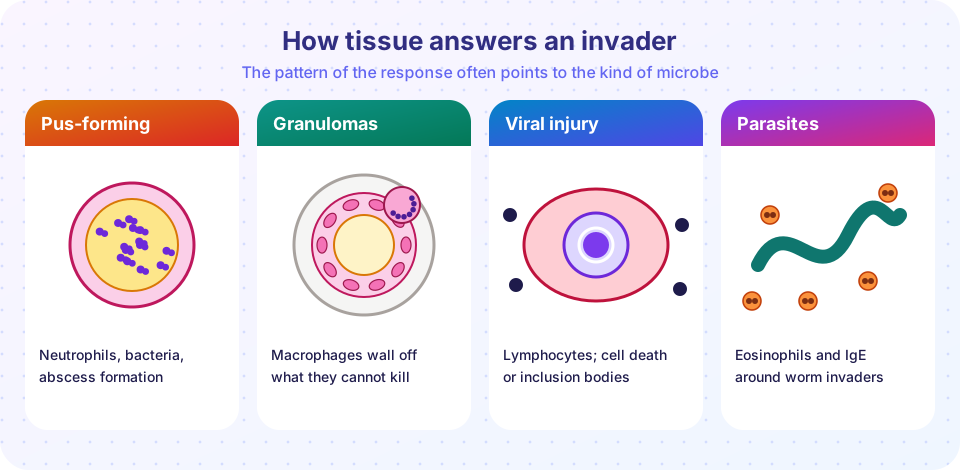
Pathologists start with a simple question: what are the cells doing? Different microbes provoke different inflammatory patterns.
- Pyogenic bacteria (such as Staphylococcus aureus) attract neutrophils, which release enzymes that liquefy tissue, producing pus and, when walled off, an abscess.
- Viruses hide inside cells, so the response is mostly lymphocytes and the injury is often cell death or characteristic inclusion bodies or fused giant cells.
- Intracellular bacteria and fungi that resist killing, such as the tuberculosis bacillus, provoke a slow, cell-mediated response that forms granulomas.
- Parasites such as worms stimulate eosinophils and IgE.
Then comes a second question, which is about scale: is the infection local or has it spread through the blood? If the body's reaction to a bloodstream infection spirals out of control, the result is sepsis, a medical emergency.
How to approach neuropathology
A neuropathologist asks about location, timing and pattern. A small infarct in the brainstem can be fatal while a larger one in a quiet region may hardly be noticed, so anatomy matters. Timing separates a sudden event (stroke), a progressive one (dementia, tumors), and a relapsing one (multiple sclerosis). Pattern tells you the type: dead tissue in the territory of an artery (infarct), protein deposits in specific regions (neurodegeneration), or inflammation around the meninges (meningitis).
What each lesson covers
- Host response, granulomas and sepsis covers inflammatory patterns, tuberculosis and the sepsis cascade.
- Stroke and dementia covers ischemic and hemorrhagic stroke, Alzheimer disease and other neurodegenerative diseases.
- CNS infection, demyelination and tumors covers meningitis, encephalitis, multiple sclerosis, brain tumors and raised pressure.
- Chapter review.
How to study this chapter
For infection, learn the patterns first and the organisms second: knowing that neutrophils mean pus and that granulomas mean a persistent intracellular agent lets you reason about microbes you have never met. For the nervous system, always ask where the lesion is, how fast it appeared, and what the tissue looks like. Keep a short table of necrosis types, because each organ has its favorite. Last, rehearse the pressure story of the skull, which explains a large share of neurological emergencies.
Try it
Press Run (or Ctrl + Enter) to see the result here.
Program input · what you'd type while the program runs
Type the answers before you press Run, one per line. Each time the program reads a line (with input()), it gets the next line from this box.
Press Run (or Ctrl + Enter) to see the console output here.
No output.
Check your understanding
Quick check · 3 questions
of 3 answered You scored / 3 · perfect!
-
1. Which cell dominates the response to pyogenic bacteria?
Neutrophils respond to pyogenic bacteria and form pus. -
2. A granuloma is best described as
Granulomas are organized aggregates of activated macrophages, often with a central area of necrosis. -
3. Why is the brain vulnerable to swelling?
The rigid skull means swelling raises pressure quickly.
Summary
- Different microbes provoke different inflammatory patterns: pus, granulomas, lymphocytes or eosinophils.
- When a bloodstream infection triggers an overwhelming response, the result is sepsis.
- The brain is special: low regeneration, rigid skull, and a high demand for blood.
- The chapter covers stroke, dementia, meningitis, multiple sclerosis and tumors.
Track your progress
Create a free account to tick off lessons and pick up where you left off on any device.
of Pathology lessons completed