


















Lesson 45 of 46 · Projects and Practice
Cheat sheet: pathology chapters 5 to 8 on one page
A one-page recap of neoplasia, cardiovascular, respiratory, gut, liver, kidney, endocrine, infectious and neurological pathology, with key numbers, rules and patterns.
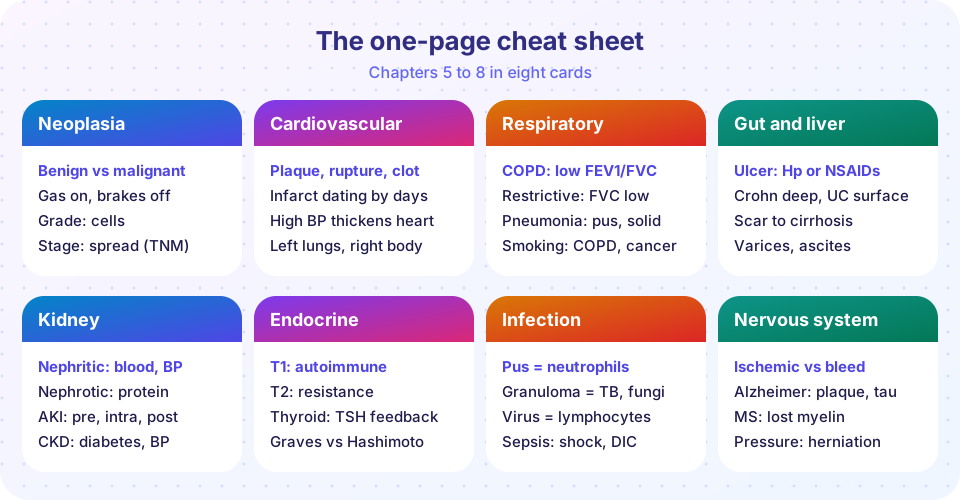
A cheat sheet is not a replacement for understanding, but it is a very good test of it. If each line below reminds you of a mechanism, you know the topic. If a line feels like a bare fact, follow its link back to the lesson. The picture shows the whole map at a glance; the sections underneath give a little more detail and the numbers worth remembering.
What you will learn
- A compact summary of each system, with the single most useful distinctions
- The numbers and rules of thumb that recur
- How to use the page for revision
Key terms
Pattern: a combination of necrosis type, cell type and location that suggests a cause. Mechanism: the chain of events from cause to damage. Rule of thumb: a simple guide that works most of the time, not always.
Neoplasia
- Benign tumors end in -oma and stay local; malignant epithelial tumors are carcinomas, mesenchymal ones sarcomas. Exceptions: melanoma, lymphoma, mesothelioma and seminoma are malignant.
- Anaplasia: pleomorphism, large dark nuclei, abnormal mitoses, loss of polarity. In situ means basement membrane intact.
- Oncogene (gain of function, one hit) versus tumor suppressor (loss of function, two hits). Philadelphia chromosome: BCR-ABL. HPV: E6 binds p53, E7 binds RB.
- Grade = how abnormal the cells look. Stage = how far it has spread (TNM). Markers monitor more than they screen.
- About 30 doublings take one cell to a billion cells (a detectable lump).
Cardiovascular and respiratory
- Atherosclerosis: injury, LDL, foam cells, fibrous cap, rupture, thrombus. Risk factors multiply: LDL, blood pressure, smoking, diabetes.
- Infarct timeline: nothing visible for 4 hours, coagulative necrosis by 1 day, neutrophils 1 to 3 days, macrophages 3 to 7 days (rupture risk), granulation 1 to 3 weeks, scar by 2 months.
- Hypertension: primary (most) or secondary; hyaline and onion-skin arterioles; left ventricular hypertrophy.
- Left heart failure congests the lungs; right heart failure congests the body.
- Spirometry: obstructive = FEV1/FVC low (below about 0.7); restrictive = FVC low with a normal or high ratio.
- Lobar pneumonia stages: congestion, red hepatization, gray hepatization, resolution. Lung cancer: adenocarcinoma (peripheral), squamous (central), small cell (central, aggressive, hormones).
Gut, liver, kidney, endocrine
- Peptic ulcer: H. pylori or NSAIDs. Crohn: transmural, skip lesions, granulomas. Ulcerative colitis: mucosal, continuous from the rectum.
- Colorectal cancer: adenoma-carcinoma sequence (APC, KRAS, TP53); screening finds polyps.
- Liver: viral, alcohol and metabolic injury lead through steatosis and fibrosis to cirrhosis, with portal hypertension (varices, ascites) and liver failure.
- Kidney: nephritic = blood, hypertension, falling GFR; nephrotic = over 3.5 g protein per day, low albumin, edema. AKI: prerenal, intrinsic (ATN), postrenal. CKD: mostly diabetes and hypertension.
- Diabetes: type 1 autoimmune loss of beta cells; type 2 insulin resistance. Diagnostic cut-offs: fasting glucose 126 mg/dL (7.0 mmol/L), HbA1c 6.5 percent.
- Thyroid feedback: primary hypothyroidism has high TSH, low T4; Graves has stimulating antibodies; papillary carcinoma is the commonest thyroid cancer.
Infection and the nervous system
- Pus = neutrophils and pyogenic bacteria. Virus = lymphocytes and inclusions. Granuloma = TB, fungi, sarcoidosis. Eosinophils = parasites and allergy.
- TB: Ghon complex, latent infection, apical reactivation with cavities.
- Sepsis: dysregulated response; cytokines, vasodilation, leak, DIC, shock.
- Stroke: ischemic (thrombus, embolus, lacune) or hemorrhagic (hypertension, aneurysm, amyloid); brain infarcts liquefy. Penumbra can be saved.
- Alzheimer: amyloid plaques outside, tau tangles inside. Parkinson: nigral dopamine neurons. Huntington: CAG repeat. CJD: prion.
- Bacterial meningitis CSF: neutrophils, high protein, low glucose. MS: demyelinating plaques. Glioblastoma: adults; medulloblastoma: children; metastases are the commonest adult brain tumors.
- Skull volume is fixed (Monro-Kellie): pressure rises steeply when compensation is used up.
Quick pattern recognition
| If you see... | Think of... |
|---|---|
| Foam cells in the intima | Early atherosclerosis (fatty streak) |
| Coagulative necrosis, then neutrophils at 1 to 3 days | Myocardial infarct |
| Macrophages and a soft wall at 3 to 7 days | Infarct at risk of rupture |
| Honeycomb fibrosis at the lung bases | Idiopathic pulmonary fibrosis |
| Crypt abscesses, continuous from the rectum | Ulcerative colitis |
| Non-caseating granulomas and skip lesions | Crohn disease |
| Mallory-Denk bodies | Alcoholic steatohepatitis |
| Foot process effacement on electron microscopy | Minimal change disease |
| Kimmelstiel-Wilson nodules | Diabetic nephropathy |
| Orphan Annie eye nuclei and psammoma bodies | Papillary thyroid carcinoma |
| Caseating granulomas with acid-fast rods | Tuberculosis |
| Neutrophils, high protein, low glucose in CSF | Bacterial meningitis |
| Pseudopalisading necrosis in the brain | Glioblastoma |
Traps to avoid
- Mixing up grade and stage. One is cells, the other is spread.
- Forgetting the exceptions. Melanoma, lymphoma, mesothelioma and seminoma are malignant, and basal cell carcinoma rarely spreads.
- Reading a normal marker as proof of health. Markers and creatinine are late or weak signals.
- Mixing up left and right heart failure. Left: lungs. Right: body.
- Treating one finding as the diagnosis. Check that the whole picture fits, and keep a second candidate on the list.
- Assuming one cause. Mixed pathology, such as vascular plus Alzheimer dementia, is common in older people.
Numbers worth remembering
| Quantity | Value or rule |
|---|---|
| Doublings: 1 cell to 10^9 cells | about 30 |
| Flow versus radius | proportional to r^4 |
| Obstructive spirometry | FEV1/FVC below about 0.7 |
| Mean arterial pressure | diastolic + (systolic - diastolic) / 3 |
| Nephrotic range proteinuria | over 3.5 g per day |
| Fasting glucose for diabetes | 126 mg/dL (7.0 mmol/L) or more |
| Glucose conversion | mg/dL divided by 18 gives mmol/L |
| Kidney filtrate | about 180 L per day; about 99 percent reabsorbed |
Press Run (or Ctrl + Enter) to see the result here.
Program input · what you'd type while the program runs
Type the answers before you press Run, one per line. Each time the program reads a line (with input()), it gets the next line from this box.
Press Run (or Ctrl + Enter) to see the console output here.
No output.
How to use this page
A cheat sheet is only useful if you use it actively. Treat each bullet as a prompt, not an answer.
Cover the page, then try to write each section from memory in one minute, saying the mechanism behind each line out loud. Compare, then underline what you missed. Repeat the next day, and again after a week. Missing items show where to reread the lessons.
Common misconceptions
- "A cheat sheet replaces the lessons." It indexes them; the understanding sits in the lessons.
- "Rules of thumb are always true." They are guides, and exceptions are common in pathology.
- "If I can recite it, I can use it." Practice applying it to cases.
Check your understanding
Quick check · 5 questions
of 5 answered You scored / 5 · perfect!
-
1. Roughly how many doublings does a single cell need to reach one billion cells?
2^30 is just over one billion. -
2. Left heart failure causes congestion of the
Blood backs up into the pulmonary veins and lungs. -
3. Which pattern suggests bacterial meningitis in the CSF?
This is the classic bacterial pattern. -
4. MAP for 120/80 mmHg is
80 + 40/3 is about 93. -
5. Which tumor is the commonest brain tumor in adults overall?
Metastases outnumber primary brain tumors in adults.
Summary
- One page can hold the main patterns of chapters 5 to 8 if each line is tied to a mechanism.
- Remember the key numbers: 30 doublings, r^4 flow, 0.7 ratio, 3.5 g protein, 126 mg/dL.
- Use the page for spaced self-testing, not for reading only.
Next: Further study
Track your progress
Create a free account to tick off lessons and pick up where you left off on any device.
of Pathology lessons completed