


















Lesson 31 of 46 · Gastrointestinal, Renal and Endocrine Pathology
Chapter 7 overview: Gastrointestinal, renal and endocrine pathology
Preview the pathology of the digestive tract, liver, kidneys and hormone glands, with the main diseases, how they connect, and what each lesson covers.
Three body systems share this chapter because they are all about exchange and regulation. The digestive tract takes in food and turns it into nutrients, and the liver and pancreas process and distribute them. The kidneys filter the blood and keep its water, salt and acid balance steady. The endocrine glands send hormone messages that tune all of it. When one of them fails, the others usually feel it: liver disease affects the kidneys, diabetes damages the kidneys and nerves, and kidney failure disturbs hormones.
The pathology in this chapter often rewards the same few questions. What is the tissue exposed to? How does it respond to injury: with inflammation, scar, or an abnormal growth? And what does the organ's loss of function do to the rest of the body?
Educational information only. This course explains mechanisms and typical findings. It does not diagnose or advise on treatment. Anyone with symptoms such as blood in vomit or stool, yellow skin, very little urine or extreme thirst should seek medical care.
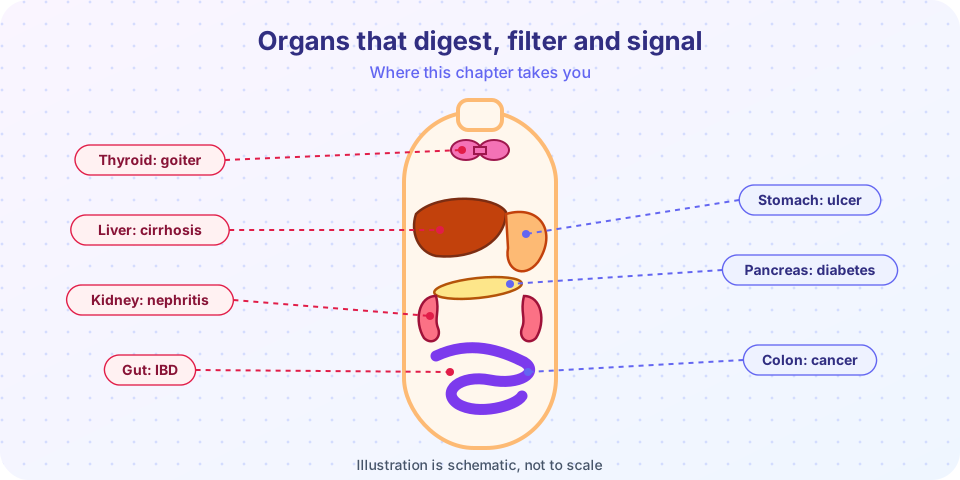
What you will learn
- How the chapter groups its diseases and why they interact
- A first look at the key terms: ulcer, cirrhosis, glomerulonephritis, diabetes, goiter
- Where each lesson fits
Key terms
Inflammatory bowel disease (IBD): chronic, relapsing inflammation of the gut, mainly Crohn disease and ulcerative colitis.
Cirrhosis: diffuse liver scarring with regenerative nodules.
Glomerulus: the kidney's tuft of filtering capillaries.
Hormone: a chemical messenger carried by the blood.
The chapter at a glance
The digestive system
The kidney
The hormone glands
A hormone problem is often an organ problem in disguise.
Why the three systems belong together
Look at diabetes. It begins in the pancreas (an endocrine problem), but its long-term damage is to the kidneys (renal), the eyes, nerves and gut. Look at cirrhosis: scar in the liver raises the pressure in the portal vein, which links the gut to the liver, so the damage shows up as swollen veins in the esophagus and fluid in the abdomen. Look at chronic kidney failure: it disturbs bone and calcium metabolism and the hormone that makes red cells. The same threads appear again and again: blood flow, filtering, and feedback.
Feedback deserves a note. Most hormone systems work like a thermostat. The hypothalamus and pituitary sense a level of hormone in the blood and adjust their own signals. So disease can come from the gland itself, from the pituitary, or from the signal, and you can often tell which by looking at both the hormone and its controller.
What each lesson covers
- Gut, liver and pancreas covers peptic ulcers and stomach cancer, inflammatory bowel disease, celiac disease, colorectal cancer, viral hepatitis, fatty and alcoholic liver disease, cirrhosis, pancreatitis and pancreatic cancer.
- Kidney disease covers acute injury, nephritic and nephrotic syndromes, chronic kidney disease, infection, stones and kidney tumors.
- Endocrine disease covers diabetes in detail, then the thyroid, adrenal, parathyroid and pituitary disorders.
- Chapter review with summary table and quiz.
How to study this chapter
Take one organ at a time, and use the same four questions: what is the normal function, what injures it, how does it respond (inflammation, scar, tumor), and what is lost. For hormone glands, add a fifth: where does the feedback loop break? Draw a small diagram of each loop. Learn the paired comparisons, because exams and clinics both depend on them: Crohn versus ulcerative colitis, nephritic versus nephrotic, type 1 versus type 2 diabetes, Graves versus Hashimoto.
Try it
Press Run (or Ctrl + Enter) to see the result here.
Program input · what you'd type while the program runs
Type the answers before you press Run, one per line. Each time the program reads a line (with input()), it gets the next line from this box.
Press Run (or Ctrl + Enter) to see the result here.
Program input · what you'd type while the program runs
Type the answers before you press Run, one per line. Each time the program reads a line (with input()), it gets the next line from this box.
Check your understanding
Quick check · 3 questions
of 3 answered You scored / 3 · perfect!
-
1. Which statement about feedback in endocrine systems is correct?
Negative feedback means a low hormone raises the stimulus; a high hormone suppresses it. -
2. Diabetes is an example of a disease that crosses systems because
High glucose over time damages small vessels and nerves throughout the body. -
3. The portal vein carries blood from the gut to
Portal blood from the intestines passes through the liver before reaching the general circulation.
Summary
- The gut, liver, pancreas, kidney and endocrine glands exchange and regulate, and failures spread between them.
- Many diseases here follow a pattern of injury, inflammation, scar and loss of function.
- Hormone problems can come from the gland, the controller or the target tissue.
- The next lessons take each system in turn.
Next: Gut, liver and pancreas
Track your progress
Create a free account to tick off lessons and pick up where you left off on any device.
of Pathology lessons completed