


















Lesson 46 of 46 · Projects and Practice
Further study: where to go after pathology
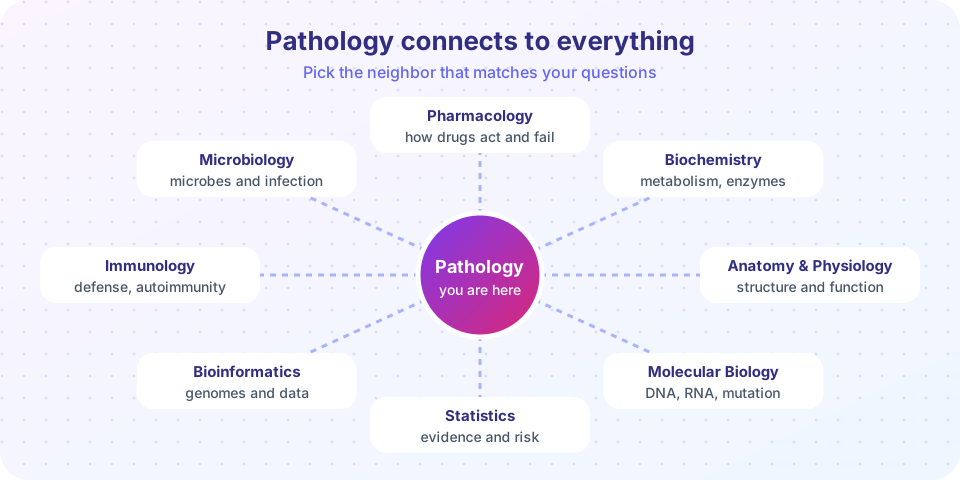
Plan your next steps after the pathology course: related tracks on immunology, microbiology, pharmacology, biochemistry, physiology, molecular biology and statistics.
You have now followed disease from the cell to the organ: how cells are injured, how tumors arise, how the heart, lungs, gut, kidney and brain fail, and how to reason from findings to a diagnosis. Pathology is a hub subject. Almost every question it raises is answered in more depth by a neighboring field, and the best way to decide what to study next is to follow the question that interests you most.
This lesson maps the neighbors, suggests study routes for different goals, and offers some habits that make further learning stick.
Educational information only. The course teaches how disease works. It does not prepare you to diagnose or treat anyone, and it does not replace formal clinical training. Anyone worried about their own health should see a qualified clinician.
What you will learn
- Which fields answer the "why" behind each chapter of this course
- Three study routes for different goals
- How to keep learning effectively once the course is over
Key terms
Prerequisite: knowledge you need before a topic makes sense. Spaced repetition: reviewing material at growing intervals. Primary literature: original research papers.
The neighbors of pathology
Each question that pathology raises has a home elsewhere.
- "Why does the immune system attack the body, or fail to stop a tumor?" Study Immunology. Granulomas, autoimmunity in diabetes, thyroid disease and multiple sclerosis, and the checkpoint drugs of cancer all rest on immune mechanisms.
- "Which microbes cause these infections, and how do they evade defenses?" Study Microbiology. It extends the infection chapter with the biology of bacteria, viruses, fungi and parasites.
- "How do drugs change the course of disease?" Study Pharmacology. Every therapy mentioned in passing, from statins to targeted cancer drugs, has a mechanism and side effects.
- "What goes wrong in the cell's chemistry?" Study Biochemistry. It explains diabetes, lipid disorders, the Warburg effect and enzyme defects.
- "What is the normal structure and function that disease disturbs?" Study Anatomy and Physiology. Every pathologic change makes sense only against the normal one.
- "How do mutations, repair and gene regulation work?" Study Molecular Biology. It supplies the basis of oncogenes, tumor suppressors and inherited disease.
- "How do we know that a risk factor really causes disease?" Study Statistics and probability. Sensitivity, predictive value, survival curves and the logic of evidence are all statistical.
- "How are genomes and big biological datasets analyzed?" Study Bioinformatics, which now underlies tumor sequencing and precision medicine.
Three study routes
Route 1: the mechanism route (for learners who want to understand disease deeply). Start with Anatomy and Physiology, then Biochemistry and Molecular Biology, then return to a pathology chapter that interested you and reread it. You will notice how much more it says.
Route 2: the infection and immunity route. Start with Microbiology, then Immunology, then Pharmacology. This route makes the infection chapter come alive and prepares you for questions about vaccines, antibiotics and resistance.
Route 3: the evidence route (for learners who like numbers). Start with Statistics and probability, then Bioinformatics. Return to the tumor growth project and extend it with real datasets. This route suits anyone who wants to work in medical data science or epidemiology.
Where this knowledge is used
Pathology is rarely the end of the road, so it helps to know where it is used in practice. In hospitals, pathologists examine biopsies and surgical specimens, and their reports decide treatment. In research, pathology links a discovery in the lab to a change that can be seen in tissue. Biomedical scientists, nurses and doctors use the same ideas at the bedside: knowing how an infarct evolves explains why certain complications arise at certain times, and knowing the patterns of kidney disease explains why a urine test is ordered. Public health and epidemiology use the logic of risk, screening and prevention, which you met in the lessons on tumor markers and the epidemic model. Data science and medical technology build tools that read images and genomes, and they need people who understand what the pictures mean.
You do not need a clinical career to benefit. Understanding how disease works makes you a better reader of health news, a better partner in your own care and your family's, and better at asking questions that clinicians can answer.
A reading plan
A simple plan for a new topic is the three-pass method. On the first pass, read for the big picture: headings, pictures and summaries, and write down three questions. On the second pass, read for mechanisms, and check each question. On the third pass, close the book and try to explain the topic from memory, then look up whatever you missed. For deeper reading, start with a standard textbook on the topic, then move to review articles, and only then to original papers, where you should note the sample size, the comparison group and the limits stated by the authors.
Habits that make learning stick
- Retrieve, do not reread. After a lesson, close it and write what you remember. The effort is the learning.
- Space your reviews. The next section shows why intervals help.
- Connect topics. For each new idea, ask which organ, which mechanism and which chapter it relates to.
- Teach it. Explain a mechanism aloud to someone, or to an empty room.
- Read sources with care. In biology, newer evidence often revises older teaching. Look for review articles and guidelines, and be wary of single studies and of health claims on social media.
Press Run (or Ctrl + Enter) to see the result here.
Program input · what you'd type while the program runs
Type the answers before you press Run, one per line. Each time the program reads a line (with input()), it gets the next line from this box.
Using this course again
Come back to the chapter reviews after a month. Redo the practice problems and the case reasoning exercise without looking at the answers. Then try the tumor growth project with different parameters or your own data. If you can explain why each result changed, you have built understanding that a cheat sheet cannot give.
Common misconceptions
- "I need to finish one field before starting another." Fields overlap; switching between related topics strengthens both.
- "Understanding disease means I can treat it." Clinical practice needs training, supervision and judgment beyond textbooks.
- "Medical knowledge is fixed." It changes with new evidence, so keep checking current guidelines.
Check your understanding
Quick check · 4 questions
of 4 answered You scored / 4 · perfect!
-
1. Which field would best explain why the immune system attacks the thyroid in Hashimoto disease?
Autoimmunity is a central topic of immunology. -
2. Which field underlies sensitivity, specificity and predictive value?
Test accuracy is a statistical concept. -
3. Spaced review works because
Retrieval at growing intervals strengthens memory and flattens the forgetting curve. -
4. Which source is generally most reliable for a health claim?
Guidelines and reviews summarize many studies and are updated.
Summary
- Pathology connects to immunology, microbiology, pharmacology, biochemistry, physiology, molecular biology, statistics and bioinformatics.
- Choose a route by your questions: mechanism, infection and immunity, or evidence.
- Retrieve, space, connect and teach; read sources critically.
- Revisit the practice problems, cases and project to see how much you have grown.
Back to the track: Pathology
Track your progress
Create a free account to tick off lessons and pick up where you left off on any device.
of Pathology lessons completed