


















Lesson 5 of 46 · Getting Started
Chapter 1 Review: Pathology Foundations
Review chapter 1 of the pathology course: disease vocabulary, the four aspects of a disease, the tissue-to-slide workflow and how to interpret test results.
You now have the vocabulary and the habits of thought that the rest of the course depends on. This review pulls chapter 1 into one picture, gives you a table to scan before a test, and ends with a ten-question quiz that mixes all four lessons. Treat the quiz as practice for recall: answer each question before reading the options carefully, then check the explanation even when you are right.
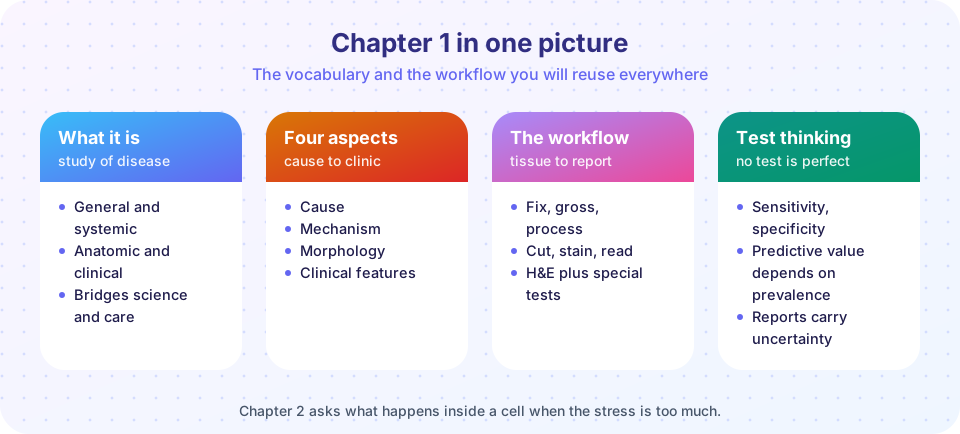
What you will learn
- How the four lessons of chapter 1 connect.
- Which terms and numbers are worth knowing cold.
- Where you are still uncertain, through a mixed quiz.
Recap table
| Lesson | Big idea | Terms to know |
|---|---|---|
| Course map | The course moves from cells to tissues to organ systems | Pathology, lesion, morphology |
| What is pathology? | Disease is studied through structure and function; reference ranges are statistical | General vs systemic, anatomic vs clinical, sign vs symptom, prevalence |
| Etiology and pathogenesis | Every disease has a cause, a mechanism, an appearance and an effect | Etiology, pathogenesis, risk factor, idiopathic, iatrogenic, risk ratio |
| How pathologists work | Tissue becomes a slide by fixing, cutting and staining | Fixation, H&E, IHC, frozen section, sensitivity, specificity, PPV |
Three ideas to carry forward
- Ask the four questions. For every disease in later chapters, say the etiology, pathogenesis, morphology and clinical picture in that order.
- Treat tests as evidence, not verdicts. A positive result changes probability. How much it changes depends on prevalence and on the test itself.
- Remember sampling. A slide is a thin slice of a chosen piece. Good diagnosis combines the slice, the clinical story and sometimes extra tests.
Worked mini-cases
Case 1: the surprising lab result. A healthy volunteer has a routine panel of 20 independent tests and one value is slightly outside the reference range. Should anyone worry? Apply what you learned: the range covers the central 95 percent of healthy people, so each test has a 5 percent chance of flagging a healthy person. Across 20 tests the chance of at least one flag is about 64 percent. The sensible response is to repeat the test or look at the trend, not to assume disease.
Case 2: the screening test. A test has 90 percent sensitivity and 90 percent specificity, and the disease affects 1 in 100 of the people tested. Of 1,000 people, 10 are truly affected and the test finds 9. Of the 990 unaffected, 99 are falsely flagged. A positive result therefore means a true case in 9 of 108 positives, about 8 percent. The test is still useful because it selects the people who need a more definitive examination, such as a biopsy, but a positive screen is not a diagnosis.
Case 3: telling the story. A pathologist receives a small biopsy from a lung nodule. Before reading the slide she asks the clinician for the history. Why? Because etiology (smoking, exposure) shapes which diseases are likely, and the morphology on the slide is evidence about the pathogenesis. Good diagnosis combines the clinical story with the slide.
Try it
The first block is a small flashcard drill. Edit the cards to add your own.
Press Run (or Ctrl + Enter) to see the console output here.
No output.
The second block builds a confusion matrix for a hypothetical test, a useful way to see all four outcomes at once. The counts are made up for teaching.
Press Run (or Ctrl + Enter) to see the result here.
Program input · what you'd type while the program runs
Type the answers before you press Run, one per line. Each time the program reads a line (with input()), it gets the next line from this box.
Check your understanding
Quick check · 10 questions
of 10 answered You scored / 10 · perfect!
-
1. Which sequence lists the four aspects of a disease in the order used in this course?
Cause, then mechanism, then appearance, then effect on the patient. -
2. A patient reports pain; the doctor measures a fever. These are respectively:
Reported experience is a symptom; observed or measured findings are signs. -
3. Which pair correctly matches pioneer and idea?
Virchow's cellular pathology (1858) placed disease in cells; Morgagni (1761) tied it to organs. -
4. Which is a statistical definition rather than a medical one?
A reference range is built from the central 95 percent of results in a healthy group. -
5. Hematoxylin and eosin respectively stain:
Hematoxylin binds nucleic acids in nuclei; eosin binds cytoplasmic proteins and collagen. -
6. Which statement about risk factors is correct?
A risk factor raises odds without being necessary or sufficient. -
7. A disease affects 1% of a group. A test with high sensitivity and 90% specificity is positive. Why might the chance of disease still be low?
With few true cases and many healthy people, even a 10 percent false-positive rate creates more false than true positives. -
8. Which method gives a surgeon an answer within minutes during an operation?
Frozen sections are cut and stained quickly, at some cost in detail. -
9. A disease with no known cause is called:
Idiopathic means of unknown cause. -
10. In a study 20 of 100 exposed people and 10 of 100 unexposed people become ill. The risk ratio is:
0.20 divided by 0.10 equals 2.
Summary
- Pathology studies disease through causes, mechanisms, structure and function.
- General pathology gives the shared reactions; systemic pathology applies them to organs.
- The four-aspect story and the four-outcome test table are your two main thinking tools.
- Tissue becomes a slide by fixing, cutting and staining; the report is expert judgment under uncertainty.
Track your progress
Create a free account to tick off lessons and pick up where you left off on any device.
of Pathology lessons completed