


















Lesson 15 of 46 · Inflammation and Repair
Chapter 3 Review: Inflammation and Repair
Review inflammation and repair: cardinal signs, vascular and cellular events, mediators, chronic inflammation, granulomas and wound healing, with a ten-question quiz.
Chapter 3 followed what happens after a cell dies or a microbe invades: an alarm, a recruitment of defenders, a cleanup, and, if all goes well, a repair. It also showed how the same machinery can turn against the body when the trigger will not go away. Use this review to check that you can tell the story in order, and then to test yourself on the details that exams and real cases depend on.
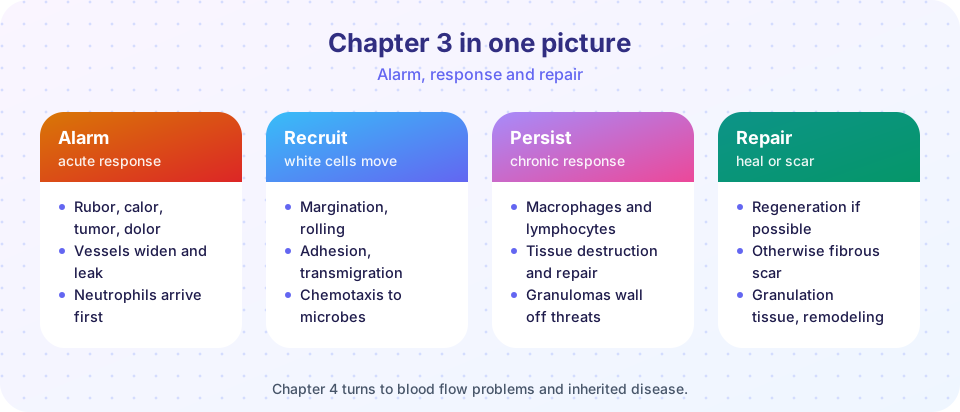
What you will learn
- How the four lessons of chapter 3 form one continuous story.
- The key terms, cells and mediators to recall.
- Which topics need review, using a mixed quiz.
Recap table
| Topic | Key facts |
|---|---|
| Cardinal signs | Rubor, calor, tumor, dolor, functio laesa |
| Vascular changes | Vasodilation (histamine, NO); increased permeability (endothelial contraction, injury); exudate versus transudate |
| Leukocyte recruitment | Margination, rolling (selectins), adhesion (integrins and ICAM-1), transmigration (PECAM-1), chemotaxis |
| Cells over time | Neutrophils first (6 to 24 hours), monocytes and macrophages (24 to 48 hours), lymphocytes later |
| Killing | Opsonins, phagosome, respiratory burst, myeloperoxidase, lysosomal enzymes |
| Mediators | Histamine, prostaglandins, leukotrienes, TNF and IL-1, chemokines, complement, bradykinin |
| Chronic inflammation | Macrophages, lymphocytes, plasma cells; tissue injury plus repair; fibrosis |
| Granuloma | Epithelioid macrophages, giant cells; caseating in tuberculosis |
| Healing | Hemostasis, inflammation, proliferation, remodeling; first versus second intention; labile, stable, permanent cells |
Worked mini-cases
Case 1: the splinter. A splinter lodges in a fingertip. Within minutes mast cells release histamine, the arterioles widen and the venules leak: rubor, calor and tumor. Within hours neutrophils roll, adhere and migrate toward bacteria along chemokine gradients, and phagocytes kill them with the respiratory burst. If the splinter is removed, the response resolves. If it stays, macrophages and giant cells may wall it off in a foreign-body granuloma.
Case 2: the persistent cough. A person has a lung lesion where the center is soft and cheese-like, surrounded by pink macrophages, giant cells and lymphocytes. Which process? A caseating granuloma, typical of tuberculosis, a form of chronic inflammation in which T cell signals (interferon-gamma) keep macrophages activated. Special stains for acid-fast bacteria and culture confirm the cause.
Case 3: the clean incision. A surgical wound is closed with stitches. By day 7 it has only about 10 percent of normal strength, because collagen is still scant; by three months it reaches roughly 70 to 80 percent. That is healing by first intention. A deep ulcer with tissue loss would heal by second intention, with abundant granulation tissue and a larger scar.
Try it
The first block compares the typical cell mix of acute and chronic inflammation. The proportions are illustrative, to fix the idea that the cast changes.
Press Run (or Ctrl + Enter) to see the result here.
Program input · what you'd type while the program runs
Type the answers before you press Run, one per line. Each time the program reads a line (with input()), it gets the next line from this box.
The second block is a revision drill for mediators and what they do.
Press Run (or Ctrl + Enter) to see the console output here.
No output.
Check your understanding
Quick check · 10 questions
of 10 answered You scored / 10 · perfect!
-
1. Which sign is explained mainly by leakage of protein-rich fluid from small vessels?
Swelling (tumor) results from exudate escaping from permeable venules. -
2. Which step of leukocyte recruitment depends on integrins binding ICAM-1?
Selectins cause rolling; integrin binding to ICAM-1 stops the cell and causes firm adhesion. -
3. Which cells arrive first at a bacterial injury?
Neutrophils predominate in the first hours; monocytes and macrophages follow. -
4. Hypochlorous acid in neutrophils is produced by:
Myeloperoxidase uses hydrogen peroxide and chloride to make hypochlorous acid. -
5. An exudate differs from a transudate in that it:
Exudates arise from inflammation with leaky vessels; transudates from pressure imbalance. -
6. Which cells dominate chronic inflammation?
Chronic inflammation is a mononuclear process with tissue destruction and repair. -
7. A granuloma with a cheese-like center is typical of:
Caseous necrosis in a granuloma strongly suggests tuberculosis. -
8. Which cells in the liver can regenerate after partial removal?
Hepatocytes are stable cells that re-enter the cell cycle when needed. -
9. Which is the correct order of wound healing phases?
The phases overlap but start in this order. -
10. Which problem causes a scar that extends beyond the original wound?
A keloid grows beyond the wound borders.
Summary
- Acute inflammation protects through vessel changes, white cell recruitment and phagocytosis, coordinated by mediators.
- Chronic inflammation replaces neutrophils with macrophages and lymphocytes and drives fibrosis; granulomas wall off persistent agents.
- Healing is regeneration or scar, through hemostasis, inflammation, proliferation and remodeling.
- Many diseases are problems of this machinery: too little, too much or too long.
Track your progress
Create a free account to tick off lessons and pick up where you left off on any device.
of Pathology lessons completed