


















Lesson 35 of 46 · Gastrointestinal, Renal and Endocrine Pathology
Chapter 7 review: Gastrointestinal, renal and endocrine pathology
Review ulcers, IBD, hepatitis and cirrhosis, glomerular disease, kidney failure, diabetes and thyroid disease with a summary picture, recap table and ten-question quiz.
This chapter covered three organ systems that work as one network of exchange and control. Before the quiz, try to explain each of the following without notes: why Crohn disease causes fistulas while ulcerative colitis causes bloody diarrhea; how chronic liver injury becomes cirrhosis and what portal hypertension does; what separates a nephritic from a nephrotic pattern; and why type 2 diabetes damages so many organs.
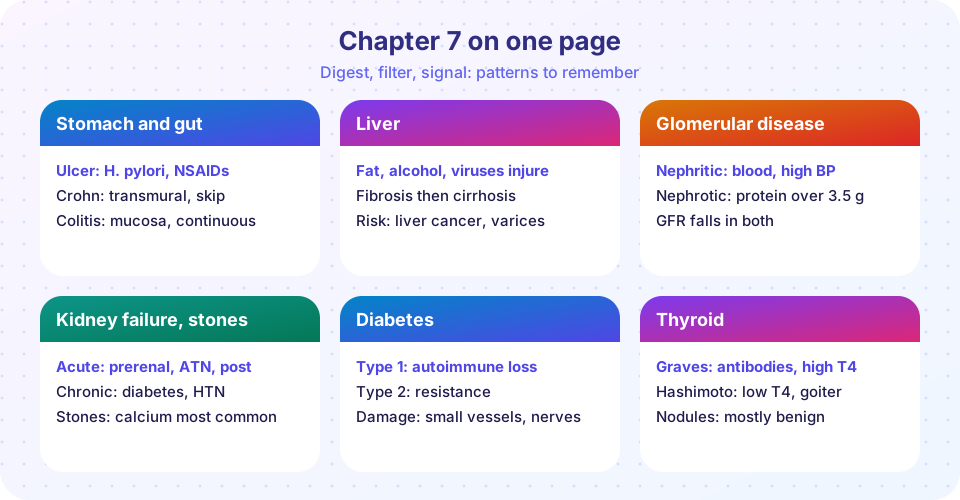
What you will learn
- How to compare diseases that look alike on the surface
- Which features each lesson contributed to the picture
- Where to review first
Key terms
Transmural: full-thickness inflammation (Crohn). Cirrhosis: diffuse scar with nodules. Nephrotic: more than 3.5 g protein per day. Insulin resistance: weak tissue response to insulin. Negative feedback: hormone suppresses its own stimulus.
Recap table
| Topic | Key facts | Lesson |
|---|---|---|
| Peptic ulcer | H. pylori and NSAIDs; bleeding, perforation, obstruction | Gut, liver and pancreas |
| Gastric cancer | Intestinal (after gastritis) and diffuse (signet ring, linitis plastica) | Gut, liver and pancreas |
| IBD | Crohn: transmural, skip, granulomas; UC: mucosal, continuous | Gut, liver and pancreas |
| Colorectal cancer | Adenoma-carcinoma sequence; FAP, Lynch; screening | Gut, liver and pancreas |
| Liver | Viral hepatitis, alcohol, MASLD, fibrosis, cirrhosis, portal hypertension | Gut, liver and pancreas |
| Pancreas | Pancreatitis (gallstones, alcohol); ductal adenocarcinoma (KRAS, TP53) | Gut, liver and pancreas |
| Glomerular disease | Nephritic (blood, hypertension) and nephrotic (protein, edema) | Kidney disease |
| Kidney failure | AKI (prerenal, ATN, postrenal); CKD (diabetes, hypertension) | Kidney disease |
| Stones, tumors | Calcium oxalate; clear cell RCC (VHL); urothelial carcinoma | Kidney disease |
| Diabetes | Type 1 autoimmune; type 2 resistance; micro- and macrovascular damage | Endocrine disease |
| Thyroid and others | Graves, Hashimoto, goiter, tumors; Cushing, Addison, MEN | Endocrine disease |
Connections
- Portal flow links gut and liver: blood from the intestines passes through the liver, and cirrhosis dams it back, producing varices and ascites.
- The kidney is the target of other diseases: diabetes and hypertension cause most chronic kidney failure, so a kidney lesson is also a diabetes and blood pressure lesson.
- Autoimmunity recurs: type 1 diabetes, Graves disease, Hashimoto thyroiditis, celiac disease, IBD (partly), IgA nephropathy and Addison disease share a theme of misdirected immunity. Several often appear together in the same person or family.
- Feedback rules endocrine diagnosis: look at both the hormone and its controller.
Common misconceptions
- "A symptom names the disease." Jaundice, edema, hematuria and goiter are signs with many causes.
- "Chronic means mild." Chronic means long lasting; many chronic diseases here lead to organ failure.
- "Autoimmune means contagious." It does not.
Questions to explain in your own words
Try these without notes.
- Why do Crohn disease and ulcerative colitis cause different complications even though both are inflammatory bowel disease?
- Trace the path from chronic liver injury to esophageal varices.
- Why can a patient lose a large share of kidney function before the creatinine looks clearly abnormal?
- In type 2 diabetes, why do blood glucose and insulin levels often rise together?
- Use the feedback idea to explain why TSH is high in a failing thyroid.
If an answer feels hazy, return to the linked lesson and rewrite the explanation in fewer words.
Try it
Press Run (or Ctrl + Enter) to see the result here.
Program input · what you'd type while the program runs
Type the answers before you press Run, one per line. Each time the program reads a line (with input()), it gets the next line from this box.
Press Run (or Ctrl + Enter) to see the console output here.
No output.
Check your understanding
Quick check · 10 questions
of 10 answered You scored / 10 · perfect!
-
1. Transmural inflammation with skip lesions suggests
Crohn disease involves the full thickness of the bowel in patches. -
2. Which condition raises pressure in the portal vein?
Scar and nodules obstruct flow through the liver, raising portal pressure. -
3. Hepatitis B differs from hepatitis A because it
Hepatitis A is acute and self-limiting; hepatitis B can persist. -
4. Nephritic syndrome is characterized by
Inflamed glomeruli leak red cells and retain salt and water. -
5. The most common causes of chronic kidney disease are
Diabetic and hypertensive injury cause most CKD. -
6. Type 2 diabetes begins mainly with
Tissues respond poorly to insulin, and beta cells eventually fail. -
7. Graves disease is due to
Stimulating antibodies cause hyperthyroidism. -
8. Painless jaundice with a mass at the head of the pancreas suggests
Tumor in the head of the pancreas can block the common bile duct. -
9. Which is a typical feature of Addison disease?
Cortisol deficiency lowers blood pressure, and high ACTH darkens skin. -
10. Calcium oxalate stones represent about what share of kidney stones?
About 80 percent of stones contain calcium, mostly oxalate.
Summary
- Gut: ulcers from H. pylori and NSAIDs, IBD with two patterns, celiac disease, and polyp-to-cancer colorectal cancer.
- Liver: injury leads through steatosis and fibrosis to cirrhosis, with portal hypertension and failure; the pancreas fails by autodigestion or cancer.
- Kidney: nephritic versus nephrotic, AKI versus CKD, stones and tumors.
- Endocrine: diabetes types and complications; thyroid feedback and autoimmunity; adrenal, parathyroid and pituitary disorders.
Next: Chapter 8 overview: Infectious and neurological disease
Track your progress
Create a free account to tick off lessons and pick up where you left off on any device.
of Pathology lessons completed