


















Lesson 3 of 46 · Getting Started
Etiology and Pathogenesis: Why Disease Starts and How It Unfolds
Understand etiology, pathogenesis, morphology and clinical features, risk factors versus causes, and how multifactorial diseases are analyzed step by step.
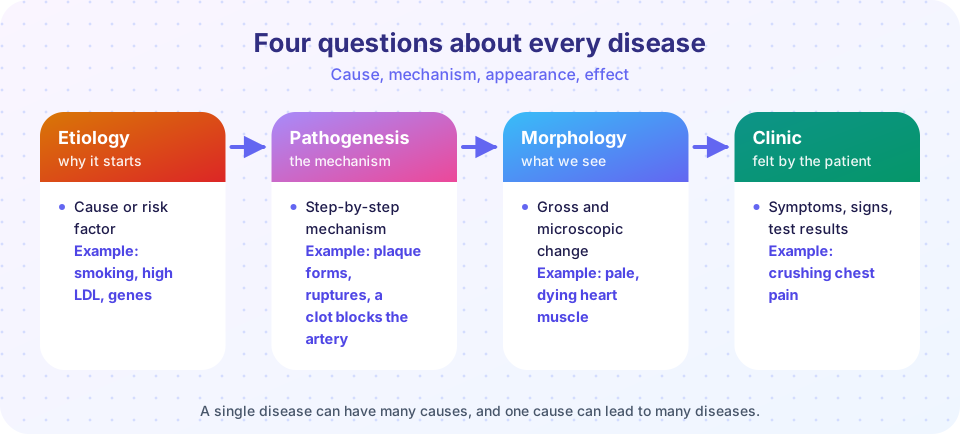
Ask "why did this person get ill?" and you quickly find that there are two different questions hiding in it. One asks about the start: what exposure, gene or event set the process going? The other asks about the path: how did that start turn into damaged tissue and symptoms? Pathology gives these two questions names, etiology and pathogenesis, and adds two more, morphology and clinical manifestations, that complete the story. Together they form a template you can apply to any disease from a common cold to a rare cancer.
What you will learn
- To separate the cause of a disease from its mechanism, appearance and symptoms.
- The main categories of cause: genetic, infectious, chemical, physical, nutritional, immune and others.
- Why most diseases have several causes, and how risk factors differ from causes.
- How to read a simple two-by-two table to compare risks.
Key terms
Etiology: the cause or set of causes that start a disease.
Pathogenesis: the step-by-step mechanism by which the cause produces the disease.
Risk factor: something that raises the probability of disease without being strictly necessary or sufficient.
Idiopathic: of unknown cause. Iatrogenic: caused by medical care itself, such as a drug side effect.
Complication: a new problem that arises from an existing disease or its treatment.
Etiology: the starting point
Etiology (also spelled aetiology) is the study of causes. Pathologists group causes into broad families.
| Family | Examples |
|---|---|
| Genetic | Inherited mutations (cystic fibrosis), chromosomal changes (Down syndrome), new mutations in somatic cells (cancer) |
| Infectious | Bacteria, viruses, fungi, parasites, and rarely prions |
| Physical | Trauma, heat and cold, radiation, electrical injury |
| Chemical | Poisons, alcohol, tobacco smoke, drugs at toxic doses |
| Nutritional | Deficiency (vitamin C and scurvy), excess (obesity), imbalance |
| Immune | Allergy, autoimmunity (the body attacks itself), immunodeficiency |
| Vascular | Reduced or blocked blood supply (ischemia) |
| Degenerative and aging | Wear, accumulated damage, loss of repair capacity |
Most real diseases combine several families. Lung cancer may involve tobacco smoke (chemical), inherited susceptibility (genetic) and repeated inflammation (immune). Type 2 diabetes involves genes, diet, weight and physical activity. This is called a multifactorial disease. The older idea of "one disease, one cause" works best for infections where a particular organism is required, and even there host factors matter. Robert Koch's postulates of the 1880s, a famous checklist for proving that a microbe causes a disease, assume that a single organism is necessary. They were a major advance, but have well-known limits: some microbes cannot be grown in culture, some carriers are healthy, and some diseases need a particular host condition.
Necessary, sufficient and risk factors
Logicians distinguish two strong kinds of cause.
- A necessary cause must be present for the disease to occur. Without Mycobacterium tuberculosis there is no tuberculosis.
- A sufficient cause guarantees the disease when present. Very few exist; a large dose of a lethal poison approaches one.
Most "causes" in medicine are neither. They are risk factors: they raise the odds. Smoking raises the chance of lung cancer but many smokers never get it, and some non-smokers do. A useful modern way to think about this is the sufficient-component cause model: a disease occurs when a certain bundle of components all come together, and several different bundles can produce the same disease. A risk factor is a component in one or more bundles.
Pathogenesis: the chain of events
Pathogenesis answers "how". Take a heart attack (myocardial infarction), which is covered in detail later. A simplified chain is:
- Risk factors (smoking, high blood cholesterol, high blood pressure, diabetes, genes) damage the lining of an artery.
- Fatty material and inflammatory cells accumulate and form a plaque.
- The plaque's surface cracks, exposing material that triggers clotting.
- A clot blocks the artery and cuts off oxygen to heart muscle.
- Without oxygen, cells run out of energy, swell and die.
Each link is a mechanism you can study separately. Notice that you can intervene at different points: reducing risk factors acts early; clot-dissolving drugs and procedures act on step 4; once the muscle is dead, the focus shifts to preserving what remains.
The latent period is the delay between start and visible disease. In atherosclerosis it is decades. In some infections it is days. In subclinical disease the process is under way but causes no symptoms, which is why screening exists.
Morphology: what the tissue shows
Morphology (from the Greek for shape) is how the lesion looks. Pathologists describe two levels.
- Gross appearance, seen without a microscope: size, shape, color, consistency, location. A freshly infarcted heart is first pale, then yellow, then replaced by a white scar.
- Microscopic appearance, seen on a stained slide: which cells are present, how they are arranged, whether nuclei have changed.
Because a given pathogenesis tends to leave a recognizable pattern, morphology works backwards: it is evidence about the mechanism. Pathologists reading a slide of a lung that shows dense clusters of inflammatory cells around dead tissue are not just describing, they are inferring.
Clinical manifestations and natural history
Clinical manifestations are what the patient and the doctor notice: symptoms, signs, abnormal test results. They arise because the structural change disturbs function. When heart muscle dies, the pumping force falls (weak circulation), pain nerves fire (chest pain), and the dying cells leak proteins such as troponin into the blood (a laboratory sign). The progression from start to outcome, with or without treatment, is the natural history of the disease. Possible outcomes include complete recovery, healing with a scar, chronic disease, a complication, or death.
Reading risk with a two-by-two table
To compare groups, epidemiologists use a two-by-two table of exposed and unexposed people against whether they developed the disease. From it we calculate the risk in each group (cases divided by total) and the risk ratio: the risk in the exposed divided by the risk in the unexposed. A risk ratio of 1 means no association; 2 means double the risk. Association is not proof of cause: confounding (a third factor that influences both) can create or hide a link. Proving cause usually needs several kinds of evidence together: strength of association, consistency across studies, a plausible mechanism and, ideally, experimental or natural-experiment evidence.
Common misconceptions
- "A risk factor is a cause." A risk factor raises probability, it does not guarantee disease and may not be causal at all.
- "Everyone with the cause gets the disease." Exposure, dose, genes and chance all matter.
- "If I know the cause, I know the disease." Different causes can converge on the same mechanism, and the same cause can produce several diseases.
Try it
The first block works through a two-by-two table with made-up numbers. It is a calculator for the formulas above, not real data.
Press Run (or Ctrl + Enter) to see the result here.
Program input · what you'd type while the program runs
Type the answers before you press Run, one per line. Each time the program reads a line (with input()), it gets the next line from this box.
The second block shows the sufficient-component idea. A disease appears when any one of several bundles of components is complete. Change the person's components and see which bundle completes.
Press Run (or Ctrl + Enter) to see the console output here.
No output.
Check your understanding
Quick check · 5 questions
of 5 answered You scored / 5 · perfect!
-
1. Which term describes the step-by-step mechanism by which a cause produces disease?
Etiology is the cause; pathogenesis is the mechanism that follows. -
2. A disease with no known cause is called what?
Idiopathic means of unknown cause. Iatrogenic means caused by medical care. -
3. In a study, 30 of 200 exposed people and 10 of 200 unexposed people develop a disease. What is the risk ratio?
Risk exposed = 0.15, risk unexposed = 0.05, ratio = 3. -
4. Why are Koch's postulates not a complete test of cause for every disease?
The postulates are a useful framework but assume one necessary organism that can be grown and that always causes disease. -
5. A necessary cause is one that:
Without the necessary cause there is no disease, but its presence alone may not be enough.
Summary
- Etiology is the cause, pathogenesis the mechanism, morphology the structural appearance and clinical manifestations the effects on the patient.
- Causes fall in families (genetic, infectious, physical, chemical, nutritional, immune, vascular, degenerative) and are often combined.
- Risk factors raise probability; necessary and sufficient causes are rare.
- A disease may be silent for years (latent period, subclinical stage).
- A two-by-two table lets you compute risks and a risk ratio, but association alone does not prove cause.
Next: How Pathologists Work
Track your progress
Create a free account to tick off lessons and pick up where you left off on any device.
of Pathology lessons completed