


















Lesson 20 of 46 · Hemodynamics and Genetic Disease
Chapter 4 Review: Hemodynamics and Genetic Disease
Review chapter four: Starling forces and edema, hemorrhage, Virchow's triad, embolism, infarction, shock and the patterns of genetic disease, with a ten-question quiz.
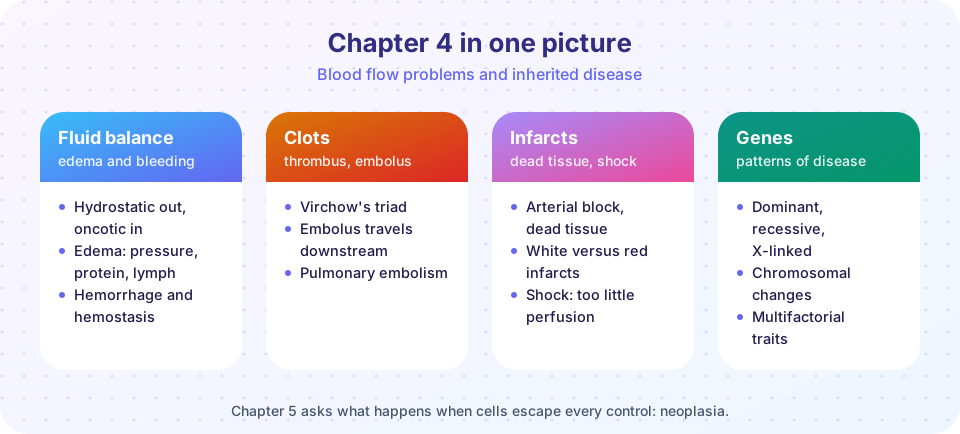
This chapter put two big ideas side by side. Blood flow must be regulated: not too much fluid in tissue, not too little blood in an organ, no clots where there should be none and no bleeding where the vessel should be intact. And genes must be copied and read correctly: when one is not, disease can follow, in patterns that can often be predicted. These are the last of the foundation topics. After this review, chapter 5 turns to neoplasia, where several of the mechanisms you have met (cell division, apoptosis, mutation and inflammation) fail together.
What you will learn
- How the three lessons of chapter 4 connect.
- The key numbers, terms and patterns to recall.
- Where you need more practice, through a mixed quiz.
Recap table
| Topic | Key facts |
|---|---|
| Starling forces | Hydrostatic pressure out, oncotic pressure in; lymphatics drain the surplus |
| Edema causes | Raised venous pressure, low albumin, lymphatic obstruction, sodium and water retention, increased permeability |
| Congestion | Passive, bluish; chronic congestion gives heart failure cells and nutmeg liver |
| Hemorrhage | Petechiae, purpura, ecchymosis, hematoma; severity depends on volume, rate and site |
| Hemostasis | Platelet plug (von Willebrand factor), then coagulation cascade and fibrin |
| Virchow's triad | Endothelial injury, abnormal flow (stasis, turbulence), hypercoagulability |
| Embolism | 99 percent thromboemboli; pulmonary emboli from leg veins; also fat, air, amniotic fluid, tumor |
| Infarcts | White (arterial, solid organs); red (venous, loose or dual-supply tissue); coagulative necrosis except brain |
| Shock | Cardiogenic, hypovolemic, septic, anaphylactic, neurogenic; compensated, progressive, irreversible |
| Genes | Dominant 50 percent; recessive 25 percent for carrier parents; X-linked mainly males; trisomy 21; multifactorial |
Three questions to ask of any case
- Is the problem in the vessel (clot, bleed), around the vessel (edema) or downstream (infarct, shock)?
- Which element of the triad or which Starling force is disturbed?
- If a family is involved, which pattern fits: dominant, recessive, X-linked, mitochondrial, chromosomal or multifactorial?
Worked mini-cases
Case 1: swollen ankles. At the end of the day a person has pitting swelling of both ankles. List the possible mechanisms before choosing: raised venous pressure (heart failure, venous disease), low albumin (liver or kidney disease), lymphatic blockage, salt and water retention, or increased permeability (inflammation). Each points to a different set of tests. This is why edema is a sign, not a diagnosis.
Case 2: the long-haul clot. After a major operation and several days in bed, a patient develops a swollen calf and then sudden breathlessness. Apply Virchow's triad: endothelial injury (surgery), stasis (immobility) and hypercoagulability (the stress of surgery). A thrombus formed in the deep leg veins, a piece broke off and traveled through the right heart to the lungs as a pulmonary embolus. The lung often escapes infarction because it has a second blood supply.
Case 3: the family tree. A couple with no disease have a child with cystic fibrosis. The pattern fits autosomal recessive inheritance with both parents as carriers. Each future child has a 25 percent chance of being affected, 50 percent of being a carrier and 25 percent of being unaffected non-carrier. Every pregnancy is an independent event, and counselors explain such numbers to families.
Try it
The first block is a revision drill that links each cause to its mechanism.
Press Run (or Ctrl + Enter) to see the console output here.
No output.
The second block compares the risk for a child under four inheritance patterns in one chart. The numbers are the standard Mendelian expectations for the parent combinations named.
Press Run (or Ctrl + Enter) to see the result here.
Program input · what you'd type while the program runs
Type the answers before you press Run, one per line. Each time the program reads a line (with input()), it gets the next line from this box.
Check your understanding
Quick check · 10 questions
of 10 answered You scored / 10 · perfect!
-
1. Which pair of forces keeps fluid balance across capillaries?
Hydrostatic pressure pushes fluid out; plasma proteins, chiefly albumin, pull it in. -
2. Which condition causes edema mainly through increased venous hydrostatic pressure?
Failing heart pumping raises venous pressure and pushes fluid into tissues. -
3. A 'nutmeg liver' is typical of:
Congestion makes the centers of the liver lobules dark, giving a nutmeg pattern. -
4. Which protein links platelets to exposed collagen?
von Willebrand factor is the bridge in primary hemostasis. -
5. Stasis from a long period of immobility fits which part of Virchow's triad?
Slow or stagnant flow is the abnormal flow component. -
6. Most pulmonary emboli come from:
Deep vein thrombi in the legs are the usual source. -
7. Which tissue typically shows a red (hemorrhagic) infarct after blockage?
Loose tissue with dual supply, like the lung, bleeds into the infarct. -
8. Which shock type results from severe infection and widespread mediator release?
Septic shock is driven by cytokines causing vasodilation and leakage. -
9. A boy has hemophilia A. His mother is most likely:
Hemophilia A is X-linked recessive; a carrier mother passes it to half her sons. -
10. Which condition is caused by trisomy 21?
Down syndrome results from an extra copy of chromosome 21.
Summary
- Fluid balance depends on pressure and protein; five mechanisms cause edema, and hyperemia and congestion differ in cause and color.
- Hemostasis stops bleeding in two stages; Virchow's triad explains pathological clots; emboli, infarcts and shock follow when flow fails.
- Genetic disease arises from mutations that follow dominant, recessive, X-linked, mitochondrial or chromosomal patterns, or from multifactorial causes.
Track your progress
Create a free account to tick off lessons and pick up where you left off on any device.
of Pathology lessons completed