


















Lesson 28 of 46 · Cardiovascular and Respiratory Pathology
Hypertension, heart failure and valve disease
Learn how high blood pressure damages vessels and organs, why the heart fails and on which side, and how rheumatic, calcific and infective valve disease arise.
Blood pressure is the force that drives blood through the circulation, and the heart is the pump that creates it. When pressure stays high, the pump and the vessels adapt, and the adaptations eventually turn against the body. When the pump cannot keep up with what the body needs, the result is heart failure, a syndrome that looks different depending on which side falters. And when the valves that keep blood flowing one way are narrowed or leaky, the heart is forced to work harder or less efficiently.
These three topics belong together because they describe one chain: load on the heart, the heart's response, and the point where the response fails. This lesson follows that chain.
What you will learn
- How blood pressure is defined and classified, and the difference between primary and secondary hypertension
- The vascular and organ damage of long-standing hypertension
- The causes and clinical patterns of left and right heart failure
- The main valve diseases: rheumatic, calcific, degenerative and infective
Key terms
Hypertension: persistently raised arterial blood pressure.
Hypertrophy: increase in cell size, here the thickening of heart muscle.
Ejection fraction (EF): the fraction of the ventricle's blood pumped out per beat; about 55 to 70 percent is normal.
Stenosis / regurgitation: a valve that fails to open fully, or fails to close fully.
Vegetation: a mass of clot, microbes and inflammatory cells on a heart valve.
Hypertension
Blood pressure is written as two numbers in mmHg: the systolic pressure when the ventricle contracts and the diastolic pressure when it relaxes. The cut-off between "normal" and "high" is a matter of guideline, because risk rises continuously with pressure. A commonly used definition places hypertension at readings repeatedly at or above about 130/80 (American guidelines) or 140/90 mmHg (many European and international guidelines). It is common, affecting a large share of adults, and often has no symptoms until damage is done, which is why it is called a silent disease.
Types and causes
About 90 to 95 percent of cases are primary (essential) hypertension, with no single identifiable cause: it arises from the interaction of genes, salt intake, body weight, age and other factors, with a tendency of the kidney to retain sodium and of the arteries to be stiff or narrow. Secondary hypertension has a specific cause: kidney disease, narrowing of a renal artery (renovascular hypertension), endocrine tumors such as primary aldosteronism or pheochromocytoma, Cushing syndrome, or narrowing of the aorta (coarctation). Secondary causes are important because treating them can cure the pressure.
The damage
High pressure harms the vessels first, and through them the organs.
- Hyaline arteriolosclerosis: small arteries and arterioles have a pink, glassy thickening of the wall that narrows the lumen. It is typical of long-standing benign hypertension and diabetes, and it is most visible in the kidney.
- Hyperplastic arteriolosclerosis: in severe or "malignant" hypertension, arterioles show concentric layers of smooth muscle and basement membrane that look like onion skin, often with fibrinoid necrosis of the wall, which can cause acute kidney injury and brain swelling.
- Heart: the left ventricle thickens in a concentric hypertrophy, because it pumps against high resistance. A thick wall needs more oxygen, is stiff, and is more prone to ischemia and rhythm disturbances (hypertensive heart disease).
- Brain: stroke, either from a vessel ruptured by pressure (hemorrhage) or from small deep infarcts (lacunes).
- Kidney: nephrosclerosis, a fine granular shrinkage of the kidneys.
- Eyes and aorta: retinal vessel changes, and acceleration of atherosclerosis, aneurysm and aortic dissection.
Heart failure
Heart failure is the clinical state in which the heart cannot pump enough blood to meet the body's needs at normal filling pressures, or can do so only with elevated filling pressures. It is the common endpoint of many diseases: ischemic heart disease, hypertension, valve disease, cardiomyopathy, and others.
Two patterns are named by the ejection fraction. In systolic failure (reduced EF) the ventricle cannot contract well, as after large infarcts or in dilated cardiomyopathy. In diastolic failure (preserved EF) the ventricle contracts normally but is too stiff to fill, as in hypertensive hypertrophy.
The body's compensations
Falling output triggers rescue responses. The Frank-Starling mechanism means that a stretched ventricle contracts more forcefully, up to a limit. The sympathetic nervous system raises heart rate and contractility, and the renin-angiotensin-aldosterone system makes the kidneys retain salt and water to increase filling. The heart wall hypertrophies. These measures help at first, but they increase the heart's workload and oxygen needs, so over time they accelerate decline. The drugs that improve outcomes in heart failure largely block these neurohormonal systems.
Press Run (or Ctrl + Enter) to see the result here.
Program input · what you'd type while the program runs
Type the answers before you press Run, one per line. Each time the program reads a line (with input()), it gets the next line from this box.
Left and right failure
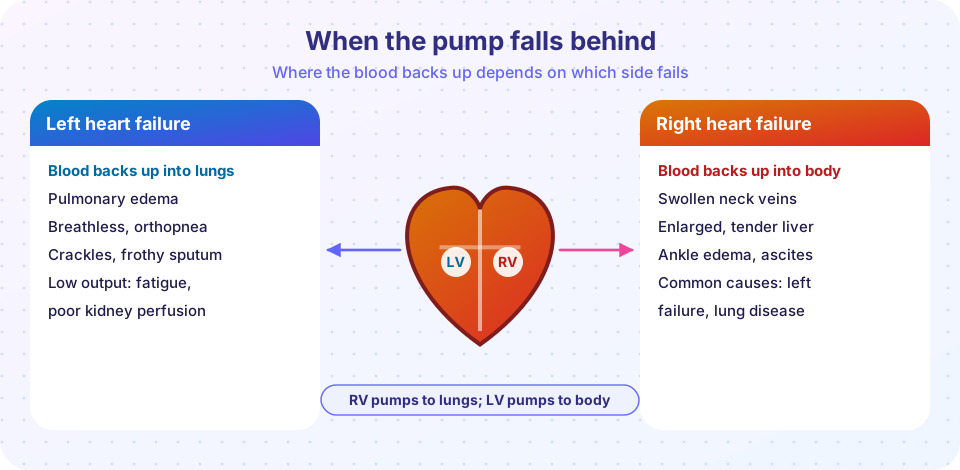
- Left heart failure causes blood to back up into the lung veins. Fluid leaks into the air spaces (pulmonary edema), producing shortness of breath, difficulty lying flat (orthopnea), waking at night breathless, and frothy sputum. Reduced forward flow causes fatigue and poor kidney perfusion. The lungs of long-standing failure contain macrophages loaded with iron from leaked red cells ("heart failure cells").
- Right heart failure causes blood to back up into the body's veins: distended neck veins, an enlarged tender liver, ankle swelling and fluid in the abdomen (ascites). The most common cause of right failure is left failure. Failure of the right ventricle from lung disease is called cor pulmonale.
Cardiomyopathies
Diseases of the heart muscle itself fall into three classic patterns: dilated (enlarged, thin-walled, weak, from alcohol, viral injury, genes or drugs), hypertrophic (thick wall, often an inherited sarcomere gene defect, a cause of sudden death in young athletes), and restrictive (stiff wall, for example from amyloid deposits).
Valve disease
Heart valves are thin, flexible, avascular leaflets of connective tissue. They fail by two mechanisms: stenosis (they cannot open fully, so the chamber behind must push harder) and regurgitation (they do not close, so blood leaks backward and the heart handles the same volume twice).
- Calcific aortic stenosis is the most common valve disease in older adults. Calcium builds up on the aortic valve's leaflets, and a congenitally bicuspid valve (two leaflets instead of three) wears out earlier. The left ventricle hypertrophies against the obstruction. Typical symptoms in advanced disease are angina, fainting and heart failure.
- Rheumatic heart disease follows an immune reaction to group A streptococcal throat infection, in which antibodies and T cells directed against the bacteria cross-react with heart tissue (molecular mimicry). The acute disease, rheumatic fever, causes inflammation of the heart (pancarditis) with granulomas called Aschoff bodies containing characteristic macrophages. The healing leaves mitral valve stenosis with thickened, fused leaflets and "fish-mouth" openings. It is rare in rich countries but still common where untreated strep infection and crowding persist.
- Mitral valve prolapse is a floppy valve with myxoid change, usually benign and often found incidentally.
- Infective endocarditis is infection of the valves, with vegetations of platelets, fibrin and microbes. Acute disease is caused by aggressive organisms such as Staphylococcus aureus, which can attack normal valves and destroy them in days. Subacute disease, often from viridans streptococci, tends to affect damaged valves. Fragments embolize to the brain, kidney and spleen, causing infarcts and abscesses, and immune-complex reactions produce skin and eye signs (splinter hemorrhages, Osler nodes, Janeway lesions, Roth spots).
Common misconceptions
- "Heart failure means the heart has stopped." It means the pump is inadequate; the heart usually keeps beating, and many people live for years with treatment.
- "Hypertension always causes symptoms like headache." Most people feel nothing until damage occurs.
- "Systolic and diastolic failure are the same." The first is weak contraction; the second is a stiff ventricle that cannot fill, and the treatments differ.
- "Rheumatic fever is an infection of the heart." It is an autoimmune reaction that follows a streptococcal infection elsewhere.
Try it
The blood pressure explorer and the Frank-Starling plot above are good places to experiment. Here is one more calculation.
Press Run (or Ctrl + Enter) to see the result here.
Program input · what you'd type while the program runs
Type the answers before you press Run, one per line. Each time the program reads a line (with input()), it gets the next line from this box.
Check your understanding
Quick check · 5 questions
of 5 answered You scored / 5 · perfect!
-
1. Which arteriolar change is typical of malignant (severe) hypertension?
Severe hypertension produces concentric 'onion-skin' layering and fibrinoid necrosis of arterioles. -
2. Swollen ankles, an enlarged liver and distended neck veins suggest
Right-sided failure backs blood up into the systemic veins. -
3. A heart in heart failure with preserved ejection fraction typically has
Diastolic failure arises from impaired relaxation and filling, as in hypertensive hypertrophy. -
4. What causes rheumatic heart disease?
Cross-reactive antibodies and T cells damage the heart after a strep infection. -
5. The most common valve disease in older adults is
Age-related calcification of the aortic valve is the most frequent.
Summary
- Hypertension is mostly primary; it thickens the left ventricle and damages arterioles, brain, kidney, eyes and aorta.
- Heart failure is the common end of many diseases; compensation helps first and harms later.
- Left failure congests the lungs, right failure congests the body.
- Valves fail by stenosis or regurgitation: calcific aortic disease, rheumatic mitral disease and infective endocarditis are key examples.
Next: Lung disease
Track your progress
Create a free account to tick off lessons and pick up where you left off on any device.
of Pathology lessons completed