


















Lesson 19 of 46 · Hemodynamics and Genetic Disease
Genetic Disease: Mutations, Inheritance Patterns and Chromosomes
Understand how mutations cause disease, read pedigrees for dominant, recessive and X-linked inheritance, and meet chromosomal and multifactorial disorders with worked examples.
Every cell in your body carries about 20,000 protein-coding genes, and a small change in one of them can change the protein it makes. If the protein is important enough, the change causes disease. Genetic disease is therefore not a separate corner of pathology but another way of asking the same question: what is the cause (etiology) and how does it lead to the disease (pathogenesis)? This lesson covers the kinds of mutation, the classic patterns of inheritance, the disorders of whole chromosomes, and the idea that most common diseases arise from genes and environment together.
What you will learn
- The main types of mutation and how they alter proteins.
- How to read a pedigree and predict risk for autosomal dominant, autosomal recessive and X-linked recessive conditions.
- What chromosomal disorders are, with trisomy 21 as the model.
- Why multifactorial disease cannot be predicted by Mendel's rules alone.
- How carrier frequency can be calculated with the Hardy-Weinberg principle.
Key terms
Gene and allele: a gene is a stretch of DNA that codes for a product; an allele is one version of a gene.
Genotype and phenotype: the alleles a person carries, and the traits and disease that result.
Homozygous and heterozygous: having two identical alleles, or two different ones.
Penetrance: the proportion of people with a mutation who show the disease.
Carrier: a person who has one copy of a recessive mutation and is usually unaffected.
Mutations and what they do
A mutation is a lasting change in DNA. Germline mutations are present in the egg or sperm and can be inherited; somatic mutations arise in body cells during life. Types of change in a gene include:
- Point mutations, in which one base is replaced. A missense mutation swaps one amino acid for another. In sickle cell disease a single change in the β-globin gene replaces glutamic acid with valine at position 6. A nonsense mutation creates a stop signal and the protein is cut short. A silent mutation changes the DNA but not the amino acid.
- Frameshift mutations, in which bases are inserted or deleted in numbers that are not multiples of three, scrambling everything downstream.
- Larger deletions or duplications of part or all of a gene. A large deletion of the dystrophin gene causes most cases of Duchenne muscular dystrophy.
- Trinucleotide repeat expansions, in which a three-letter sequence is repeated too many times. Huntington disease results from an expanded CAG repeat; fragile X syndrome from an expanded CGG repeat. Repeats tend to grow from one generation to the next.
- Splice-site mutations, which disturb the cutting and joining of the gene's message.
A mutation usually acts in one of two ways. In loss of function the protein is absent or weak. In gain of function the protein acquires a harmful new activity, as in Huntington disease. A third possibility, dominant negative, is a faulty protein that interferes with the normal copy made by the same person's other allele.
The classic inheritance patterns
Humans have 22 pairs of autosomes and one pair of sex chromosomes (XX in females, XY in males). Whether a mutation is on an autosome or on the X chromosome, and whether one or two copies are needed, gives the patterns below.
Autosomal dominant
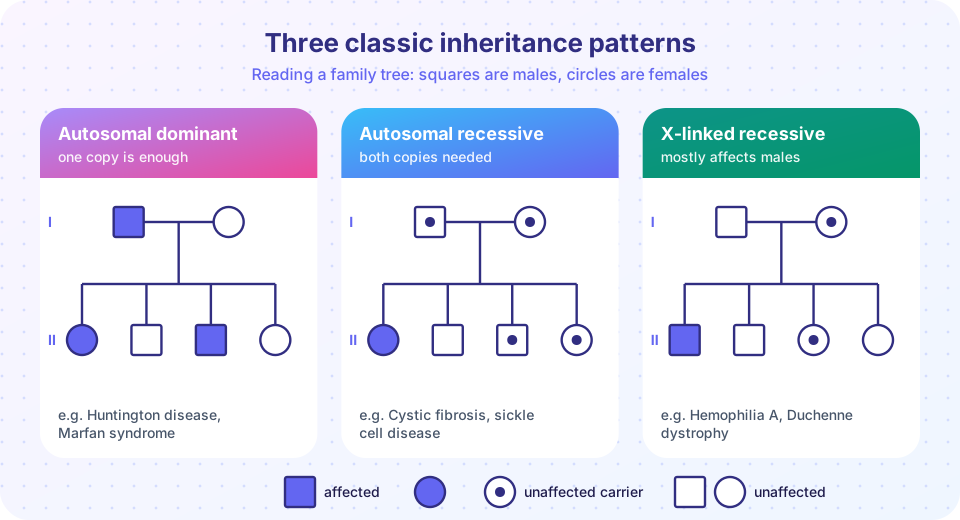
One mutated copy is enough to cause disease. An affected person usually has an affected parent, and each child has a 50 percent chance of inheriting the mutation. Males and females are equally affected, and the condition appears in every generation. Typical products are structural proteins or receptors. Examples:
- Huntington disease (adult-onset brain degeneration).
- Marfan syndrome (fibrillin-1 defect: tall build, long limbs, weakened aorta).
- Familial hypercholesterolemia (LDL receptor defect: very high cholesterol, early heart disease).
Real families can look messier. Incomplete penetrance means some carriers show no disease; variable expressivity means the severity differs between carriers in a family; new (de novo) mutations can cause the disease in a child with unaffected parents.
Autosomal recessive
Two mutated copies are needed. Parents are usually carriers (one normal and one mutated copy) and unaffected. Each child of two carriers has a 25 percent chance of being affected, 50 percent of being a carrier and 25 percent of having two normal copies. The disease often skips generations and affects males and females equally; it is more frequent when parents are related (consanguinity). Many are enzyme deficiencies. Examples:
- Cystic fibrosis (CFTR protein defect: thick mucus in lungs and gut). The most common mutation is a three-base deletion called F508del.
- Sickle cell disease, with two copies of the sickle mutation.
- Phenylketonuria (phenylalanine hydroxylase deficiency, which is detected by newborn screening and managed with diet).
- Tay-Sachs disease (hexosaminidase A deficiency: fat accumulates in nerve cells).
X-linked recessive
The mutation is on the X chromosome. Males have only one X, so a single mutated copy causes disease. Females have two X chromosomes, and a female with one mutated copy is usually an unaffected carrier, partly because one X chromosome in each cell is randomly switched off early in development (X inactivation, the Lyon hypothesis). For a carrier mother and an unaffected father, each son has a 50 percent chance of being affected, and each daughter a 50 percent chance of being a carrier. An affected father cannot pass the condition to a son (a son gets his Y chromosome from his father), but all his daughters will be carriers. Examples: hemophilia A (factor VIII), Duchenne muscular dystrophy (dystrophin) and red-green color blindness.
Mitochondrial inheritance
Mitochondria have their own small circular DNA, inherited almost entirely from the mother. A mother with a mitochondrial mutation can pass it to all her children, but an affected father usually passes it to none. Because each cell has many mitochondria and only some may carry the mutation (heteroplasmy), severity varies.
Chromosomal disorders
Some diseases result from too many, too few or rearranged chromosomes rather than from a single-gene change.
- Numerical abnormalities usually result from nondisjunction, in which chromosomes fail to separate when egg or sperm cells form. A cell with three copies of a chromosome is a trisomy; with one copy, a monosomy.
- Down syndrome (trisomy 21) is the most common chromosomal disorder among live births, affecting roughly 1 in 700 babies. The risk rises with maternal age. Features include intellectual disability of variable degree, characteristic facial features, and an increased frequency of heart defects.
- Turner syndrome (45,X, one X chromosome only) affects females; Klinefelter syndrome (47,XXY) affects males.
- Structural abnormalities include deletions, duplications and translocations (pieces exchanged between chromosomes). The 22q11.2 deletion causes DiGeorge syndrome, which can affect the heart, the thymus and the parathyroid glands.
A karyotype (a picture of the chromosomes arranged in order) and newer techniques such as chromosomal microarray detect these changes.
Multifactorial and polygenic disease
Most common diseases, among them type 2 diabetes, coronary artery disease, many cancers and many birth defects, do not follow neat Mendelian patterns. They arise from the combined effects of many genes, each contributing a small risk, and environmental exposures such as diet, smoking and infection. Family members share genes and environments, so such diseases cluster in families without a simple ratio. Twin studies help to separate the two: if identical twins (who share all their genes) are more often alike for a trait than fraternal twins (who share about half), genes matter. Heritability is the share of variation in a trait in a population that can be attributed to genetic differences. It does not tell how much of an individual's disease is genetic, and a high heritability does not mean the trait cannot be changed by environment.
Additional mechanisms exist: genomic imprinting (in which a gene is switched on or off depending on which parent it came from, as in Prader-Willi and Angelman syndromes) and epigenetic changes (chemical marks on DNA and its packaging that alter gene activity without changing the sequence).
Diagnosis and counseling
Genetic disease is investigated through the family history (drawn as a pedigree), physical examination, biochemical tests (an enzyme level), a karyotype, targeted tests for known mutations, and increasingly DNA sequencing. Newborn screening tests a heel-prick blood sample for treatable conditions such as phenylketonuria. Carrier screening and prenatal testing are available in some settings. Genetic counselors help families understand the results and the options, including the ethical and emotional aspects. Questions of privacy, discrimination and informed choice are part of genetic medicine. This lesson explains principles; it does not advise any person on testing or family planning.
Common misconceptions
- "A dominant disease is always severe or common." Dominant refers to how many copies are needed, not to severity or frequency.
- "If a parent has a recessive disease, the child always does." Unless the other parent also carries the mutation, the child is only a carrier.
- "Genetic means untreatable." Many genetic conditions are managed or treated effectively, for example by diet in phenylketonuria or clotting factor replacement in hemophilia.
- "Heritability tells you your personal risk." It describes variation in populations.
Try it
The first block simulates children of two carrier parents of an autosomal recessive condition and compares the observed ratios with the expected 25, 50 and 25 percent. Small families scatter; large numbers converge. It is a demonstration of chance, not a prediction for any family.
Press Run (or Ctrl + Enter) to see the result here.
Program input · what you'd type while the program runs
Type the answers before you press Run, one per line. Each time the program reads a line (with input()), it gets the next line from this box.
The second block uses the Hardy-Weinberg principle to estimate how common carriers are, given how common a recessive disease is. It assumes random mating and a stable allele frequency. The disease frequency here is an illustrative round number.
Press Run (or Ctrl + Enter) to see the console output here.
No output.
Check your understanding
Quick check · 6 questions
of 6 answered You scored / 6 · perfect!
-
1. Two carrier parents of an autosomal recessive condition have a child. What is the chance the child is affected?
Each parent passes the mutated allele with probability 1/2, so both do so with probability 1/4. -
2. An affected father with an X-linked recessive disease and an unaffected non-carrier mother. Which is correct?
Sons receive the father's Y chromosome; daughters receive his X, so they are carriers. -
3. Which mutation type is responsible for Huntington disease?
An expanded CAG repeat in the huntingtin gene causes a toxic gain of function. -
4. What causes Down syndrome?
An extra copy of chromosome 21, usually from nondisjunction. -
5. Which statement about heritability is correct?
Heritability applies to populations, not to individuals, and does not imply fixed outcomes. -
6. Mitochondrial diseases are typically inherited:
Mitochondria in the embryo come almost entirely from the egg.
Summary
- Mutations change proteins by missense, nonsense, frameshift, deletion, repeat expansion or splicing changes, producing loss or gain of function.
- Autosomal dominant: one copy is enough, 50 percent risk. Autosomal recessive: two copies, 25 percent risk for children of carriers. X-linked recessive: mainly males, carrier mothers.
- Mitochondrial inheritance passes through the mother.
- Chromosomal disorders (Down, Turner, Klinefelter, deletions) involve whole chromosomes.
- Most common diseases are multifactorial; heritability describes populations.
- Hardy-Weinberg links disease frequency to carrier frequency, and genetic counseling supports families.
Next: Chapter 4 Review
Track your progress
Create a free account to tick off lessons and pick up where you left off on any device.
of Pathology lessons completed