


















Lesson 26 of 46 · Cardiovascular and Respiratory Pathology
Chapter 6 overview: Cardiovascular and respiratory pathology
Preview the heart, vessel and lung diseases ahead: atherosclerosis, heart attack, hypertension, heart failure, COPD, pneumonia and lung cancer, and how they connect.
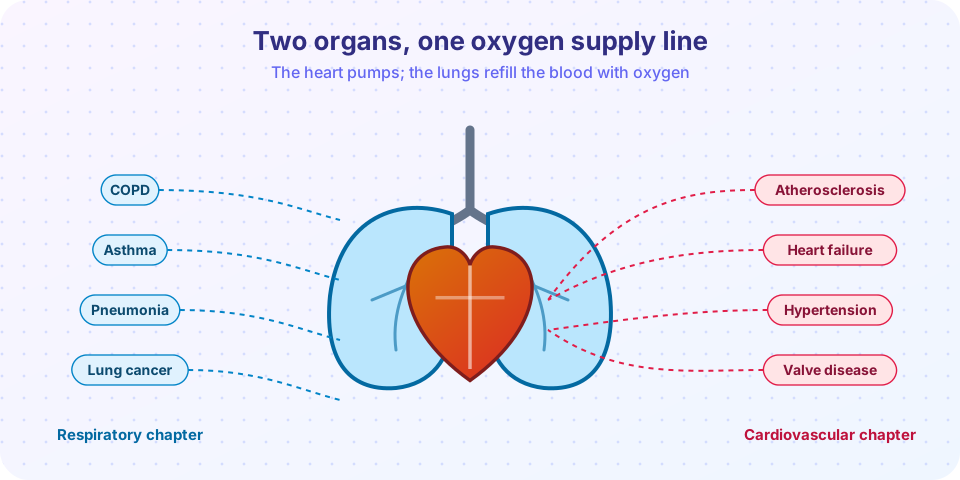
The heart and the lungs work as one system with a single job: delivering oxygen to every tissue and carrying carbon dioxide away. The right side of the heart pushes blood through the lungs; the lungs load it with oxygen; the left side of the heart sends it to the rest of the body. Because the two organs are plumbed in series, damage to one soon becomes damage to the other, and the commonest diseases of both are among the largest causes of illness and death worldwide.
This chapter walks through those diseases with the pathologist's questions in mind: what injured the tissue, how did the tissue respond, and what is the functional consequence? You will see that a small number of mechanisms (a plaque that ruptures, a pressure that stays too high, a smoke that scars airways) explain a large amount of disease.
Educational information only. The lessons explain mechanisms and typical findings. They do not diagnose or recommend treatment, and nothing here replaces advice from a qualified clinician. If you or someone near you has chest pain, severe breathlessness, or any sudden symptom, seek urgent medical help.
What you will learn
- How the chapter's lessons are organized around a few core mechanisms
- Why heart and lung diseases so often occur together
- The basic vocabulary: ischemia, infarction, hypertrophy, obstruction, restriction
Key terms
Ischemia: too little blood flow for the tissue's needs, which is reversible at first.
Infarction: tissue death caused by ischemia.
Hypertrophy: an increase in cell size, as in a pressure-loaded heart.
Obstructive / restrictive lung disease: trouble getting air out versus trouble getting air in.
The chapter at a glance
Vessels first
The pump under load
Lungs
Many of these diseases share risk factors, especially smoking.
The big picture
Three ideas recur in this chapter.
Blood supply is everything. Heart muscle uses oxygen at a high rate even at rest, and it cannot store much, so a narrowed coronary artery can starve it quickly. Brain and kidney have the same weakness. Atherosclerosis, the buildup of plaque in artery walls, underlies most of the heart attacks, strokes and limb gangrene you will meet.
Pressure remodels tissue. A heart that pumps against high pressure thickens, and a thick heart needs more blood and stretches less. A lung that is scarred cannot expand. Long-lasting load causes structural change that is hard to undo.
Smoke and other inhaled particles are a common thread. Tobacco smoke contributes to atherosclerosis, COPD and lung cancer, and many occupational dusts scar the lungs. Seeing these links makes the diseases easier to remember.
What each lesson covers
- Atherosclerosis and ischemic heart disease explains plaque formation, angina, and how a myocardial infarction evolves over hours, days and weeks.
- Hypertension, heart failure and valves covers high blood pressure and its damage, why the heart fails (and on which side), and the common valve diseases.
- Lung disease compares obstructive and restrictive lung disease, then covers pneumonia and lung cancer.
- Chapter review pulls the chapter together.
How to study this chapter
Organize the chapter around blood flow and pressure. For each disease, write one sentence of the form "X reduces flow (or raises pressure) and the tissue responds by Y". Learn the infarct timeline as a story, not a table: first nothing, then death, then cleanup, then repair, then scar. For the lungs, always start with the spirometry question, obstruction or restriction, because it sorts a long list of diseases into two groups. Finally, link the two organs: left heart failure congests the lungs, and chronic lung disease strains the right heart.
Try it
Press Run (or Ctrl + Enter) to see the result here.
Program input · what you'd type while the program runs
Type the answers before you press Run, one per line. Each time the program reads a line (with input()), it gets the next line from this box.
Press Run (or Ctrl + Enter) to see the result here.
Program input · what you'd type while the program runs
Type the answers before you press Run, one per line. Each time the program reads a line (with input()), it gets the next line from this box.
Check your understanding
Quick check · 3 questions
of 3 answered You scored / 3 · perfect!
-
1. Ischemia means
Ischemia is inadequate perfusion; infarction is the tissue death that can follow. -
2. If a vessel's radius halves and the pressure drop stays the same, the idealized flow falls to
Flow is proportional to radius to the fourth power, and (1/2)^4 = 1/16. -
3. Which pair is correct?
Obstructive disease limits expiratory flow; restrictive disease limits lung expansion.
Summary
- The heart and lungs are linked in series, so disease in one soon affects the other.
- Atherosclerosis, pressure overload and inhaled injury explain most disease in this chapter.
- Flow depends strongly on vessel radius, so modest narrowing can matter.
- The next lessons cover plaques and infarcts, hypertension and heart failure, and lung diseases.
Track your progress
Create a free account to tick off lessons and pick up where you left off on any device.
of Pathology lessons completed