


















Lesson 23 of 46 · Neoplasia
Carcinogenesis: oncogenes, tumor suppressors and causes
Understand how normal cells become cancer: oncogenes, tumor suppressor genes, the two-hit idea, DNA repair, the hallmarks of cancer and the main causes.
If a tumor is a clone that escaped control, the natural question is: control by what? The answer, worked out over decades, is a set of genes. Some push the cell cycle forward when the body sends growth signals. Others apply brakes, repair damage, or order a damaged cell to die. Carcinogenesis, the making of cancer, is the story of those genes being altered, most often one at a time over many years, until a cell and its descendants are free of normal limits.
Understanding this story explains why cancer risk rises with age, why some families have inherited predispositions, why smoking and sunburn matter, and why certain modern drugs can attack one specific broken protein.
What you will learn
- The difference between proto-oncogenes, oncogenes and tumor suppressor genes
- How the two-hit hypothesis explains inherited cancer syndromes
- The hallmarks of cancer that most tumors acquire
- How chemicals, radiation and viruses cause cancer
- Why cancer is a multistep process
Key terms
Proto-oncogene: a normal gene that promotes controlled growth.
Oncogene: a mutated or overactive version that drives growth without control.
Tumor suppressor gene: a gene whose product restrains growth or triggers repair or death; cancer arises when both copies are lost.
Driver / passenger mutation: a driver gives the cell an advantage; a passenger is carried along without effect.
Apoptosis: programmed cell death.
The gas pedal and the brakes
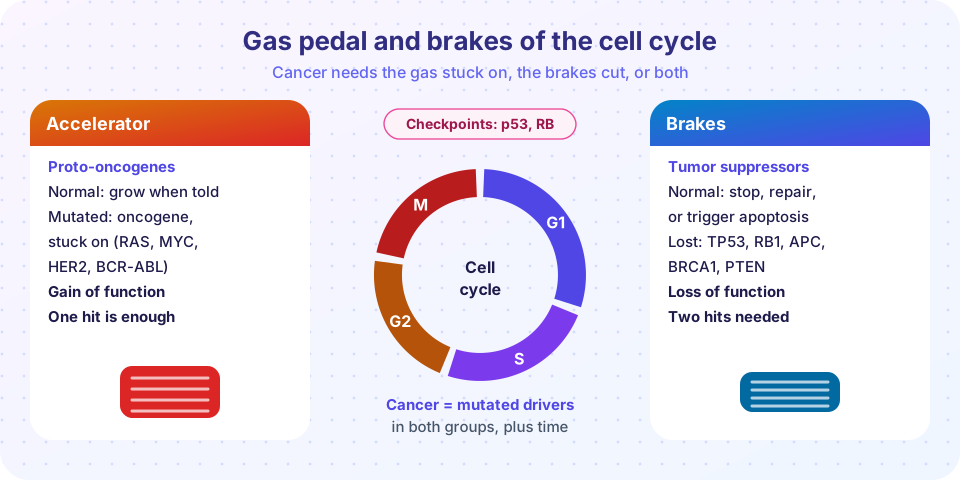
Oncogenes: gain of function
A proto-oncogene is a gene that normally helps cells respond to growth signals. A growth factor binds a receptor, the receptor activates a signaling relay inside the cell, and the relay switches on genes that push the cell through its cycle. When a proto-oncogene is mutated, amplified or relocated so that its product is always on, it becomes an oncogene. Because a single overactive copy can drive growth, oncogenes act in a dominant way: one hit is enough.
There are several ways a proto-oncogene is turned into an oncogene:
- Point mutation. The RAS family encodes small proteins that switch signaling on when bound to GTP and off when they hydrolyze it to GDP. A point mutation that cripples the GTP-hydrolyzing step leaves RAS stuck on. RAS mutations are among the most common oncogenic changes in human cancers.
- Chromosomal translocation. Pieces of two chromosomes swap. In chronic myeloid leukemia the Philadelphia chromosome, a translocation t(9;22), fuses the BCR and ABL genes. The fusion protein is a tyrosine kinase that is always active. This discovery led to the drug imatinib, which blocks it, a landmark in targeted therapy. In Burkitt lymphoma a translocation t(8;14) places the MYC gene next to the strong immunoglobulin gene promoter, so MYC is made at high levels.
- Gene amplification. Extra copies of a gene give extra protein. HER2 is amplified in a minority of breast cancers, and N-MYC is amplified in some neuroblastomas, where it signals a more aggressive course.
- Overexpression by other means. In follicular lymphoma, a t(14;18) translocation raises BCL2, a gene that blocks apoptosis, so cells that should die survive.
Tumor suppressors: loss of function
Tumor suppressor genes are the brakes. They work in different ways: some halt the cell cycle at a checkpoint, some repair DNA, some trigger apoptosis, and some hold cells in contact with their neighbors. Because one working copy can usually do the job, tumor suppressors are recessive at the cellular level: both copies must be lost.
- RB1 is a gatekeeper of the G1-to-S transition. In its active, unphosphorylated form it holds the cell in G1 by binding E2F transcription factors. Phosphorylation by cyclin-dependent kinases releases it.
- TP53, often called "the guardian of the genome," makes the p53 protein, which accumulates when DNA is damaged. It can halt the cycle to allow repair, and if damage is too great, trigger apoptosis. TP53 is mutated in roughly half of human cancers.
- APC restrains the Wnt signaling pathway in the colon, and its loss is the earliest event in most colon cancers.
- BRCA1 and BRCA2 are involved in repairing double-strand DNA breaks.
- PTEN opposes the PI3K growth pathway, and NF1 restrains RAS.
The two-hit hypothesis
In 1971 Alfred Knudson examined the rare eye cancer retinoblastoma, which occurs in two forms. In the hereditary form children develop tumors early, often in both eyes. In the sporadic form tumors appear later and usually in one eye only. Knudson proposed that two "hits" (inactivating events) are needed. In hereditary disease a child inherits one damaged copy in every cell, so only one more hit is needed in any of millions of retinal cells, which makes early, multifocal tumors likely. In sporadic disease both hits must strike the same cell, a rare coincidence, so tumors come later and singly. Later work showed the gene was RB1, and the idea generalizes to many inherited syndromes, such as Li-Fraumeni syndrome (TP53) and familial adenomatous polyposis (APC).
Press Run (or Ctrl + Enter) to see the result here.
Program input · what you'd type while the program runs
Type the answers before you press Run, one per line. Each time the program reads a line (with input()), it gets the next line from this box.
DNA repair, epigenetics and genome instability
A third class of cancer genes does not push or brake the cell directly but keeps the genome intact. Mismatch repair genes fix copying errors, and when they fail (hereditary nonpolyposis colorectal cancer, also called Lynch syndrome) mutations accumulate quickly, especially in repetitive DNA. A defect in nucleotide excision repair causes xeroderma pigmentosum, in which patients cannot repair the DNA damage caused by ultraviolet light and develop skin cancers at a very young age. A defect in BRCA-related repair leaves cells reliant on backup pathways, a weakness that PARP inhibitors exploit.
Gene activity can also be switched off without changing DNA sequence. Epigenetic silencing, such as methylation of the promoter of a tumor suppressor gene, can mimic loss of the gene, and unlike a mutation it is reversible in principle. Many tumors show both mutations and epigenetic changes.
The hallmarks of cancer
In 2000 Douglas Hanahan and Robert Weinberg proposed that cancers share a small set of acquired capabilities, which they called the hallmarks of cancer. They later updated the list. Together the hallmarks are:
- Self-sufficiency in growth signals (oncogene activation).
- Insensitivity to growth-inhibitory signals (loss of RB, TP53 and other brakes).
- Evasion of apoptosis (for example, BCL2 up or p53 lost).
- Limitless replicative potential: normal cells stop after a limited number of divisions because their telomeres shorten; most cancer cells reactivate telomerase.
- Sustained angiogenesis: tumors beyond about 1 to 2 mm cannot grow without new blood vessels, and they secrete factors such as VEGF. Judah Folkman championed the idea that blocking angiogenesis could starve tumors.
- Invasion and metastasis, described in the previous lesson.
- Reprogrammed energy metabolism: many tumors rely heavily on glycolysis even with oxygen available (the Warburg effect).
- Evasion of immune destruction, for example by displaying PD-L1, which switches off attacking T cells. Checkpoint inhibitor drugs target this.
- Genomic instability and mutation and tumor-promoting inflammation are enabling features that speed everything else.
Not every tumor has every hallmark to the same degree, and the order differs. The list is a map of capabilities, not a timetable.
Multistep carcinogenesis
Cancer almost never comes from one mutation. The best-known illustration is colorectal cancer. Bert Vogelstein and colleagues described an adenoma-carcinoma sequence: loss of APC leads to a small benign polyp (adenoma); mutation of KRAS (a RAS gene) allows it to grow larger; loss of other suppressors and of TP53 pushes it to invasive carcinoma. This process takes many years, which is why screening by colonoscopy can find and remove polyps before they become cancer.
Because several rare events must occur in one lineage, the chance of cancer rises steeply with age. Early epidemiologists, Peter Armitage and Richard Doll, noticed in the 1950s that incidence of many adult cancers increases roughly with a power of age. If k independent steps are needed, incidence grows roughly as age raised to the power k - 1.
Press Run (or Ctrl + Enter) to see the result here.
Program input · what you'd type while the program runs
Type the answers before you press Run, one per line. Each time the program reads a line (with input()), it gets the next line from this box.
What causes cancer?
Several kinds of agents damage DNA or push cells to divide more often (more divisions means more chances for copying errors).
- Chemical carcinogens. Many are not dangerous until the body processes them. For example, polycyclic aromatic hydrocarbons in tobacco smoke are activated by liver and lung enzymes into reactive forms that bind DNA. Aflatoxin B1, made by a mold on stored grains and nuts, causes a characteristic TP53 mutation and liver cancer. Asbestos causes mesothelioma and lung cancer, and aromatic amines in some dyes cause bladder cancer.
- Radiation. Ultraviolet light creates pyrimidine dimers in DNA; ionizing radiation breaks DNA strands. Skin cancers follow sun exposure, and thyroid cancers in children rose after the Chernobyl accident.
- Oncogenic viruses. High-risk human papillomavirus (types 16 and 18) causes cervical and some throat cancers. Its E6 protein promotes breakdown of p53 and E7 inactivates RB, so the virus removes two brakes at once. Hepatitis B and C viruses promote liver cancer, largely through chronic injury and regeneration. Epstein-Barr virus is linked to Burkitt lymphoma and nasopharyngeal carcinoma, and HTLV-1 to adult T-cell leukemia.
- Chronic inflammation and infection. Helicobacter pylori infection of the stomach is a major risk factor for gastric cancer.
- Heredity. Inherited mutations in genes such as BRCA1/2, TP53, APC and the mismatch repair genes account for a minority of cancers but explain many family clusters.
Most cancers have more than one contributing cause, which is why individual cases often cannot be traced to one exposure.
Common misconceptions
- "An oncogene is a gene that exists to cause cancer." The normal version is a growth gene with a useful job; cancer arises when it is damaged.
- "A cancer gene means you will get cancer." Inherited mutations raise risk but do not guarantee disease, because further hits are needed.
- "Cancer is one mutation." It is almost always the sum of several changes across years.
Try it
The two simulations above are teaching models. You can change the numbers to see how the shapes respond.
Press Run (or Ctrl + Enter) to see the console output here.
No output.
Check your understanding
Quick check · 5 questions
of 5 answered You scored / 5 · perfect!
-
1. Which description fits a tumor suppressor gene?
Tumor suppressors are recessive at the cell level: one working copy is enough to keep the brake on. -
2. The Philadelphia chromosome produces
The t(9;22) translocation fuses BCR to ABL; the fusion kinase is permanently on, which is the target of imatinib. -
3. In Knudson's two-hit hypothesis, why do children with the hereditary form develop tumors earlier?
With one hit inherited in every cell, a single further hit in any of millions of cells is enough. -
4. How do the HPV E6 and E7 proteins promote cancer?
E6 promotes p53 degradation and E7 inactivates RB, removing two important brakes. -
5. The Armitage-Doll idea explains why cancer incidence
If k independent steps are needed, incidence rises roughly with age to the power k - 1.
Summary
- Proto-oncogenes are growth genes; in oncogene form they act dominantly (gain of function).
- Tumor suppressors apply brakes, repair DNA or trigger apoptosis; both copies must be lost (loss of function).
- Knudson's two-hit idea explains inherited versus sporadic cancers.
- Hallmarks include self-sufficient growth, evading brakes and death, telomerase, angiogenesis, invasion, altered metabolism and immune evasion.
- Cancer develops in multiple steps, which is why risk rises with age, and causes include chemicals, radiation, viruses, inflammation and inherited variants.
Track your progress
Create a free account to tick off lessons and pick up where you left off on any device.
of Pathology lessons completed