


















Lesson 21 of 46 · Neoplasia
Chapter 5 overview: Neoplasia
Start the neoplasia chapter with the big picture: normal growth, mutation, tumors, spread and staging, and how the next lessons fit together.
Every tissue in your body is a balancing act. Cells divide when the body needs more of them, rest when it does not, and die on schedule when they are damaged or worn out. Neoplasia (literally "new growth") is what happens when that balance fails in one cell family and the cells keep dividing without listening to the signals around them. The resulting mass is a neoplasm, and the word tumor (originally just "swelling") is now used for the same thing.
This chapter is the heart of pathology for many learners, because cancer touches nearly every organ and nearly every family. You will meet the vocabulary pathologists use, the genes that act as accelerators and brakes, the way tumors invade and travel, and the two scales (grade and stage) that doctors use to describe a tumor and to estimate how it will behave.
Educational information only. This course explains how disease works. It cannot diagnose anything, and it is not a substitute for care from a qualified clinician. If you are worried about a symptom, talk to a doctor.
What you will learn
- Why a neoplasm is different from a normal response to a stimulus
- How the chapter's four lessons build from names, to genes, to staging
- The idea that cancer is a disease of accumulated, inherited-by-the-clone changes
- Why size, speed and spread matter at the bedside
Key terms
Neoplasm: an abnormal mass of tissue whose growth is no longer coordinated with the body and persists after the stimulus that started it is gone.
Benign / malignant: a benign tumor stays local; a malignant tumor (cancer) invades and can metastasize.
Metastasis: a secondary tumor that grows far from the primary one.
Grade and stage: grade is how abnormal the cells look; stage is how far the tumor has spread.
The chapter at a glance
From one cell to a tumor
What the next lessons cover
Why it matters
Cancer biology explains screening, surgery and drug targets.
The big picture in four sentences
Most cancers start with changes (mutations or epigenetic switches) in the DNA of a single cell. If those changes hit genes that speed up division or block the cell's self-destruct program, the cell and its descendants gain an edge over their neighbors. Over years, further changes accumulate, because a growing clone is a population under selection. Eventually some cells learn to invade, to recruit blood vessels, and to travel, and that is when a growth becomes dangerous in the way patients fear.
A useful comparison is a car. A healthy cell has a gas pedal (proto-oncogenes) and brakes (tumor suppressor genes). Cancer usually needs the pedal stuck down, the brakes cut, or both, and a car that has been broken in several places is harder to stop than one that is broken in one.
What each lesson in this chapter covers
- Names and growth explains how tumors are named, how benign and malignant behavior differs, what dysplasia and anaplasia mean, and the steps of metastasis.
- Carcinogenesis covers oncogenes, tumor suppressors, the two-hit idea, DNA repair, the hallmarks of cancer and the causes (chemicals, radiation, viruses).
- Grading, staging and diagnosis shows how biopsies, markers and the TNM system turn a lump into a stage.
- Chapter review puts all of it on one page with a long quiz.
How fast does a tumor grow?
Cells in a tumor are often thought of as "dividing wildly," but the arithmetic is more modest and more interesting. A single cell has to double about 30 times to reach roughly a billion cells, about the size of a pea or a grape, which is around the earliest size at which a mass can be found by touch or imaging. That is the bulk of the tumor's life. Ten further doublings would take it to a trillion cells, a size that is usually not survivable. Run the numbers yourself.
How to study this chapter
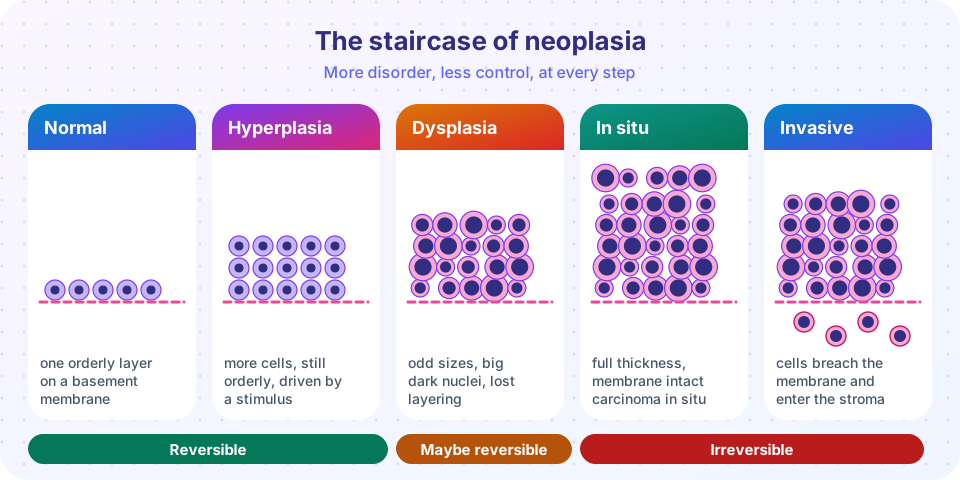
Neoplasia has many names, so build a map rather than a list. For every tumor you meet, ask three questions: what tissue did it come from, how does it behave (benign or malignant), and what is the mechanism (which gene, which cause). Draw the staircase from the picture above from memory at the end of each lesson. Keep a running list of exceptions, because pathology tests them. Finally, pay attention to the numbers, such as 30 doublings and the 3.5 g threshold in later chapters, because small quantitative anchors make large ideas easier to recall.
Try it
Press Run (or Ctrl + Enter) to see the result here.
Program input · what you'd type while the program runs
Type the answers before you press Run, one per line. Each time the program reads a line (with input()), it gets the next line from this box.
Press Run (or Ctrl + Enter) to see the result here.
Program input · what you'd type while the program runs
Type the answers before you press Run, one per line. Each time the program reads a line (with input()), it gets the next line from this box.
Check your understanding
Quick check · 3 questions
of 3 answered You scored / 3 · perfect!
-
1. Which statement best describes a neoplasm?
Hyperplasia needs its stimulus; neoplasia keeps going without it because the cells' own control has changed. -
2. Roughly how many doublings does one cell need to reach about a billion cells?
2^30 is just over a billion, so about 30 doublings. -
3. Which pair correctly describes grade and stage?
Grade is about cell appearance (differentiation); stage is about extent (size, nodes, distant spread).
Summary
- A neoplasm is an autonomous growth that persists after its trigger is gone.
- Cancer grows from one mutated cell whose descendants accumulate more changes under selection.
- Most of a tumor's life happens before it can be detected: about 30 doublings.
- This chapter covers names and growth, genes, and grading and staging.
Next: Names and growth
Track your progress
Create a free account to tick off lessons and pick up where you left off on any device.
of Pathology lessons completed