


















Lesson 43 of 46 · Projects and Practice
Practice problem sets with worked answers
Work through twelve problems on neoplasia, cardiovascular and respiratory, gut, kidney and endocrine, and infection and neurological pathology, with full worked answers.
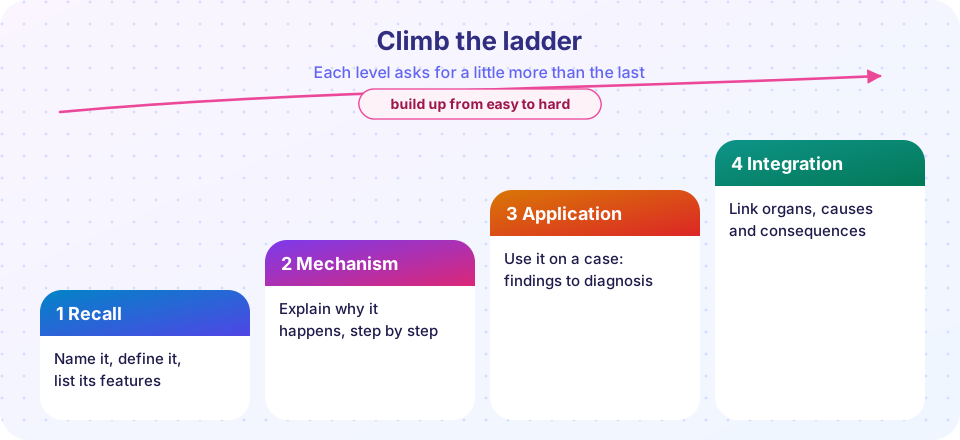
Reading is only the first half of learning. The second half is retrieving what you have read and using it, because effortful recall builds memory much better than rereading. This lesson gives you twelve problems arranged by chapter, from simple recall to integrated reasoning. Try each one on paper first. Then check the worked answers below, and use the code cells to test your arithmetic.
The problems mix calculation and explanation, because pathology uses both. Some are quantitative (how long does a tumor take to grow?), and some ask you to name a pattern or explain a mechanism.
Educational information only. The problems use simplified numbers and fictional scenarios. They are for study, not for diagnosis or treatment decisions.
What you will learn
- How to use retrieval practice on the material of chapters 5 to 8
- How to set up and solve the quantitative problems of the course
- How to write a short, complete explanation of a mechanism
Key terms
Retrieval practice: testing yourself instead of rereading.
Positive predictive value (PPV): the share of positive tests that are true positives.
FEV1/FVC: ratio used to separate obstructive from restrictive patterns.
Mean arterial pressure (MAP): average pressure in the arteries, approximately diastolic plus one third of the pulse pressure.
The problems
Set A: Neoplasia
- A tumor has a doubling time of 90 days. Assuming constant exponential growth, how many days does it take to grow from 10^6 to 10^9 cells?
- A hypothetical tumor marker has 80 percent sensitivity and 90 percent specificity. In a group where 2 percent of people have the cancer, what share of positive results are true positives?
- Name (a) a malignant tumor of cartilage and (b) a benign tumor of glandular epithelium. Then explain why the word "melanoma" is an exception to the usual naming rule.
Set B: Cardiovascular and respiratory
- A coronary artery's radius falls to half its normal value. By what factor does idealized flow fall, if the pressure drop is unchanged?
- Two patients have spirometry: Patient X has FEV1 2.0 L and FVC 3.5 L. Patient Y has FEV1 2.1 L and FVC 2.4 L with FVC at 60 percent of the predicted value. Compute each ratio and say which pattern each suggests.
- A blood pressure is 150/90 mmHg. Calculate the mean arterial pressure and the pulse pressure. Then explain two organ consequences of long-standing hypertension.
Set C: Gut, kidney and endocrine
- A creatinine of 2.0 mg/dL in a 60-year-old man gives roughly what eGFR using the equation in the kidney lesson? Which CKD stage band does it fall in?
- The kidneys filter about 180 L of plasma a day and produce 1.5 L of urine. What percentage of the filtered water is reabsorbed?
- A fasting glucose of 126 mg/dL equals how many mmol/L? Then explain in two sentences how type 1 and type 2 diabetes differ in mechanism.
Set D: Infection and the nervous system
- A bacterium doubles every 30 minutes under ideal conditions. How many cells come from one after 6 hours?
- A lumbar puncture shows many neutrophils, high protein and low glucose. What is the likely diagnosis, and what is the urgency?
- A patient has weakness that came on suddenly, and a scan shows a wedge of pale brain tissue in an arterial territory. Explain what happens to the tissue over the following weeks, and name the type of necrosis.
Check your own answers with code
Press Run (or Ctrl + Enter) to see the result here.
Program input · what you'd type while the program runs
Type the answers before you press Run, one per line. Each time the program reads a line (with input()), it gets the next line from this box.
Press Run (or Ctrl + Enter) to see the result here.
Program input · what you'd type while the program runs
Type the answers before you press Run, one per line. Each time the program reads a line (with input()), it gets the next line from this box.
Worked answers
1. Growth from 10^6 to 10^9 is a factor of 1,000, which needs log2(1000), about 9.97 doublings. At 90 days per doubling that is about 897 days, roughly 2.5 years. The lesson: the part of a tumor's life between 1 million and 1 billion cells is long, and then the last ten doublings come fast in clinical terms.
2. Imagine 10,000 people. With a prevalence of 2 percent, 200 have the cancer and 9,800 do not. The test finds 80 percent of the 200 (160 true positives) and falsely flags 10 percent of the 9,800 (980 false positives). So 160 of 1,140 positives are true, which is 14 percent. Low prevalence swamps a decent test with false alarms.
3. (a) Chondrosarcoma, a malignant mesenchymal tumor of cartilage. (b) Adenoma, a benign tumor of glandular epithelium. Melanoma is an exception because it ends in -oma but is malignant; it arises from melanocytes, and the name is historical.
4. Flow is proportional to r^4, so halving the radius reduces flow to (1/2)^4 = 1/16, about 6 percent of normal. Real arteries adjust, so this is an idealization, but it shows why a modest narrowing can limit flow during exertion.
5. Patient X: 2.0 / 3.5 = 0.57, which is below 0.7, so an obstructive pattern. Patient Y: 2.1 / 2.4 = 0.875, a normal or high ratio with low FVC, so a possible restrictive pattern, to be confirmed with lung volume measurements and imaging.
6. MAP = 90 + (150 - 90) / 3 = 110 mmHg; pulse pressure = 60 mmHg. Two consequences are concentric left ventricular hypertrophy (and heart failure risk) and hyaline arteriolosclerosis leading to nephrosclerosis; stroke and retinopathy are other answers.
7. The equation gives roughly 37 mL/min per 1.73 m², which falls in stage G3b (30 to 44). Run the cell to see the exact value. Note how a creatinine of 2.0 mg/dL, which a reader may think is only "a bit high," corresponds to a large loss of function.
8. The fraction excreted is 1.5 / 180, about 0.83 percent, so about 99.2 percent is reabsorbed.
9. 126 / 18.016 is about 7.0 mmol/L. In type 1 diabetes autoimmune destruction of beta cells leaves almost no insulin. In type 2 tissues respond poorly to insulin (resistance), and beta cells eventually fail to compensate.
10. Six hours is 12 doublings, so 2^12 = 4,096 cells. Real infections are limited by defenses, but unchecked growth is fast.
11. The pattern (neutrophils, high protein, low glucose) is bacterial meningitis, a medical emergency. Causes include Streptococcus pneumoniae and Neisseria meningitidis; complications include hydrocephalus, infarcts and sepsis.
12. This is an ischemic stroke. Brain infarcts undergo liquefactive necrosis: red neurons within a day, neutrophils at 1 to 3 days, macrophages over days and weeks, and finally a fluid-filled cavity surrounded by astrocytic gliosis. The surrounding penumbra may be salvageable if flow returns early.
How to use the problems well
- Space them out. Revisit a problem set after a day and again after a week. Spacing beats cramming.
- Say it aloud. If you cannot explain a mechanism in plain words, you do not yet own it.
- Write your own. Change the numbers in a problem and solve it again, or invent a case for a different organ.
- Keep an error log. A list of the mistakes you made shows which ideas need work.
Common misconceptions
- "If I understood it while reading, I will remember it." Recognition is easier than recall; test yourself.
- "A correct answer means I understand." Check that you can explain why each wrong option is wrong.
- "Quantitative problems are not pathology." Growth, predictive value and flow are the ways pathologists reason about risk and function.
Try it
Press Run (or Ctrl + Enter) to see the console output here.
No output.
Check your understanding
Quick check · 5 questions
of 5 answered You scored / 5 · perfect!
-
1. If a test has 90% sensitivity and 90% specificity, and prevalence is 1%, the PPV is roughly
Per 10,000 people: 90 true positives and 990 false positives, so PPV is 90/1,080, about 8 percent. -
2. Halving a vessel's radius reduces idealized flow to
Flow is proportional to r^4. -
3. A normal FEV1/FVC ratio with a low FVC suggests
Both volumes fall in proportion in restriction. -
4. A brain infarct heals by
The brain forms a cystic cavity surrounded by astrocytic scar. -
5. Retrieval practice means
Recall effort strengthens memory.
Summary
- Practice by retrieval, with problems on growth, test accuracy, flow, spirometry, pressure, kidney function, glucose and infection.
- Worked answers show how each quantitative idea reappears in clinical reasoning.
- Space your practice, explain aloud, write new problems and keep an error log.
Next: Glossary
Track your progress
Create a free account to tick off lessons and pick up where you left off on any device.
of Pathology lessons completed