


















Lesson 1 of 46 · Getting Started
Course Map: How This Pathology Course Works
Start here: what pathology is, who this course suits, the prerequisites, a nine-chapter route map and a study method that makes disease mechanisms stick.
Pathology is the study of disease: what goes wrong in cells, tissues and organs, why it goes wrong, and how those changes produce the symptoms a person feels. It is sometimes called the bridge between basic science and clinical medicine, because it takes the anatomy, physiology and biochemistry you already know and asks what happens when they fail. If you can explain why a blocked coronary artery kills heart muscle within hours, or why a long-standing infection leaves a scar, you are thinking like a pathologist.
This course is a guided tour of those ideas. It is written for curious learners of about 16 and up, for students starting a health-science, biology or pre-medical program, and for adults who want to understand diagnoses they read about. Each lesson explains the mechanism, shows a picture, lets you run a small simulation, and checks your understanding.
Educational information only. This course explains how disease works in general. It does not diagnose, treat or give advice about any person's health. If you are worried about a symptom or a test result, talk to a qualified health professional. Interactive demonstrations are simplified models for learning, never medical tests.
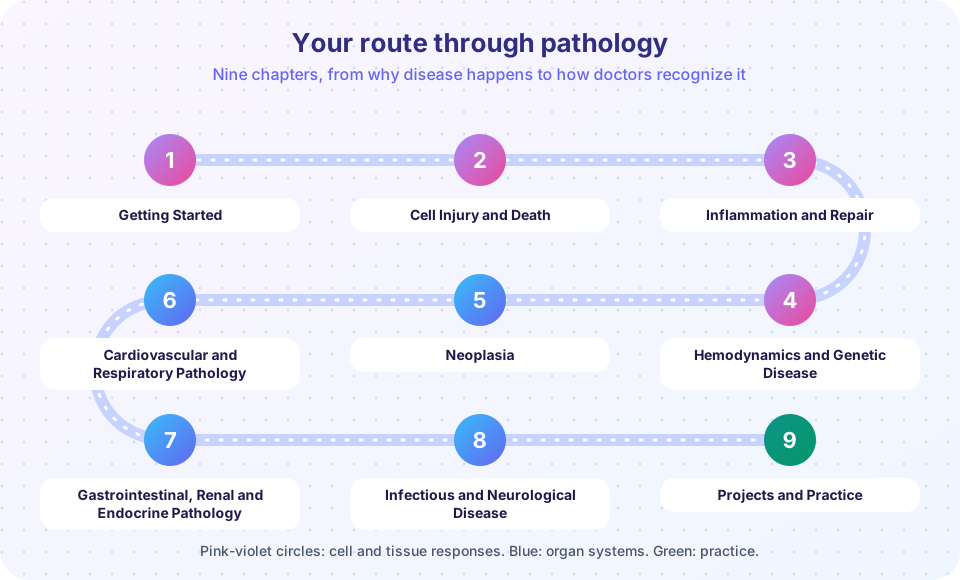
What you will learn
- What topics the nine chapters cover and how they build on each other.
- Which background knowledge helps, and what you can safely learn as you go.
- A study method based on mechanisms, not memorized lists.
- How the interactive blocks, quizzes and illustrations are meant to be used.
Key terms
Pathology: the scientific study of disease, its causes, mechanisms, structural changes and consequences.
Etiology: the cause of a disease (or the set of causes and risk factors).
Pathogenesis: the sequence of events by which the cause produces the disease.
Morphology: the structural appearance of diseased tissue, seen with the naked eye (gross) or the microscope (microscopic).
Lesion: any abnormal change in a tissue, such as an ulcer, a scar or a tumor.
The nine chapters at a glance
Foundations
Cells under stress
Defense and repair
Blood and genes
Cancer and organs
Infection, brain, practice
Chapters 1 to 4 are the engine of the whole course. Chapter 2 shows how a single cell responds to stress, adapts, or dies. Chapter 3 shows how the body mobilizes defenses and repairs damage. Chapter 4 covers blood flow problems and the logic of inherited disease. Once you know these, every organ-system chapter is a variation on a theme you have already met.
Prerequisites
You do not need medical training. Helpful background, roughly in order of importance:
- Basic cell biology: membrane, nucleus, mitochondria, endoplasmic reticulum, DNA. The track on cells and genetics covers this if you need a refresher.
- Basic anatomy and physiology: the names of the major organs and what they do.
- Comfort with simple numbers and graphs: percentages, ratios and reading a curve. The simulations use only these.
If something is missing, do not stop. Look it up, note it, and keep moving. Pathology revisits the same ideas many times, so each pass strengthens the last.
A study method that works
Most people try to memorize pathology as lists: "causes of edema", "types of necrosis". Lists are fragile. Mechanisms are durable. Whenever you meet a disease, ask four questions in order.
- Etiology: what starts it?
- Pathogenesis: what chain of events follows?
- Morphology: what would the tissue look like, to the eye and under the microscope?
- Clinical consequences: what does the patient notice, and what would tests show?
If you can tell that story from start to finish, the list of facts falls into place by itself. For example, if you know that a blood clot stops oxygen delivery, and that heart muscle needs oxygen to make ATP, you can predict that cells will swell, then die, and that the heart will release enzymes into the blood. That is the logic of a heart attack, and you did not memorize it.
After every lesson, close the page and write the four-question story for one example from memory. If you stall, that is the exact place to reread.
How to use the interactive parts
Every lesson has a Try it section. The blocks run in your browser. Python blocks run in a real Python interpreter with plotting, so you can change a number and rerun. A few blocks are plain JavaScript or small web widgets. Each one is labelled as a demonstration: they model an idea (a growth curve, a predictive-value calculation), they do not diagnose anything, and the numbers are teaching values rather than clinical data.
Press Run (or Ctrl + Enter) to see the result here.
Program input · what you'd type while the program runs
Type the answers before you press Run, one per line. Each time the program reads a line (with input()), it gets the next line from this box.
Press Run (or Ctrl + Enter) to see the console output here.
No output.
Check your understanding
Quick check · 4 questions
of 4 answered You scored / 4 · perfect!
-
1. Which sequence matches the four questions to ask about every disease?
The study method moves from cause to mechanism to appearance to effect on the patient. -
2. What does the word morphology mean in pathology?
Morphology is what the lesion looks like, grossly or under the microscope. -
3. Why does the course teach cell injury, inflammation and hemodynamics first?
Every organ disease is a variation on cell injury, inflammation, blood-flow or genetic mechanisms. -
4. What is the purpose of the interactive blocks?
They are labelled demonstrations that help you see how an idea behaves; they are never diagnostic.
Summary
- Pathology links basic science to clinical care by explaining how and why disease arises.
- The course has nine chapters: foundations, cell injury, inflammation and repair, hemodynamics and genetics, neoplasia, organ systems, infection and the nervous system, and practice.
- You need only basic biology; the rest is explained as you go.
- Learn mechanisms through the four questions: etiology, pathogenesis, morphology, clinical consequences.
- All interactive blocks are demonstrations, and this course never gives medical advice.
Next: What Is Pathology?
Track your progress
Create a free account to tick off lessons and pick up where you left off on any device.
of Pathology lessons completed