


















Lesson 40 of 46 · Infectious and Neurological Disease
Chapter 8 review: Infectious and neurological disease
Review inflammatory patterns, tuberculosis, sepsis, stroke, dementia, meningitis, multiple sclerosis and brain tumors with a summary picture, table and ten-question quiz.
This chapter put two ideas next to each other: how tissue reacts to a living invader, and how the brain, with its unusual rules, is injured by lack of blood, abnormal proteins, infection, immune attack or growth. Use the picture and table for a quick check, and read the "connections" section: the strongest answers in an exam, and the best clinical thinking, link a pattern to a mechanism.
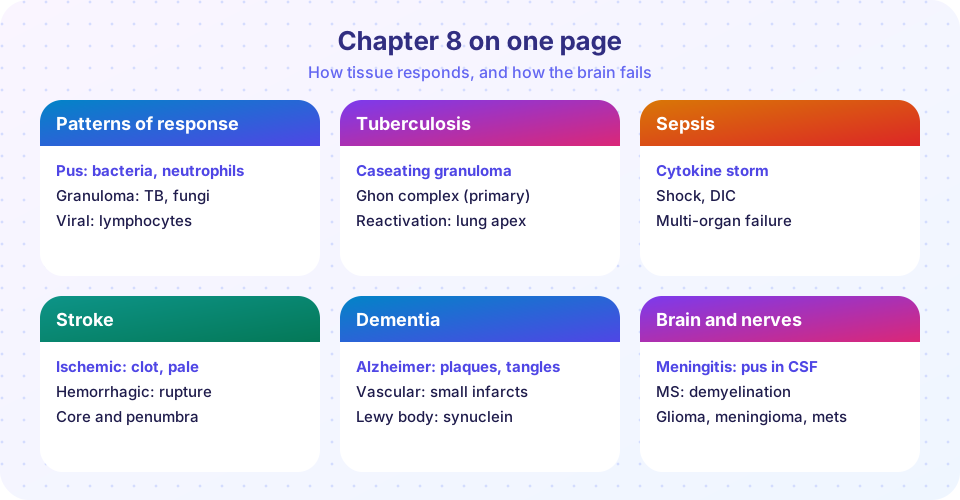
What you will learn
- How to match tissue patterns and brain lesions to their causes
- Which features separate similar conditions
- How the lessons connect
Key terms
Granuloma: macrophage aggregate walling off a persistent agent. Sepsis: organ dysfunction from a dysregulated response to infection. Penumbra: salvageable tissue around an infarct. Plaque (MS): demyelinated lesion. Herniation: displacement of brain under pressure.
Recap table
| Topic | Key facts | Lesson |
|---|---|---|
| Pyogenic infection | Neutrophils, liquefactive necrosis, abscess | Host response |
| Viral infection | Lymphocytes, inclusions, giant cells, koilocytes | Host response |
| Granuloma and TB | Interferon-gamma; caseation; Ghon complex; apical reactivation | Host response |
| Sepsis | Cytokines, vasodilation, leak, DIC, shock, organ failure | Host response |
| Ischemic stroke | Thrombus, embolus, lacune, watershed; liquefactive necrosis; penumbra | Stroke and dementia |
| Hemorrhagic stroke | Hypertensive, amyloid angiopathy, berry aneurysm; epidural and subdural | Stroke and dementia |
| Alzheimer disease | Amyloid plaques, tau tangles, hippocampal onset, atrophy | Stroke and dementia |
| Other degeneration | Lewy bodies, Parkinson (substantia nigra), Huntington (CAG), CJD (prion) | Stroke and dementia |
| CNS infection | Meningitis by age; HSV-1 encephalitis; abscess | CNS infection and tumors |
| Multiple sclerosis | Autoimmune demyelination; plaques; relapsing-remitting | CNS infection and tumors |
| Brain tumors | Glioblastoma, meningioma, medulloblastoma; metastases most common | CNS infection and tumors |
| Intracranial pressure | Monro-Kellie; herniation syndromes | CNS infection and tumors |
Connections
- Necrosis differs by organ. Heart muscle undergoes coagulative necrosis, the brain liquefies, TB caseates, and pyogenic infection forms pus. The type of necrosis is itself a clue.
- Immune responses help and harm. Granulomas contain TB but scar the lung; the cytokines of sepsis cause shock; MS is an immune response gone wrong.
- Misfolded proteins link several diseases. Amyloid and tau (Alzheimer), alpha-synuclein (Lewy body disease), huntingtin, and prions all show that abnormal protein shape can spread damage.
- The closed skull is a shared constraint. Stroke swelling, abscess, hemorrhage, meningitis and tumor all converge on raised pressure.
Common misconceptions
- "All infections make pus." Viral and granulomatous infections have very different tissue patterns.
- "Dementia and Alzheimer disease are the same." Alzheimer disease is one cause of dementia.
- "A stroke always means a clot." A minority of strokes are hemorrhagic, caused by bleeding.
Questions to explain in your own words
Answer each in two or three sentences.
- Why do the same macrophages that contain tuberculosis also damage the lung?
- In sepsis, which part of the harm comes from the microbe and which from the host?
- Why is a brain infarct different from a heart infarct under the microscope?
- What is the penumbra and why does it matter?
- How does the rigid skull turn a growing mass into an emergency?
Compare your answers with the recap table and the chapter lessons, and then try the quiz.
Try it
Press Run (or Ctrl + Enter) to see the console output here.
No output.
Press Run (or Ctrl + Enter) to see the result here.
Program input · what you'd type while the program runs
Type the answers before you press Run, one per line. Each time the program reads a line (with input()), it gets the next line from this box.
Check your understanding
Quick check · 10 questions
of 10 answered You scored / 10 · perfect!
-
1. Which type of necrosis is typical of a brain infarct?
Brain tissue liquefies after infarction. -
2. Caseating granulomas with apical cavitation suggest
Reactivation TB typically cavitates at the lung apex. -
3. Which is NOT a feature of sepsis?
Blood pressure falls in sepsis and septic shock. -
4. Plaques of Alzheimer disease are made of
Amyloid plaques are extracellular deposits of beta-amyloid. -
5. Which is the main cause of hemorrhage into deep brain structures such as the basal ganglia?
Hypertensive damage to small penetrating arteries is the commonest cause. -
6. A crescent-shaped collection of blood from torn bridging veins is a
Subdural hematomas are crescent shaped; epidurals are lens shaped. -
7. In bacterial meningitis the CSF typically shows
This is the classic bacterial pattern. -
8. Multiple sclerosis is best described as
MS is caused by immune attack on CNS myelin. -
9. The Monro-Kellie doctrine says that
Skull volume is fixed; once compensation is used up, pressure rises sharply. -
10. Huntington disease is caused by
An expanded CAG repeat in the huntingtin gene causes disease with 50 percent transmission.
Summary
- Different infections produce different tissue patterns; granulomas and sepsis are the two special cases.
- Stroke is vascular; dementia is mostly protein deposition and neuron loss; MS is immune attack on myelin.
- Brain tumors are dangerous by location and pressure.
- The type of necrosis, the cell type and the location together narrow the diagnosis.
Track your progress
Create a free account to tick off lessons and pick up where you left off on any device.
of Pathology lessons completed