


















Lesson 16 of 46 · Hemodynamics and Genetic Disease
Chapter 4 Overview: Hemodynamics and Genetic Disease
Preview chapter four: edema, hemorrhage, thrombosis, embolism, infarction and shock, then how inherited mutations cause disease in families.
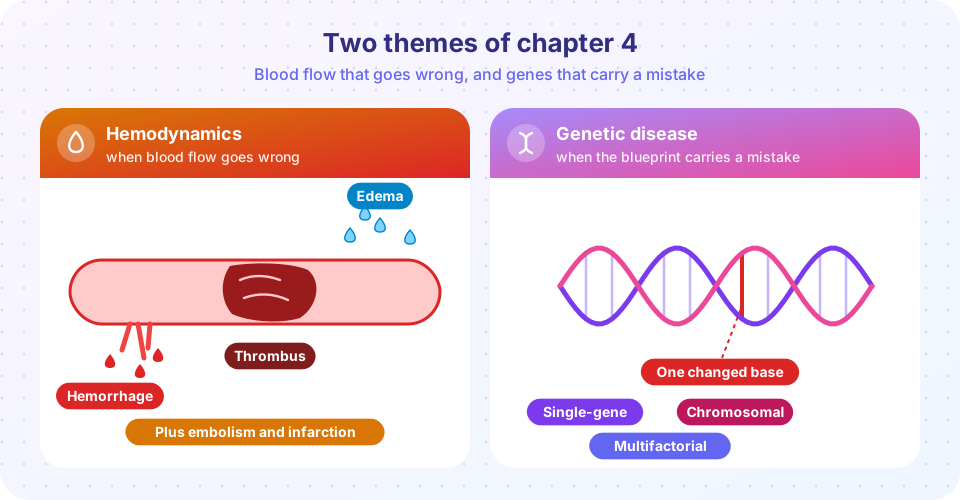
So far the course has looked at what happens inside a cell and in the tissue around it. This chapter widens the view in two directions. First, it looks at the blood: how fluid moves between vessels and tissues, why blood sometimes clots where it should not or bleeds where it should not, and what happens when an organ loses its supply. Together these topics are called hemodynamics, from the Greek words for blood and force. Second, it looks at genes: how a change in the DNA can cause disease and why some diseases run in families.
The two themes fit together in a practical way. A person with an inherited tendency to clot has a genetic disease that appears as a blood-flow problem. And almost every organ-system disease later in the course involves a vessel, a gene or both.
What you will learn
- What hemodynamics covers and why blood must stay liquid in vessels yet clot at a wound.
- The conditions that follow from failed fluid balance, clotting or perfusion.
- How genetic disease is classified.
- How the lessons in this chapter fit together.
Key terms
Hemostasis: the processes that stop bleeding at a wound while keeping blood liquid elsewhere.
Thrombosis: formation of a blood clot (thrombus) inside an intact vessel.
Embolism: a mass carried in the blood from one place to lodge in another.
Infarction: tissue death caused by an interrupted blood supply.
Mutation: a lasting change in DNA sequence.
The big picture
Fluid must stay in balance
Clot or bleed
Supply cut off
Genes
Part 1: hemodynamics
Why blood flow matters
Every cell needs a steady supply of oxygen, so any change in flow can injure tissue. The body maintains a delicate balance. Blood must remain fluid inside vessels, but it must clot quickly at an injury. The fluid part of the blood must stay in the vessels, but must also exchange nutrients and wastes with the tissue. When one of these balances fails, hemodynamic disorders appear.
What the lessons cover
- Edema and hemorrhage covers excess fluid in tissues (edema), the Starling forces behind it, congestion, and bleeding with its clinical forms.
- Thrombosis, embolism and infarction covers how clots form (Virchow's triad), what happens when they travel, how tissues die when a supply is cut off, and shock.
Part 2: genetic disease
Genetic diseases are caused by mutations in DNA. Some mutations are inherited from a parent (germline), and appear in every cell of the body. Others arise in a body cell during life (somatic), as in cancers, and are not passed to children. The classification you will use is:
| Type | Cause | Examples |
|---|---|---|
| Single-gene (Mendelian) | A mutation in one gene follows a predictable inheritance pattern | Cystic fibrosis, sickle cell disease, Huntington disease |
| Chromosomal | Extra, missing or rearranged chromosomes | Down syndrome (trisomy 21), Turner syndrome |
| Multifactorial | Many genes plus environmental factors | Type 2 diabetes, most heart disease, many birth defects |
| Mitochondrial | Mutations in mitochondrial DNA, inherited from the mother | Some forms of muscle and nerve disease |
The lesson on genetic disease explains how mutations change proteins, what the main inheritance patterns look like in a family, and how new diagnostic technologies change medicine. A chapter review ends the unit: chapter 4 review.
Common misconceptions
- "Genetic means inherited." Many mutations arise during life (such as those that cause cancer) and are not inherited. Many inherited diseases also need environmental triggers.
- "Edema is a disease." Edema is a sign that can come from many causes, from a sprained ankle to heart failure.
- "A clot is always bad." Clotting is essential at a wound. The disease is a clot in the wrong place or at the wrong time.
Try it
The first block shows where blood is found in the body, using the commonly quoted textbook proportions. It illustrates why veins act as the reservoir, and why changes in venous pressure matter in disorders such as edema and shock.
Press Run (or Ctrl + Enter) to see the result here.
Program input · what you'd type while the program runs
Type the answers before you press Run, one per line. Each time the program reads a line (with input()), it gets the next line from this box.
The second block lists conditions and the chapter-4 category they belong to. Add your own as you meet them.
Press Run (or Ctrl + Enter) to see the console output here.
No output.
Check your understanding
Quick check · 4 questions
of 4 answered You scored / 4 · perfect!
-
1. What does hemodynamics study?
Hemodynamics covers fluid balance, clotting, bleeding and perfusion. -
2. Which describes a thrombus?
Thrombosis is clot formation in the vessel; an embolus is a traveling mass. -
3. A mutation in a body cell that is not passed to children is:
Somatic mutations arise during life and are not inherited, as in most cancers. -
4. Down syndrome is an example of which type of genetic disease?
It results from an extra copy of chromosome 21.
Summary
- Hemodynamics covers fluid balance, clotting, bleeding, perfusion and the death of tissue when supply fails.
- Genetic diseases are classified as single-gene, chromosomal, multifactorial and mitochondrial.
- Germline mutations are inherited; somatic mutations arise during life.
- The three lessons ahead cover edema and hemorrhage, thrombosis and infarction, and genetic disease.
Next: Edema and Hemorrhage
Track your progress
Create a free account to tick off lessons and pick up where you left off on any device.
of Pathology lessons completed