


















Lesson 2 of 46 · Getting Started
What Is Machine Design?
Learn what machine designers actually decide, how design differs from analysis, the families of machine elements and why every design is a trade-off between strength, weight and cost.
Open any machine and you find the same small cast of parts: shafts that carry torque, gears that change speed, bearings that let things turn, bolts that hold things together, springs that store energy. A washing machine, a bicycle, a wind turbine and a jet engine all use them. Machine design is the discipline of choosing, sizing and arranging those parts so that the whole machine does its job safely, for as long as it should, at a price someone will pay.
The key word is design. Analysis starts with a finished part and asks "will it hold?". Design starts with a need and asks "what should exist?". Analysis has one right answer. Design has many acceptable answers, and the designer must pick one and defend it. This lesson shows how that choosing works.
What you will learn
- The difference between design and analysis, and why design problems are open-ended.
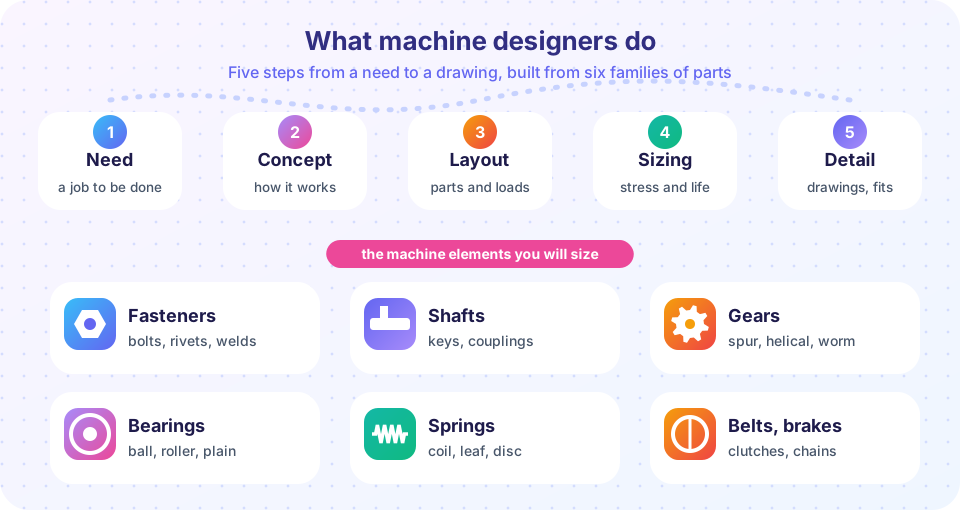
- The five stages from a need to a detailed design.
- The main families of machine elements and what each one does.
- Why every design is a trade-off, and how to compare options with a weighted matrix.
Key terms
- Design: creating a new thing (or a new version of one) that meets a stated need.
- Analysis: calculating how an existing or proposed design behaves.
- Specification: the measurable requirements a design must meet (load, speed, life, cost, size).
- Trade-off: improving one property (for example strength) at the expense of another (weight or cost).
- Failure: any way a part stops doing its job, including breaking, bending, wearing out or becoming too noisy.
Design versus analysis
Suppose someone hands you a steel shaft 30 mm in diameter and asks whether it can carry 200 N·m of torque. That is an analysis problem. You compute the shear stress τ = 16 T / (π d³), compare it with the material strength, and answer yes or no. There is exactly one correct result.
Now suppose someone says: "Transmit 7.5 kW from this motor to that pulley." That is a design problem. You must decide the shaft material, the diameter, how it is supported, how the pulley is attached, how long it must last and what it may cost. The torque is only one input. A thinner shaft with a stronger and more expensive steel may do the job; so may a thicker shaft in a cheaper steel. Several answers work, and good judgment decides between them.
In practice the two activities alternate. You guess a design, analyze it, find it too weak or too heavy, change it and analyze again. That loop is the heart of the profession, and we study it in detail in chapter 2.
The five stages of a design
- Need. Someone wants something done: lift a load, cut a metal bar, pump water. A good need statement says what must happen, not how. "Raise a 500 kg load 3 m in 20 seconds" is better than "build a winch".
- Concept. You sketch different ways to meet the need: a winch, a hydraulic jack, a block and tackle. You compare them roughly and keep the most promising.
- Layout. You draw the chosen concept to scale, decide where shafts, gears and bearings go, and estimate the forces on each part.
- Sizing. You calculate stresses, deflections and lives, and choose dimensions and materials so each part meets its requirements with a margin of safety.
- Detail. You produce the drawings: exact dimensions, tolerances, fits, surface finishes and materials, so that someone else can make the part.
Most beginners jump straight to stage 4, because that is where the formulas are. Experienced designers spend most of their effort in stages 1 to 3, because a poor concept cannot be rescued by careful sizing.
The families of machine elements
Machine elements are the standard parts you combine. The course follows this grouping.
| Family | What it does | Typical examples |
|---|---|---|
| Fasteners | Hold parts together | Bolts, screws, rivets, welds, keys |
| Shafts and couplings | Carry torque and rotation | Drive shafts, axles, flexible couplings |
| Gears | Change speed, torque and direction | Spur, helical, bevel and worm gears |
| Bearings | Support rotating parts with low friction | Ball, roller and plain bearings |
| Springs | Store energy, absorb shock, apply force | Coil, leaf and disc springs |
| Belts, chains, clutches, brakes | Transmit power, connect, stop | V-belts, roller chains, disc brakes |
Notice how the elements depend on each other. A gear needs a shaft; a shaft needs bearings; the bearings need a housing held by bolts. Changing the shaft diameter changes the bearing choice, which changes the housing, which changes the bolts. That chain of dependencies is why design is iterative.
Every design is a trade-off
A designer balances several goals that pull against each other.
- Strength and safety push parts to be larger and made of better steel.
- Weight pushes the other way, especially for vehicles and aircraft where every kilogram costs fuel.
- Cost limits material choices and manufacturing methods.
- Size and shape may be fixed by the space available.
- Life requires resistance to wear and fatigue, usually more material.
- Manufacturability means the part must be makeable with the machines you have.
No design wins on every goal. A safety factor that is too low risks failure; one that is too high wastes material and money. The skill is to find the point where all the requirements are just met.
A simple way to compare concepts is a weighted decision matrix. List the criteria, give each a weight showing its importance, score each concept from 1 to 5 on every criterion, multiply and add. The result is not a law of nature, but it forces you to write down your reasoning, and it exposes disagreements early.
Press Run (or Ctrl + Enter) to see the result here.
Program input · what you'd type while the program runs
Type the answers before you press Run, one per line. Each time the program reads a line (with input()), it gets the next line from this box.
Change a weight, for example make cost matter more, and see how the winner changes. That sensitivity is exactly why the weights must be argued about openly.
A trade-off you can feel
A solid round steel shaft transmits torque T. The shear stress in it is τ = 16 T / (π d³). Doubling the diameter divides the stress by eight, but the mass per metre grows with the square of the diameter, so it quadruples. The widget below lets you see both sides at once for a 47.7 N·m torque and a low-carbon steel with yield strength 370 MPa (the shear yield strength is about 0.577 of that).
Slide the diameter down until the safety factor falls toward 1.5. The shaft gets light, but you are now close to the edge. Slide it up and the shaft is very safe but heavy and expensive. The design lies somewhere between, and fatigue (chapter 3) will move that point.
Where parts really fail
Designers think in terms of failure modes, because every formula in this course protects against one of them.
- Yielding: the part bends permanently. Protected by comparing stress with yield strength.
- Fracture: the part breaks, especially brittle materials like cast iron.
- Fatigue: a crack grows under repeated loading and the part breaks suddenly. By far the most common failure in rotating machinery.
- Wear and surface failure: gear teeth pit, bearings spall, brake pads wear away.
- Buckling and excessive deflection: a slender part bows, or a shaft bends enough to ruin a gear mesh.
- Loosening and fretting: bolts relax, joints move.
When you read a design problem, ask first: how can this fail? The calculation follows from the answer.
Common misconceptions
- "The formulas give the design." The formulas check a guess. You must first choose a layout, a material and a rough size.
- "A higher safety factor is always better." Excessive safety factors waste material and weight, and sometimes make a part worse (a bigger shaft needs a bigger bearing and housing).
- "Strong and tough are the same." A strong material resists high stress; a tough one absorbs energy before breaking. Glass is strong in compression but not tough.
Check your understanding
Quick check · 5 questions
of 5 answered You scored / 5 · perfect!
-
1. Which task is a design problem rather than an analysis problem?
Design starts from a need and leaves materials, sizes and layout open. The other three start from a defined part. -
2. In which stage does most of the effort go for experienced designers?
A poor concept cannot be fixed by careful sizing, so experienced designers invest in the early stages. -
3. A shaft's diameter doubles. How does its shear stress under the same torque change?
Stress is16 T / (π d³). Doubling d multiplies the denominator by 8, so stress becomes one eighth. -
4. What is the purpose of a weighted decision matrix?
The matrix makes criteria and their importance explicit, so decisions can be discussed and challenged. -
5. Which is the most common cause of failure in rotating machinery?
Rotating parts see stress that reverses every turn. Cracks grow slowly and the part fails suddenly, which is why chapter 3 devotes so much time to fatigue.
Summary
- Design starts from a need and has many acceptable answers; analysis checks a given part.
- The five stages are need, concept, layout, sizing and detail, repeated as a loop.
- Machine elements fall into families: fasteners, shafts, gears, bearings, springs, and belts, brakes and clutches.
- Every design trades strength, weight, cost, size, life and manufacturability.
- Think in failure modes: yielding, fracture, fatigue, wear, deflection, loosening.
Track your progress
Create a free account to tick off lessons and pick up where you left off on any device.
of Machine Design lessons completed