


















Lesson 45 of 46 · Projects and Practice
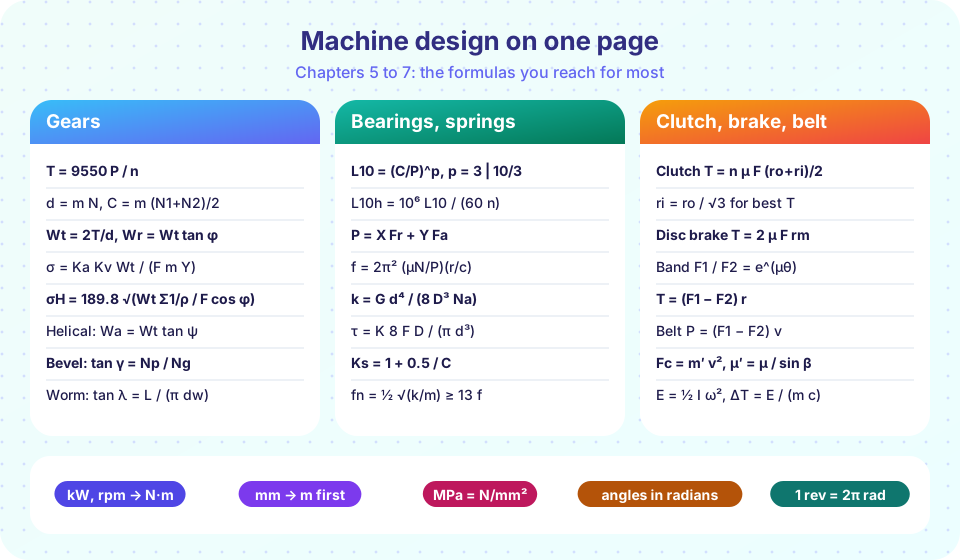
Cheat sheet: chapters 5 to 8 in one page
A one-page recap of the key formulas and typical values for gears, bearings, springs, clutches, brakes, belts and design checks, with a reusable Python formula library.
This page is the whole second half of the course on one sheet. It is not a replacement for understanding: a formula without its meaning is dangerous. But when you are in the middle of a design and need to know whether it is 9550 P / n or 9550 n / P, or what Y and Kv were called, you want the formula at hand. Print this page, keep it next to your calculator and use the links to the lessons for the reasoning.
What you will learn
- Where each of the main formulas of chapters 5 to 8 is and when it applies.
- Typical values to sanity check your numbers.
- How to keep a small formula library as code.
Key terms
- Unit consistency: using millimeters, newtons and MPa together (N/mm² = MPa), or meters, newtons and pascals together, but never mixing them.
- Typical value: a value for orientation, not for design. Take real values from standards and catalogs.
Gears (chapter 5)
| What | Formula |
|---|---|
| Torque from power | T = 9550 P / n (kW, rpm, N·m) |
| Pitch diameter | d = m N |
| Center distance | C = m (N1 + N2) / 2 |
| Tip / root diameter | da = m (N + 2), df = m (N − 2.5) |
| Pitch-line speed | v = π d n / 60 (d in m, v in m/s) |
| Tooth forces | Wt = 2T / d, Wr = Wt tan φ, W = Wt / cos φ |
| Contact ratio | [√(ra1² − rb1²) + √(ra2² − rb2²) − C sin φ] / (π m cos φ) |
| Minimum teeth (20°) | 2 / sin² φ ≈ 17 |
| Lewis bending | σ = Ka Kv Wt / (F m Y), Kv = (6.1 + v) / 6.1 |
| Hertz contact | σH = 189.8 √[(Wt/(F cos φ))(1/ρ1 + 1/ρ2)] MPa, ρ = d sin φ / 2 |
| Helical | d = mn N / cos ψ, Wr = Wt tan φn / cos ψ, Wa = Wt tan ψ |
| Bevel | tan γp = Np / Ng, Wr = Wt tan φ cos γ, Wa = Wt tan φ sin γ |
| Worm | ratio Ng / Nw, tan λ = L / (π dw), η = (cos φn − μ tan λ)/(cos φn + μ / tan λ), self-locking if μ ≥ cos φn tan λ |
Bearings and springs (chapter 6)
| What | Formula |
|---|---|
| Rolling bearing life | L10 = (C / P)^p, p = 3 balls, 10/3 rollers (million rev) |
| Life in hours | L10h = 10⁶ L10 / (60 n) |
| Required rating | C = P L10^(1/p) |
| Equivalent load | P = X Fr + Y Fa (use catalog values) |
| Reliability | Ln = a1 L10; a1 = 1, 0.64, 0.55, 0.47, 0.37, 0.25 at 90, 95, 96, 97, 98, 99 % |
| Journal pressure | P = W / (2 r l) |
| Petroff | f = 2π² (μN / P)(r / c), T = f W r, power T ω (N in rev/s, SI units) |
| Sommerfeld number | S = (r/c)² μN / P |
| Spring rate | k = G d⁴ / (8 D³ Na); series 1/k = Σ 1/ki; parallel k = Σ ki |
| Spring stress | τ = K 8 F D / (π d³); Ks = 1 + 0.5/C; K_B = (4C + 2)/(4C − 3) |
| Music wire | Sut = 2211 / d^0.145 MPa (d in mm); Ssy ≈ 0.45 Sut |
| Solid / free length | squared and ground: Ls = Nt d, Nt = Na + 2; L0 = Ls + (1 + ξ) y, ξ ≈ 0.15 |
| Surge | fn = ½ √(k / m); keep fn ≥ 13 f_operating |
Clutches, brakes and belts (chapter 7)
| What | Formula |
|---|---|
| Clutch, uniform wear | F = 2π pmax ri (ro − ri), T = n μ F (ro + ri) / 2; best ri = ro / √3 |
| Clutch, uniform pressure | T = n (2/3) μ F (ro³ − ri³) / (ro² − ri²) |
| Disc brake | T = 2 μ F rm |
| Block brake | T = μ N r, Fa a = N (b ∓ μ c); locks if b ≤ μ c |
| Band brake | F1/F2 = e^(μθ), T = (F1 − F2) r, p_max = F1 / (w r) |
| Belt geometry | sin α = (D − d)/(2C), θ = π ∓ 2α, L = 2C + π(D + d)/2 + (D − d)²/(4C) |
| Belt tensions | (F1 − Fc)/(F2 − Fc) = e^(μθ), Fc = m′ v², P = (F1 − F2) v |
| V-belt | μ′ = μ / sin β (β = half the groove angle) |
| Best belt speed | v = √(F1 / (3 m′)) |
| Energy and heat | E = ½ I ω² or ½ m v²; ΔT = E / (m c); engagement E = Tc ω t / 2 |
| Slip time | t = I ω / (Tc − TL) |
Typical values for sanity checks
| Quantity | Typical value |
|---|---|
| Gear mesh efficiency (spur, oil) | 0.97 to 0.99 |
| Worm drive efficiency | 0.4 to 0.9 (depends on lead angle) |
| V-belt efficiency | 0.93 to 0.98 |
| Pitch-line speed, splash lubrication | below about 12 to 15 m/s |
| Contact ratio of spur gears | 1.4 to 1.8 |
| Dry friction, organic lining | 0.25 to 0.4 |
| Oil-immersed clutch | 0.05 to 0.15 |
| Belt on cast iron pulley | about 0.3 |
Journal bearing clearance ratio c / r |
about 0.001 |
| Spring index | 4 to 12 |
| Safety factors (well known loads) | 1.2 to 1.5 |
| Required bearing life | 8,000 to 60,000 h depending on duty |
Try it
The first TryIt turns the cheat sheet into a small Python library. Import-style functions with units in their names are easier to reuse than loose formulas. Copy the functions into your own script and test them against the worked examples of the course.
Press Run (or Ctrl + Enter) to see the result here.
Program input · what you'd type while the program runs
Type the answers before you press Run, one per line. Each time the program reads a line (with input()), it gets the next line from this box.
The second TryIt is a converter between power, speed, torque and tooth force. Change a slider and read the others.
Check your understanding
Quick check · 5 questions
of 5 answered You scored / 5 · perfect!
-
1. Which formula gives the torque in N·m from power in kW and speed in rpm?
Torque is power divided by angular speed. The constant 9550 equals 60000 / 2π. -
2. Which of these is NOT a check on gear teeth?
The Petroff equation belongs to journal bearings. -
3. What does the capstan equation relate?
F1 / F2 = e^(μθ) links the two tensions of a band or belt. -
4. A spring has d = 2 mm and D = 20 mm. Is its index in the normal range?
C = D / d = 10, which is within the usual range of 4 to 12. -
5. Which relation gives the life in hours of a bearing from L10 in million revolutions?
Revolutions divided by revolutions per hour (60 n) give hours.
Summary
- One page carries the formulas for gears, bearings, springs, clutches, brakes and belts.
- Use consistent units and sanity check with typical values.
- A small formula library in code makes repeated checks quick, and tests itself against worked examples.
- Go back to the lessons for the meaning and limits of each formula.
Next: Further study
Track your progress
Create a free account to tick off lessons and pick up where you left off on any device.
of Machine Design lessons completed