


















Lesson 35 of 46 · Brakes, Clutches and Belts
Belt drives
Design flat and V-belt drives: belt length, wrap angle, tight and slack tensions with centrifugal effect, the V-belt wedge, shaft load and the speed for maximum power.
A belt drive carries power between two shafts that are too far apart for gears. A loop of belt runs around two pulleys, and friction between the belt and the pulleys does the job. Belts are quiet, smooth, forgiving of misalignment and shock, and cheap, and they can slip safely in an overload, which protects the machine. You find them driving the fans of cars, the compressor of an air conditioner, washing machines, lathes, the farm machinery of every country and the conveyors in factories.
You already know the key equation. A belt is a band wrapped around a drum, and the capstan equation F1 / F2 = e^(μθ) from the previous lesson tells you how its tensions relate. What is new is that a belt is a thing that runs: it has mass, so it is subject to centrifugal force at speed, and the belt has to be wrapped around two pulleys of different size, so the wrap angles are not equal.
What you will learn
- Calculate the belt length and the wrap angle of an open drive.
- Find the tight and slack tensions, including the centrifugal tension.
- Explain why a V-belt carries more power than a flat belt of the same size.
- Compute the shaft load and the speed at which a belt transmits the most power.
Key terms
- Wrap (contact) angle
θ: the angle of the pulley covered by the belt. The small pulley has the smaller wrap angle. - Centrifugal tension
Fc = m′ v²: the tension that the belt's own mass creates at speed (m′is the mass per meter,vthe belt speed). - Groove angle
2β: the full angle of a V-belt groove, typically about 34° to 40°. - Creep: the small slip that happens because the belt stretches differently on the tight and the slack side.
Belt types
| Type | How it grips | Typical features |
|---|---|---|
| Flat belt | Friction on a smooth pulley | Smooth, quiet, high speed, needs high tension and wrap |
| V-belt | Friction, wedged in a groove | Compact, carries much more torque, most common industrial belt |
| Ribbed (poly-V) belt | Several small V ribs | Flexible, high speed, small pulleys (car accessory drives) |
| Synchronous (timing) belt | Teeth engage pulley teeth | No slip, exact speed ratio, needs less tension |
Friction belts slip a little (about 1 to 2 percent), so the speed ratio is only approximately D/d. If the exact ratio matters, as in the camshaft drive of an engine, use a toothed belt or a chain.
Geometry
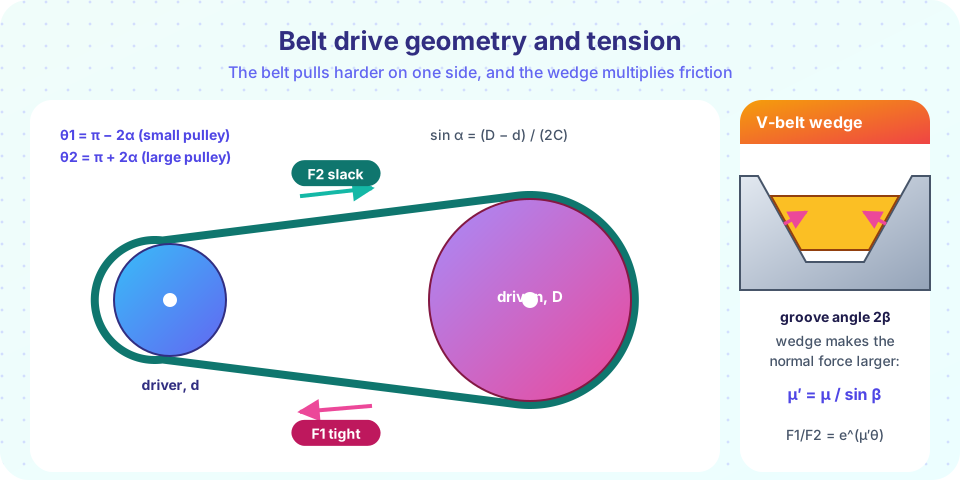
Let the pulley diameters be d (small) and D (large), with the shaft distance C. For an open belt the belt leaves the pulleys at a small angle α to the center line, where
sin α = (D − d) / (2C)
The belt wraps the small pulley by θd = π − 2α and the large pulley by θD = π + 2α (the picture shows both). The belt length is
L = 2C + π (D + d) / 2 + (D − d)² / (4C)
(an excellent approximation when D − d is smaller than C). Belts come in standard lengths, so after computing L you choose the nearest standard belt and recalculate the shaft distance C, leaving an adjustment range so that the belt can be fitted and tensioned.
Because the small pulley has the smaller wrap angle, it also has the smaller value of e^(μθ). This is the pulley that slips first, so the design is checked on the small pulley.
Tensions and power
When the drive transmits power, the tight side carries F1 and the slack side F2. The net pull is F1 − F2, so
T = (F1 − F2) d / 2 P = (F1 − F2) v v = π d n / 60
with the belt speed v in m/s for n in rpm and d in meters. If the belt were weightless, the capstan equation would give F1/F2 = e^(μθ). But at speed, the belt mass adds a centrifugal tension Fc = m′ v² to both sides (it tries to throw the belt off the pulleys, and reduces the force pressing it to the pulley). The part of the tension that is responsible for friction is F − Fc, and the capstan equation becomes
(F1 − Fc) / (F2 − Fc) = e^(μθ)
Combining this with F1 − F2 = P / v, you can solve for the tensions:
F2 = (F1 − F2) / (e^(μθ) − 1) + Fc F1 = F2 + (F1 − F2)
The belt is installed with an initial tension Fi = (F1 + F2)/2 − Fc. This tension has to be large enough to avoid slip at the design load, but not larger: too high a value shortens the life of the belt and loads the bearings.
The load on the shafts is the vector sum of the two belt pulls, which is approximately F1 + F2 when the belt is nearly parallel to the center line.
V-belts: the wedge
A V-belt sits in a groove with sloping sides. The sides push on the belt with a normal force N that is larger than the radial clamp force, because the two flanks form a wedge. If the half-angle of the groove is β, the radial force Fr that presses the belt in the groove balances 2 N sin β, so N = Fr / (2 sin β) per flank: the friction available is multiplied by 1 / sin β. For standard grooves (2β = 36°, β = 18°, sin β = 0.309), the effective friction coefficient is more than three times larger:
μ′ = μ / sin β F1/F2 = e^(μ′ θ) (with centrifugal tension subtracted)
That is why V-belts transmit much more power, need less pretension and put less load on the shaft than flat belts of the same size. The price is a slight extra loss from the wedging and bending in the groove, and a limit to speed.
Worked example
A motor drives a fan through a flat belt. Motor power P = 5 kW, n = 1440 rpm, small pulley d = 150 mm, large pulley D = 400 mm, shaft distance C = 600 mm, μ = 0.3, belt mass per meter m′ = 0.3 kg/m.
- Belt speed:
v = π × 0.150 × 1440 / 60 = 11.31 m/s. sin α = (400 − 150) / (2 × 600) = 0.2083, soα = 12.0°. Wrap on the small pulleyθd = 180° − 24.0° = 156.0° = 2.722 rad.- Belt length:
L = 1200 + π × 550 / 2 + 250² / 2400 = 1200 + 863.9 + 26.0 = 2090 mm. - Net pull:
F1 − F2 = 5000 / 11.31 = 442 N. - Centrifugal tension:
Fc = 0.3 × 11.31² = 38.4 N.e^(μθ) = e^(0.3 × 2.722) = 2.263. F2 = 442 / (2.263 − 1) + 38.4 = 388 N,F1 = 388 + 442 = 831 N.- Initial tension:
Fi = (831 + 388)/2 − 38.4 = 571 N. Shaft load:F1 + F2 ≈ 1219 N.
Now use a V-belt with a 36° groove. μ′ = 0.3 / sin 18° = 0.971, so e^(μ′θ) = e^(2.64) = 14.0. Then F2 = 442 / 13.0 + 38.4 = 72 N, F1 = 514 N, and the shaft load is about 587 N, less than half that of the flat belt, because the wedge needs far less pretension.
The speed for maximum power
The power is P = (F1 − F2) v = (F1 − Fc)(1 − e^(−μθ)) v. For a given allowable tight-side tension F1 (set by the belt's strength), the power is a product of v (which rises) and (F1 − m′ v²) (which falls with speed as the centrifugal tension takes over the allowable tension). Setting the derivative to zero gives
v_opt = √(F1 / (3 m′))
At this speed the centrifugal tension is one third of F1. Beyond that, a faster belt carries less power. In practice, V-belts run at 10 to 25 m/s, with 30 m/s about the upper limit, and the lightweight toothed or ribbed belts can go faster.
Common misconceptions
- "A tighter belt is always better." Excess tension wears the belt, the pulleys and the bearings. The initial tension should be just large enough to avoid slip at full load.
- "The belt speed ratio is exactly D/d." Friction belts creep and slip slightly, so the real ratio is a little higher.
- "A faster belt carries more power." Only up to
v_opt. Above it, the centrifugal tension reduces the pressure on the pulley. - "Both pulleys are equally likely to slip." The small pulley has the smaller wrap angle, so it slips first.
- "A V-belt is simply a flat belt with a different shape." The wedge changes the effective friction coefficient and the pretension needed.
Try it
The first TryIt is a belt-drive calculator. It handles geometry, tensions and shaft load for both a flat and a V-belt, so you can compare them with the same inputs.
Press Run (or Ctrl + Enter) to see the result here.
Program input · what you'd type while the program runs
Type the answers before you press Run, one per line. Each time the program reads a line (with input()), it gets the next line from this box.
The second TryIt plots the transmitted power against belt speed for a fixed allowable tight-side tension. The centrifugal tension makes the curve rise, peak and fall.
Press Run (or Ctrl + Enter) to see the result here.
Program input · what you'd type while the program runs
Type the answers before you press Run, one per line. Each time the program reads a line (with input()), it gets the next line from this box.
Check your understanding
Quick check · 5 questions
of 5 answered You scored / 5 · perfect!
-
1. A belt runs at 10 m/s and the net pull F1 − F2 is 300 N. What power does it transmit?
P = (F1 − F2) v = 300 × 10 = 3000 W = 3 kW. -
2. Which pulley of an open belt drive has the smaller wrap angle and therefore slips first?
θ = π − 2α on the small pulley and π + 2α on the large one. -
3. A V-belt has a groove half-angle β = 20°. How does the effective friction coefficient compare with the flat belt value μ?
The wedge multiplies the normal force by 1 / sin β = 2.92. -
4. A belt has mass 0.4 kg/m and runs at 20 m/s. What is its centrifugal tension?
Fc = m′ v² = 0.4 × 400 = 160 N. -
5. Why does power eventually fall if you increase belt speed beyond v_opt?
Since F1 is limited, a larger Fc leaves less tension (F1 − Fc) to produce friction.
Summary
- Belt length
L = 2C + π(D + d)/2 + (D − d)²/(4C); wrapθ = π ∓ 2αwithsin α = (D − d)/(2C). P = (F1 − F2) v; tensions from(F1 − Fc)/(F2 − Fc) = e^(μθ)withFc = m′ v²; check the small pulley.- V-belts use
μ′ = μ / sin β, so they need less pretension and load the shafts less. - The belt carries most power at
v_opt = √(F1 / (3 m′)); real belts run well below that. - Use a toothed belt or chain if the speed ratio must be exact.
Track your progress
Create a free account to tick off lessons and pick up where you left off on any device.
of Machine Design lessons completed