


















Lesson 3 of 46 · Getting Started
Units, Calculations and Materials
Master the SI unit habits of machine design, convert power to torque, read stress-strain curves and compare steel, aluminum, titanium and cast iron by strength, stiffness and weight.
A calculation with the wrong unit is not a slightly wrong answer. It is a wrong answer by a factor of a thousand or a million, and it looks perfectly normal on the page. This lesson sets up the habits that prevent that, and then introduces the material properties that every strength calculation in the course will use: modulus, yield strength, ultimate strength, density and ductility.
Both halves matter. The units tell you whether a formula is plausible; the material data tell you what the part can take. Together they let you do the first sanity check of any design in under a minute.
What you will learn
- The consistent unit set for machine design (N, mm, MPa) and how to convert power and speed to torque.
- How to read a stress-strain curve and name its key points.
- The typical properties of steel, aluminum, titanium and cast iron.
- How to compare materials by strength-to-weight and stiffness-to-weight.
Key terms
- Pascal (Pa): one newton per square meter. In machine design the megapascal (MPa = 10⁶ Pa) is used, and
1 MPa = 1 N/mm². - Young's modulus E: stress divided by strain in the elastic region; a measure of stiffness.
- Yield strength Sy: the stress where permanent deformation begins (usually the 0.2% offset).
- Ultimate tensile strength Su: the highest engineering stress the material reaches in a tensile test.
- Ductility: how much a material stretches before breaking; brittle materials stretch very little.
A unit system that never lets you down
The SI system has seven base units, but machine design uses only four: meter (m), kilogram (kg), second (s) and newton (N), which is a derived unit equal to 1 kg·m/s². The trouble is that real parts are measured in millimeters and real stresses are huge numbers in pascals. The way out is a consistent mixed set.
| Quantity | Unit used | Why |
|---|---|---|
| Length | millimeter (mm) | Drawings are in mm |
| Force | newton (N) | Basic SI force |
| Stress | MPa = N/mm² | Falls out of N and mm automatically |
| Moment, torque | N·mm (or N·m) | Force times mm |
| Modulus E | GPa = 10³ MPa | Steel is about 200 GPa |
| Power | watt (W), kilowatt (kW) | Standard |
| Mass | kilogram (kg) | Density in kg/m³ |
If you keep force in N and length in mm, then stress comes out in MPa with no conversion factors. For example, a 12 mm diameter rod pulled by 10 kN (10,000 N) has area A = π d²/4 = 113.1 mm² and stress σ = 10,000 / 113.1 = 88.4 MPa. Do not insert 10 kN into the formula with a 12 mm diameter: the answer would be 1,000 times too small.
Power, torque and speed
For rotating machines, the relationship you will use most is P = T ω, with angular speed ω = 2π n / 60 rad/s when n is in rpm. Rearranged: T = 9,549 · P / n with torque in N·m, power in kW and speed in rpm (the constant is 60,000 / (2π)). A motor delivering 11 kW at 1,460 rpm produces 9,549 × 11 / 1,460 = 72 N·m.
Significant figures and honesty
Material strengths are known to two or three digits at best, loads are often estimates, and safety factors are judgment. Quoting a shaft diameter as 23.4871 mm is false precision. Carry four digits through the calculation, then round the answer to the precision of the least certain input, and round up to the next standard size when the part must be strong enough.
Press Run (or Ctrl + Enter) to see the result here.
Program input · what you'd type while the program runs
Type the answers before you press Run, one per line. Each time the program reads a line (with input()), it gets the next line from this box.
Reading the tensile test
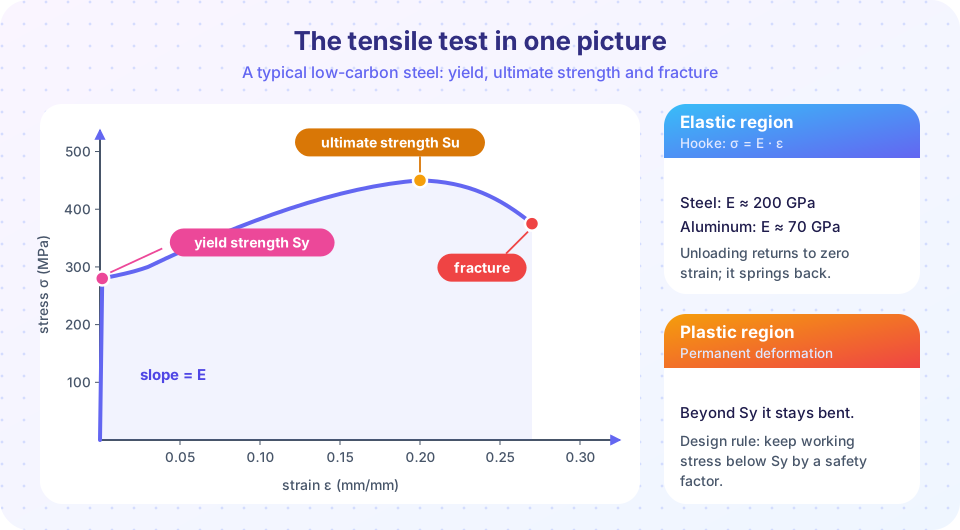
A tensile test pulls a standard bar slowly until it breaks while recording force and elongation. Dividing force by the original area gives the engineering stress σ = F / A₀, and dividing the elongation by the original length gives the strain ε = ΔL / L₀. The curve has landmarks you must be able to name.
- Elastic region. The graph is a straight line,
σ = E ε(Hooke's law). Release the load and the bar returns to its original length. The slopeEis the stiffness. For steel it is about 200 GPa, for aluminum about 70 GPa, for titanium about 115 GPa and for gray cast iron about 100 GPa (it varies). - Yield point. Beyond it, deformation is permanent. Many materials have no sharp yield point, so the 0.2% offset method is used: draw a line parallel to the elastic slope, starting at strain 0.002, and where it crosses the curve is
Sy. - Strain hardening. The material gets stronger as it deforms, and stress rises.
- Ultimate strength. The peak of the engineering curve is
Su. After it the bar necks down (a local thin spot) and the engineering stress falls. - Fracture. The bar breaks. The strain at fracture measures ductility; the elongation is often quoted as a percentage, for example 15%.
Designers treat Sy as the usual limit for ductile parts, because a part that yields is bent and no longer fits. Brittle materials (gray cast iron, glass, ceramics) have no real yield; they break near their ultimate strength, and they are much weaker in tension than in compression.
Typical material properties
The table lists typical values. Real values depend on heat treatment and supplier, so always check the data sheet for a real design.
| Material | E (GPa) | Sy (MPa) | Su (MPa) | Density (kg/m³) | Notes |
|---|---|---|---|---|---|
| Steel 1018, cold drawn | 200 | 370 | 440 | 7,850 | Cheap, easy to machine |
| Steel 1045, cold drawn | 200 | 530 | 630 | 7,850 | Common for shafts |
| Aluminum 6061-T6 | 69 | 276 | 310 | 2,700 | Light, corrodes slowly |
| Titanium Ti-6Al-4V | 114 | 880 | 950 | 4,430 | Strong, light, expensive |
| Gray cast iron ASTM 30 | about 100 | none | 214 tension, 752 compression | 7,200 | Brittle; excellent damping |
Look at the stiffness column. Steel is three times stiffer than aluminum, and titanium sits between. Yet when we divide stiffness by density the three nearly match, as the next example shows.
Press Run (or Ctrl + Enter) to see the result here.
Program input · what you'd type while the program runs
Type the answers before you press Run, one per line. Each time the program reads a line (with input()), it gets the next line from this box.
The stiffness bars are almost equal. That is a well-known fact of engineering: for the common structural metals, stiffness per kilogram is nearly constant. You cannot make a part stiffer and lighter by changing metal; you must change the shape. The strength bars differ: titanium gives the most strength per kilogram, aluminum next, steel the least. That is why aircraft use titanium and aluminum, and why a bicycle frame is a shape problem as much as a material problem.
Choosing a material in practice
A first-pass choice asks four questions.
- What limits the part: strength, stiffness, weight, wear or corrosion?
- What can the shop make: machining, casting, forging, welding?
- What does it cost per kilogram and per finished part?
- What data do you have? A common material with a published data sheet beats an exotic one you cannot verify.
For most shafts, plain medium-carbon steel such as 1045 is the starting point. For housings, cast iron or cast aluminum are typical. When weight dominates, aluminum or titanium enter. For every material, strength data should come from a data sheet or a reputable handbook, never from memory.
Hardness as a shortcut
Hardness tests (Brinell, Rockwell) are quick and do not destroy the part. For steels, ultimate strength correlates well with Brinell hardness: roughly Su ≈ 3.45 × HB in MPa. A part measured at 200 HB therefore has Su near 690 MPa. It is an estimate, good for a quick check, not a replacement for the certified test.
Press Run (or Ctrl + Enter) to see the console output here.
No output.
Common misconceptions
- "Higher strength means more stiffness." No. Hardening a steel raises strength but not its modulus: every steel is about 200 GPa. A stronger steel bends just as much under the same elastic load; it simply bends back at higher loads.
- "Yield strength and ultimate strength are interchangeable." For design against permanent bending we use
Sy; for fracture of brittle parts and for fatigue estimates we useSu. - "MPa and kPa differ only by a small amount." They differ by 1,000. A good habit is to estimate the answer first (for example 100 MPa is the order of magnitude for a loaded steel part) and then see if the result makes sense.
Check your understanding
Quick check · 5 questions
of 5 answered You scored / 5 · perfect!
-
1. A rod of area 200 mm² carries 30,000 N. What is the stress?
With N and mm the answer comes out in MPa: 30,000 / 200 = 150 MPa. -
2. A motor delivers 15 kW at 1,500 rpm. What is the torque, approximately?
T = 9,549 × 15 / 1,500 = 95.5 N·m. -
3. On the stress-strain curve, what does the slope of the straight initial part represent?
In the elastic region stress is proportional to strain with constant E, the stiffness. -
4. Which statement about stiffness per kilogram is correct?
E divided by density is about 25 MN·m/kg for all three metals, so lighter parts must get their stiffness from shape. -
5. Why is the 0.2% offset method used?
Many metals bend smoothly, so yield is defined as the stress at which 0.2% permanent strain remains after unloading.
Summary
- Use N, mm and MPa together; stress comes out in MPa without conversions.
T = 9,549 P / ngives torque in N·m from kW and rpm.- The tensile test gives E (stiffness), Sy (yield), Su (ultimate) and elongation (ductility).
- Steel, aluminum and titanium have nearly equal stiffness per kilogram but different strength per kilogram.
- Use material data sheets for real designs; hardness gives a quick strength estimate for steel.
Next: Getting Started Review
Track your progress
Create a free account to tick off lessons and pick up where you left off on any device.
of Machine Design lessons completed