


















Lesson 31 of 46 · Bearings and Springs
Chapter 6 review: bearings and springs
Review the bearings and springs chapter with a one-page picture, a recap table of formulas, a bearing selector from a small catalog and ten mixed questions.
This chapter gave you three tools for three very different jobs. Rolling bearing selection is a matter of picking a catalog size so that fatigue arrives after the required number of hours. Journal bearings are a matter of keeping an oil film alive by choosing viscosity, clearance and operating temperature. Spring design is a matter of balancing rate, stress and space. In all three cases you have estimated a load first, then used a formula to decide whether the element is good enough.
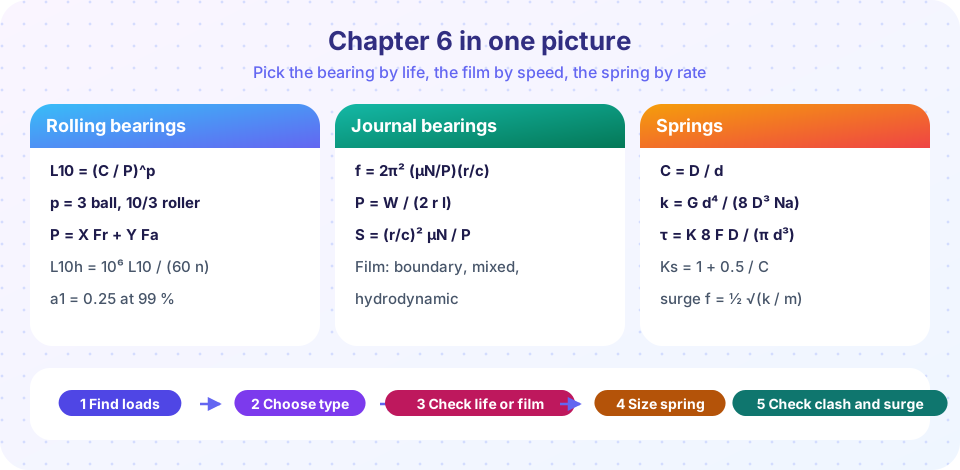
The chapter in a table
| Topic | Key relations | Remember |
|---|---|---|
| Rolling bearing life | L10 = (C / P)^p, p = 3 (balls), 10/3 (rollers) |
Half the load gives 8 times the life |
| Hours | L10h = 10⁶ L10 / (60 n) |
Speed matters for hours, not for revolutions |
| Equivalent load | P = X Fr + Y Fa; X = 0.56 if Fa / Fr > e |
Use catalog values for e, Y |
| Reliability | Ln = a1 L10, a1 = 0.25 at 99 % |
Higher reliability costs life |
| Journal bearing | P = W / (2 r l), S = (r/c)² μN / P |
The shaft makes its own film |
| Petroff | f = 2π² (μN / P)(r / c), T = f W r, power = T ω |
Friction becomes heat |
| Stribeck | boundary, mixed, hydrodynamic | Start-up wears bearings |
| Spring rate | k = G d⁴ / (8 D³ Na) |
d⁴ and D³ dominate |
| Spring stress | τ = K 8 F D / (π d³), Ks = 1 + 0.5 / C, K_B = (4C+2) / (4C−3) |
Use K_B for fatigue |
| Spring limits | Ls = Nt d, L0 = Ls + 1.15 y, fn = ½ √(k / m) |
fn at least 13 times the operating frequency |
A worked mixed problem
A shaft turns at 1200 rpm. One of its rolling bearings carries an equivalent load of 2.2 kN, the machine must run for 25,000 hours, and the owner wants 95 percent reliability instead of 90 percent.
- Required L10. With
a1 = 0.64at 95 percent, the basic rating life must beL10 = 25,000 × 60 × 1200 / 10⁶ / 0.64 = 2812 million revolutions. - Required rating. For a ball bearing,
C = P L10^(1/3) = 2.2 × 2812^(1/3) = 2.2 × 14.1 = 31.1 kN. - Compare. Without the reliability factor the same machine would need only
C = 2.2 × (1800)^(1/3) = 26.7 kN. The extra reliability costs one bearing size.
The same pattern works for journal bearings and springs. For a journal bearing, find the pressure P = W / (2 r l), then the friction coefficient and the power, and ask whether the oil can carry the heat. For a spring, find the rate from the geometry, the force at the working deflection, the stress and the safety factor, then check the solid length and the buckling guideline. In every case the order is the same: load, formula, check, decision.
Where students lose points
Three habits cost the most. Mixing up C and P in the life formula gives a life that is far too short or far too long. Forgetting that N in the Petroff equation is in revolutions per second, not rpm, makes the friction a factor of 60 wrong. Using the total number of coils instead of the active coils in the spring-rate formula gives a spring that is too soft. Write the units next to every number, and these errors show up before they cost you anything.
Try it
The first TryIt is a bearing selector that runs through a small, made-up catalog of deep groove ball bearings and prints the smallest one that gives the required life for a given load. The catalog values are illustrative, so use a real catalog for a real design.
Press Run (or Ctrl + Enter) to see the result here.
Program input · what you'd type while the program runs
Type the answers before you press Run, one per line. Each time the program reads a line (with input()), it gets the next line from this box.
The second TryIt revisits spring combinations and a quick check of the force-deflection relation. Predict the answers before you run it.
Press Run (or Ctrl + Enter) to see the result here.
Program input · what you'd type while the program runs
Type the answers before you press Run, one per line. Each time the program reads a line (with input()), it gets the next line from this box.
Check your understanding
Quick check · 10 questions
of 10 answered You scored / 10 · perfect!
-
1. A roller bearing has C = 50 kN and P = 25 kN. What is L10 in million revolutions? (p = 10/3)
L10 = 2^(10/3) = 10.08 million revolutions. -
2. A ball bearing needs 15,000 h at 1000 rpm. What is the required L10 in million revolutions?
L10 = 15,000 × 60 × 1000 / 10⁶ = 900 million revolutions. -
3. In the equivalent load P = X Fr + Y Fa, when is P simply equal to Fr?
For small axial load (Fa/Fr ≤ e), the axial component is ignored by the catalog method. -
4. In a journal bearing, which change reduces the Petroff friction coefficient?
f is proportional to μ, so a lower viscosity reduces friction (but also load capacity). Doubling the speed doubles f, and halving c doubles it. -
5. A spring with k = 12 N/mm is compressed 25 mm. What force does it carry?
F = k y = 12 × 25 = 300 N. -
6. Two springs of 30 N/mm are connected in series. The combined rate is:
1/k = 1/30 + 1/30 = 2/30, so k = 15 N/mm. -
7. Why is
K_Bused instead ofKsfor a spring cycling millions of times?Fatigue cracks start on the inside of the coil where curvature raises the stress. K_B (or Wahl) accounts for this. -
8. What is the main danger when a spring is cycled at a frequency near its natural frequency?
Resonance of the coil wave (surge) can raise stress far above the static design value. -
9. Which regime of the Stribeck curve do designers aim for in steady operation of a journal bearing?
In the hydrodynamic regime a full oil film separates the surfaces, so wear is negligible. -
10. A spring has d = 2 mm and D = 16 mm. What is its spring index?
C = D / d = 16 / 2 = 8.
Summary
L10 = (C / P)^pandL10h = 10⁶ L10 / (60 n); load matters as the cube.- A journal bearing needs a full film:
f = 2π² (μN / P)(r / c), with heat that must be carried away. - Springs:
k = G d⁴ / (8 D³ Na),τ = K 8 F D / (π d³); check clash, buckling, surge and fatigue. - Selection starts with the load and ends with checks and iteration.
Track your progress
Create a free account to tick off lessons and pick up where you left off on any device.
of Machine Design lessons completed