


















Lesson 10 of 46 · Design Process and Loads
Chapter 2 Review: Design Process and Loads
Review chapter 2 of Machine Design: the design loop, load types and cycles, gear and impact forces, stress concentration Kt and Kf, safety factors and reliability, with a ten-question quiz.
This chapter replaced the tidy single load of a textbook problem with the messier reality of a machine: a process that loops, loads that cycle and shock, geometry that concentrates stress, and uncertainty that has to be covered by a margin. Use this page to pull it together, run one combined calculation, and test yourself.
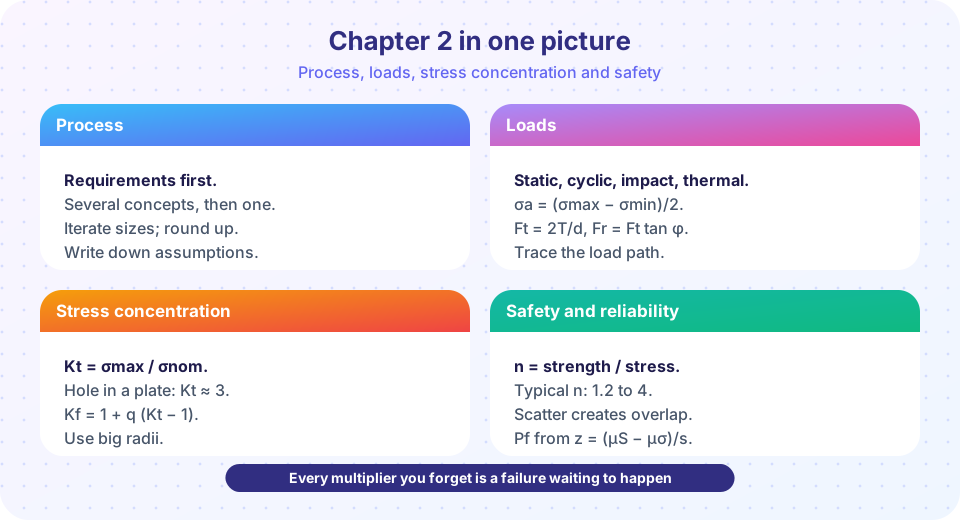
What you should now be able to do
- Turn a need into measurable requirements and iterate on a size, rounding up to a standard size.
- Classify loads, and compute
σa,σmandR, gear forces and impact factors. - Find
Ktfor a plate with a hole, and decide whether to applyKtorKf. - Choose a design factor, and estimate a failure probability from stress and strength scatter.
Recap table
| Lesson | Key ideas | Formulas |
|---|---|---|
| Design process | Requirements, concepts, iteration, documentation | d = (16 T n / (π Ssy))^(1/3), round up |
| Loads and load paths | Static, cyclic, impact, thermal; trace forces | σm = (σmax+σmin)/2, Ft = 2T/d, impact factor 1 + √(1 + 2h/δst) |
| Stress concentration | Peaks at holes, shoulders, notches | Kt = σmax/σnom, Kf = 1 + q (Kt − 1) |
| Safety factors and reliability | n = S/σ, interference, series reliability |
z = (μS − μσ)/√(sS² + sσ²) |
How the chapter fits together
Think of a real project, such as a hand winch for a well. The design process starts with the requirements: lift 500 N with a worst case of 1,500 N if the bucket jams, for 10,000 lifts, for under $120. The loads lesson then asks which loads the drum shaft will see: the rope force is static in direction but the shaft turns, so the bending stress at each point reverses once per turn. A jam is an impact load, which can double the force. Next, stress concentration warns you that the groove for the retaining ring at the shaft end is a notch with a Kt of about 3 to 5, so it must not sit at the section with the highest moment. Last, safety factors and reliability tell you how much margin the winch needs. Because a failure could drop a person's bucket or injure a user, you choose a larger design factor than for a toy, and you cannot rely on the material being as strong as the average value in the handbook.
The same chain applies to any machine. When you meet a new problem, ask the four questions in order: what are the requirements, what are the loads, where does the geometry raise the stress, and how much margin do I need?
Self-check list
You are ready for chapter 3 if you can do each of these without looking at the lessons:
- Write three measurable requirements for a machine you know.
- Compute the mean stress, amplitude and ratio for a stress cycle, and say whether it is reversed, repeated or fluctuating.
- State the stress concentration factor of a small circular hole in a wide plate, and say when to apply it.
- Explain why a factor of safety of 2 does not guarantee that a part will not fail.
Putting it together
A steel plate (width 50 mm, thickness 6 mm, yield strength 300 MPa) has a 10 mm hole and carries a static tension of 18 kN. It is lifted by a crane that may jerk the load suddenly. Compute the stress with the net area, apply a factor of 2 for the sudden load, and find the factor of safety against yielding. (Ductile material, static: Kt is ignored, but the net section and the dynamic factor are not.) Then see what happens if the material were a brittle casting with Su = 200 MPa, where Kt has to be applied.
Press Run (or Ctrl + Enter) to see the result here.
Program input · what you'd type while the program runs
Type the answers before you press Run, one per line. Each time the program reads a line (with input()), it gets the next line from this box.
The same geometry is comfortable in a ductile steel and unsafe in a brittle one. The difference is entirely in how the material handles the local peak.
Press Run (or Ctrl + Enter) to see the console output here.
No output.
Common misconceptions
- "Iteration means I made a mistake." Sizing is circular; iteration is the method.
- "If the static factor of safety is above 1, the part is safe." Impact, fatigue, stress concentration and scatter can erase a margin that looks comfortable.
- "Kt applies everywhere." For ductile static loads you ignore it; for brittle materials you use it; for fatigue you use
Kf.
Check your understanding
Quick check · 9 questions
of 9 answered You scored / 9 · perfect!
-
1. A shaft must carry 120 N·m. The shear yield strength is 200 MPa and the required factor is 2. What is the minimum diameter, from τ = 16T/(πd³)?
Allowed τ = 200/2 = 100 MPa. d³ = 16 × 120,000 / (π × 100) = 6,112 mm³, so d = 18.3 mm. In practice you would round up to a standard size such as 20 mm. -
2. σmax = 150 MPa and σmin = −50 MPa. What is R?
R = σmin / σmax = −50 / 150 = −0.33. -
3. What is the impact factor when a load is applied suddenly, without dropping?
With h = 0 the factor is 1 + √1 = 2. -
4. A plate 100 mm wide with a 10 mm hole (d/w = 0.1) has Kt of about
Kt = 3.00 − 0.314 + 0.037 − 0.002 = 2.72. -
5. Which is the best way to reduce stress concentration at a shaft shoulder?
A generous radius lets the force flow bend smoothly. -
6. A part has n = 1.8 on average. Reducing the scatter of strength and load will most directly
Narrower distributions overlap less. -
7. Four independent parts in series each have R = 0.97. What is the system reliability?
0.97⁴ = 0.885. -
8. Which load type is most dangerous for a rotating shaft over millions of turns?
Reversing stress cycles cause fatigue cracks. -
9. A fully restrained steel bar is heated by 80 K (E = 200 GPa, α = 12×10⁻⁶ per K). The thermal stress is about
σ = E α ΔT = 200,000 × 12×10⁻⁶ × 80 = 192 MPa.
Summary
- The process loops: requirements, concepts, sizing, evaluation, detail.
- Loads are static, cyclic, impact or thermal; stress cycles are described by
σa,σmandR. Ktconcentrates stress; use it for brittle parts,Kffor fatigue, and the net section always.- Safety factors cover uncertainty; reliability shows what scatter does.
Track your progress
Create a free account to tick off lessons and pick up where you left off on any device.
of Machine Design lessons completed