


















Lesson 12 of 46 · Fatigue and Failure
Static Failure Theories: Von Mises, Tresca and Brittle Criteria
Combine bending, torsion and axial stresses into one equivalent stress with the von Mises and Tresca criteria, find principal stresses, and treat brittle materials with Coulomb-Mohr.
The tensile test tells you what a bar does when pulled in one direction. Real parts are not that simple. A shaft is twisted and bent at the same time. A pressure vessel wall is stretched in two directions. At a fillet the stress is different in every direction you look. Yet the only strength data we have comes from a one-direction test. A failure theory is the bridge: a rule that converts a complicated stress state into a single number you can compare with the yield strength from the tensile test.
This lesson gives you the two theories used for ductile metals (von Mises and Tresca) and the ones used for brittle materials, with worked examples for a shaft.
What you will learn
- How to find principal stresses for plane stress.
- How to apply the von Mises (distortion energy) and Tresca (maximum shear) criteria.
- How to treat brittle materials with the maximum normal stress and Coulomb-Mohr criteria.
- Why pure shear yields at 0.577 of the tensile yield strength.
Key terms
- Principal stresses σ1 ≥ σ2 ≥ σ3: the normal stresses on the planes where shear stress is zero; the extreme values of normal stress at a point.
- Von Mises (distortion energy) stress σ′: an equivalent tensile stress that predicts yielding of ductile metals: yield occurs when
σ′ = Sy. - Tresca (maximum shear) criterion: yielding starts when the maximum shear stress reaches
Sy / 2. - Brittle material: one that fractures with little plastic deformation, with a compressive strength much larger than the tensile strength.
- Coulomb-Mohr criterion: a failure rule for brittle materials that uses both
SutandSuc.
Principal stresses
At a point on the surface of a part, stresses are described in a plane by a normal stress σx in the x direction, a normal stress σy in the y direction and a shear stress τxy. Rotate the axes and the numbers change. At one particular angle the shear vanishes, and the normal stresses are the principal stresses:
σ1, σ2 = (σx + σy)/2  ±  √( ((σx − σy)/2)² + τxy² )
τmax   = √( ((σx − σy)/2)² + τxy² )     (maximum in-plane shear)
For a shaft surface under bending stress σ and torsional shear τ (and no stress in the other direction) this simplifies to σ1,2 = σ/2 ± √((σ/2)² + τ²). One principal stress is positive, the other negative: a twisted and bent shaft is simultaneously stretched and squeezed along diagonal lines.
The Tresca criterion: maximum shear
In a tensile test with stress Sy, the maximum shear stress is Sy/2 (on planes at 45°). Henri Tresca proposed in the 1860s that yielding in any stress state begins when the largest shear stress reaches that same value. In terms of principal stresses σ1 ≥ σ3, with the third principal stress zero for plane stress, the maximum shear is the largest of |σ1 − σ2|/2, |σ1|/2 and |σ2|/2. The factor of safety is
n = Sy / max(|σ1 − σ2|, |σ1|, |σ2|)
For stresses σ and τ on a shaft this becomes σ′ = √(σ² + 4τ²) and n = Sy / σ′.
The von Mises criterion: distortion energy
Maksymilian Huber (1904), Richard von Mises (1913) and Heinrich Hencky (1924) each proposed in turn that yielding depends on the part of the strain energy that distorts the material, not the part that changes its volume. For plane stress the equivalent tensile stress is
σ′ = √(σ1² − σ1σ2 + σ2²) = √(σx² − σx σy + σy² + 3 τxy²)
and yielding begins when σ′ = Sy, so n = Sy / σ′. For the common bending-plus-torsion case, σ′ = √(σ² + 3τ²). Test data on steels, aluminum and copper fall close to this criterion. It is the standard for ductile metals.
Why pure shear gives 0.577
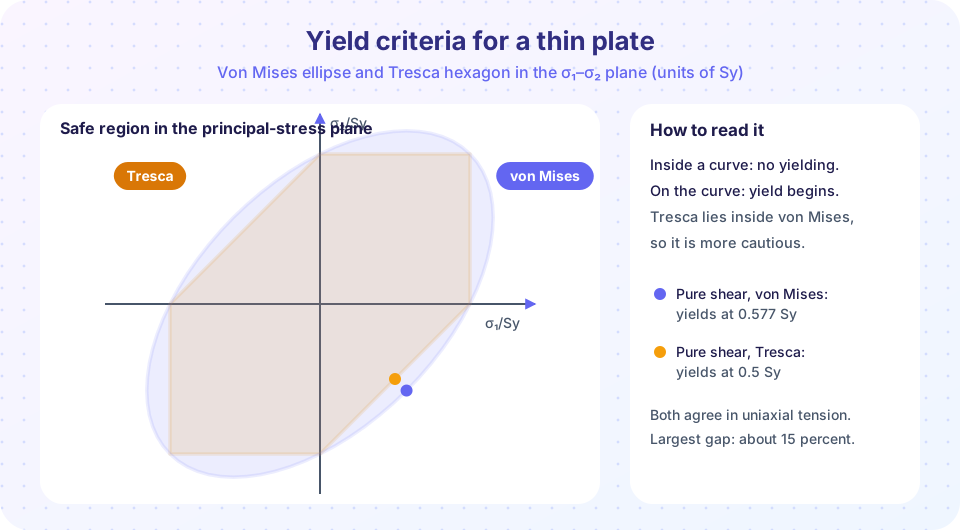
In pure shear σ1 = τ, σ2 = −τ. The von Mises stress is σ′ = √(τ² + τ² + τ²) = √3 τ. Setting it equal to Sy gives yield at τ = Sy/√3 = 0.577 Sy. Tresca gives τ = 0.5 Sy. That is why, in the previous lessons, we used Ssy = 0.577 Sy for the shear yield strength, and why Tresca is the more cautious theory: it predicts yielding earlier, by up to 15%, only in states like pure shear.
A shaft example
A solid steel shaft of diameter 30 mm (Sy = 370 MPa) carries a bending moment M = 300 N·m and a torque T = 200 N·m. The surface stresses are
σ = 32 M / (π d³) = 32 × 300,000 / (π × 27,000) = 113.2 MPa
τ = 16 T / (π d³) = 16 × 200,000 / (π × 27,000) =  37.7 MPa
The principal stresses are σ1,2 = 56.6 ± √(56.6² + 37.7²) = 56.6 ± 68.0, so σ1 = 124.6 MPa and σ2 = −11.4 MPa. Von Mises gives σ′ = √(113.2² + 3 × 37.7²) = 130.7 MPa, so n = 370 / 130.7 = 2.83. Tresca gives σ′ = √(113.2² + 4 × 37.7²) = 136.0 MPa, so n = 2.72. The two agree within about 4%, and Tresca is the more cautious.
Press Run (or Ctrl + Enter) to see the result here.
Program input · what you'd type while the program runs
Type the answers before you press Run, one per line. Each time the program reads a line (with input()), it gets the next line from this box.
Seeing the criteria
In the plane of the two principal stresses, each criterion draws a closed curve around the origin. Inside the curve the material is safe; on the curve it yields. The von Mises curve is an ellipse; the Tresca curve is a hexagon that fits just inside it. They touch at the points of uniaxial tension and compression, and where σ1 = σ2.
Press Run (or Ctrl + Enter) to see the result here.
Program input · what you'd type while the program runs
Type the answers before you press Run, one per line. Each time the program reads a line (with input()), it gets the next line from this box.
The shaft example sits well inside both curves: its load is about 0.35 of the yield stress along the diagonal. The distance from the origin to the curve along the ray through the point equals the factor of safety.
Brittle materials
Gray cast iron, glass and hard ceramics fracture before they yield, and their compressive strength is much greater than their tensile strength (for ASTM 30 cast iron about 214 MPa in tension and 752 MPa in compression). The theories for them are based on normal stress.
Maximum normal stress: fracture occurs when σ1 = Sut (tension) or σ3 = −Suc (compression). The factor of safety is n = Sut / σ1 for a tensile principal stress.
Coulomb-Mohr: a better fit when both tension and compression act. For σ1 ≥ 0 ≥ σ3 the failure line is σ1/Sut − σ3/Suc = 1, so
1/n = σ1/Sut − σ3/Suc
For a cast-iron part with σ1 = 100 MPa and σ3 = −150 MPa: 1/n = 100/214 + 150/752 = 0.467 + 0.199 = 0.667, so n = 1.50. Because brittle materials scatter more, designers add a larger design factor, often 3 or more.
Press Run (or Ctrl + Enter) to see the console output here.
No output.
Common misconceptions
- "The largest normal stress decides yielding in ductile metals." Yielding is driven by shear and distortion, not by normal stress alone. A hydrostatic stress, however large, does not yield a metal.
- "Adding σ and τ directly gives the equivalent stress." You must combine them:
√(σ² + 3τ²). Addingσ + τoverestimates the stress. - "Von Mises and Tresca differ by a lot." They differ by at most about 15% (pure shear) and often by only a few percent; designers often use von Mises and use Tresca when a conservative hand check is wanted.
Check your understanding
Quick check · 5 questions
of 5 answered You scored / 5 · perfect!
-
1. A shaft surface has bending stress σ = 100 MPa and torsional shear τ = 50 MPa. What is the von Mises stress?
σ′ = √(σ² + 3τ²) = √(10,000 + 7,500) = 132.3 MPa. -
2. In pure shear, at what shear stress does a ductile metal yield according to von Mises?
σ′ = √3 τ = Sy gives τ = Sy/√3 = 0.577 Sy. -
3. Which theory is more conservative for ductile materials?
The Tresca hexagon lies inside the von Mises ellipse, so it predicts yielding earlier. -
4. Principal stresses σ1 = 80 MPa and σ2 = −20 MPa, with Sy = 300 MPa. What is the Tresca factor of safety?
n = Sy / max(|σ1 − σ2|, |σ1|, |σ2|) = 300 / 100 = 3.0. -
5. Cast iron has Sut = 214 MPa and Suc = 752 MPa. For σ1 = 107 MPa and σ3 = 0, what is n by the maximum normal stress criterion?
n = Sut / σ1 = 214 / 107 = 2.0.
Summary
- Principal stresses are the extreme normal stresses:
σ1,2 = (σx + σy)/2 ± √(((σx − σy)/2)² + τxy²). - Von Mises:
σ′ = √(σ² + 3τ²)for bending and torsion;n = Sy / σ′. It is the standard for ductile metals. - Tresca:
σ′ = √(σ² + 4τ²); slightly more conservative; pure shear yields at 0.5 Sy (Tresca) or 0.577 Sy (von Mises). - Brittle materials use maximum normal stress or Coulomb-Mohr,
1/n = σ1/Sut − σ3/Suc.
Track your progress
Create a free account to tick off lessons and pick up where you left off on any device.
of Machine Design lessons completed