


















Lesson 9 of 46 · Design Process and Loads
Safety Factors and Reliability
Learn what a factor of safety is, how to choose a design factor, why scatter in stress and strength creates failure probability, and how part reliabilities combine in a system.
Engineers never promise that a part is exactly strong enough. They promise that it is stronger than it needs to be by a known margin. That margin is the factor of safety, and it exists because every number in a design is uncertain: the load might be larger than estimated, the material might be weaker than the data sheet average, the dimensions will not be exactly nominal, and the analysis itself is a simplification.
A single safety factor is the traditional tool. A more modern view asks the question differently: what is the probability that this part will fail during its life? In this lesson you will use both, and see why the same factor of safety can mean very different risks.
What you will learn
- The definition of the factor of safety and how designers choose it.
- How scatter in stress and strength creates a failure probability.
- How to compute that probability for normal distributions.
- How reliability of parts combines in a system.
Key terms
- Factor of safety n: the ratio of the strength (or capacity) to the stress (or load):
n = S / σ. - Design factor nd: the required value of n that the designer sets before the design starts.
- Reliability R: the probability that a part performs its function for its required life;
R = 1 − Pf. - Probability of failure Pf: the probability that stress exceeds strength.
- Standard deviation s: a measure of scatter around the mean.
The factor of safety
The simplest definition is
n = strength / stress (or capacity / load)
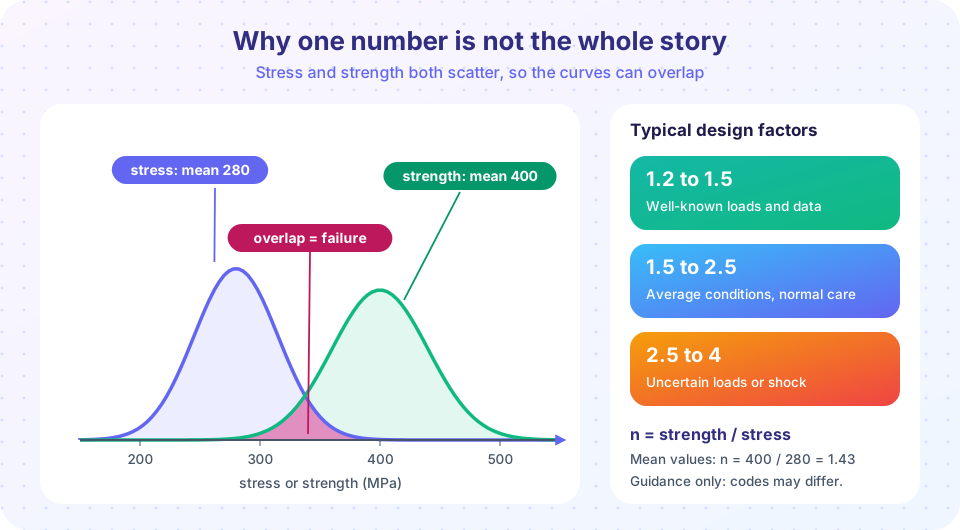
If a part's yield strength is 400 MPa and the stress is 280 MPa, then n = 400 / 280 = 1.43. The part is on the safe side as long as n is at least the design factor nd set for the project. Two words are often confused. The factor of safety n is what the part actually has. The design factor nd is what the designer requires. The design is acceptable when n ≥ nd.
Be careful about what the factor applies to. For a part with a linear relationship between load and stress, applying the factor on the load or on the stress gives the same answer. For buckling or nonlinear problems it does not, because stress may grow faster than load. In such cases, apply the factor to the load.
How designers choose nd
Choosing nd is a judgment about uncertainty and consequences. The following ranges are common guidance for ductile metals in static loading; codes and standards for specific equipment (cranes, pressure vessels, lifts, aircraft) override them and may require more.
| Situation | Typical nd |
|---|---|
| Loads, material properties and analysis known well, controlled quality | 1.2 to 1.5 |
| Average conditions, normal quality control | 1.5 to 2.5 |
| Uncertain loads or material, shock, poor quality control | 2.5 to 4 |
| Brittle materials (against ultimate strength) | 3 to 5 or more |
Four questions push the factor up or down.
- How uncertain are the loads? A conveyor with unpredictable jams needs more margin than a fan on a steady motor.
- How uncertain is the strength? Castings have more scatter than rolled bar.
- What are the consequences of failure? A broken coffee grinder is an annoyance; a broken crane hook is a catastrophe. High consequence means a larger factor.
- How good is the analysis? A simple hand model deserves more margin than a validated finite-element model.
On the other side sit weight and cost. Aircraft designers use factors close to 1.5 on ultimate load because weight is so costly, and compensate with careful analysis, testing and inspection. Heavy machinery uses larger factors because weight is cheap and testing is not.
Why scatter matters: stress-strength interference
The factor of safety hides the fact that neither the stress nor the strength is a single number. Strength varies from batch to batch, loads vary from one use to the next. Suppose strength is normally distributed with mean μS = 400 MPa and standard deviation sS = 40 MPa, and stress has μσ = 280 MPa and sσ = 35 MPa. The mean factor of safety is 1.43. Yet some of the time a low-strength part meets a high stress, and it fails: that is the interference region in the picture.
Because the difference of two independent normal variables is also normal, the margin M = S − σ has mean μM = μS − μσ = 120 MPa and standard deviation sM = √(sS² + sσ²) = √(40² + 35²) = 53.2 MPa. Failure means M < 0. In standard-deviation units this point is
z = μM / sM = 120 / 53.2 = 2.26
Pf = Φ(−z) = Φ(−2.26) ≈ 0.012
where Φ is the standard normal cumulative distribution function. About 1.2% of such parts would be expected to fail. For a toy that might be tolerable; for a part whose failure injures someone it is not.
Press Run (or Ctrl + Enter) to see the result here.
Program input · what you'd type while the program runs
Type the answers before you press Run, one per line. Each time the program reads a line (with input()), it gets the next line from this box.
The last lines show the main lesson: reducing scatter reduces risk without changing the average factor of safety. Better quality control, tighter material specifications, proof-testing every part and measuring actual loads all narrow the distributions. That is why a company with excellent quality control can safely use a smaller factor than one with poor control.
Reliability of a system
A machine has many parts. If any one of the critical parts fails, the machine fails. For independent parts in series the system reliability is the product of the individual reliabilities:
Rsystem = R1 × R2 × … × Rn
Ten parts each with R = 0.99 give 0.99¹⁰ = 0.904: a 10% chance that something fails. To reach a system reliability of 0.99, each of the ten parts needs 0.99^(1/10) = 0.999, a tenfold smaller failure probability each. This is why high-reliability machines (aircraft, spacecraft, medical devices) need very high component reliabilities, redundancy and inspection.
Press Run (or Ctrl + Enter) to see the result here.
Program input · what you'd type while the program runs
Type the answers before you press Run, one per line. Each time the program reads a line (with input()), it gets the next line from this box.
Factors in codes: load and resistance
Many modern codes, for structures and some machinery, use partial factors instead of one overall factor of safety. The characteristic load is multiplied by a load factor larger than 1 (for example, a higher factor for live load than for dead load, because live load is less certain), and the characteristic strength is divided by a resistance factor. The design is acceptable when the factored resistance exceeds the factored load. This splits the uncertainty into the part that comes from the load and the part that comes from the material, and it lets each factor be calibrated against statistics. The idea is the same as the stress-strength interference picture above, just expressed with factors instead of distributions. When you work to a particular standard, follow its own factors exactly, and treat the general guidance in this lesson as the basis for judgment rather than a replacement for the code.
Common misconceptions
- "A factor of safety of 2 is always safe." If loads and strength scatter widely,
n = 2may carry a larger failure probability thann = 1.5with tight control. The factor is a summary, not a guarantee. - "A bigger factor is free insurance." Heavy parts cost money and can introduce new problems, such as inertia, larger bearings and greater stresses elsewhere.
- "Safety factors make analysis unnecessary." A factor can cover scatter, but it cannot cover a failure mode you did not check.
Check your understanding
Quick check · 5 questions
of 5 answered You scored / 5 · perfect!
-
1. A part has yield strength 360 MPa and carries 150 MPa. What is its factor of safety?
n = 360 / 150 = 2.4. -
2. Stress has mean 200 MPa with s = 30 MPa; strength has mean 300 MPa with s = 40 MPa. What is z for the margin?
sM = √(30² + 40²) = 50 MPa and μM = 100 MPa, so z = 100 / 50 = 2.0. -
3. What is the most direct way to reduce the failure probability without raising the mean factor of safety?
Narrower distributions overlap less, so the same means give a lower failure probability. -
4. Five independent parts in series each have reliability 0.98. What is the system reliability?
0.98⁵ ≈ 0.904. -
5. Which situation justifies the largest design factor?
Uncertainty and high consequence both argue for more margin.
Summary
n = strength / stress; the design is acceptable whenn ≥ nd.- Choose
ndfrom the uncertainty in loads, strength and analysis, and the consequences of failure; codes may set minimums. - With normal scatter,
z = (μS − μσ) / √(sS² + sσ²)andPf = Φ(−z). - Reducing scatter reduces the failure probability at the same mean factor.
- System reliability for independent series parts is the product of the individual reliabilities.
Next: Chapter 2 Review
Track your progress
Create a free account to tick off lessons and pick up where you left off on any device.
of Machine Design lessons completed