


















Lesson 44 of 46 · Projects and Practice
Glossary of machine design terms
Forty clear definitions for gears, bearings, springs, clutches, brakes, belts and design practice, with formulas and a flashcard drill to learn them.
Every field has its own words, and machine design has many that look alike: pitch and lead, module and diametral pitch, tight side and slack side, dynamic and static load rating. This glossary collects the terms of chapters 5 to 8 in one place, with a short definition and the formula where there is one. Use it as a reference while you read, as a revision list before a test, or as a set of flashcards (the drill below the tables).
What you will learn
- The precise meaning of the main terms in gears, bearings, springs, clutches, brakes and belts.
- Which terms are often confused, and how to tell them apart.
- A quick drill to test yourself on definitions.
Key terms
- Module: the tooth size in millimeters,
m = d / N. - L10 life: the life reached by 90 percent of a group of bearings.
- Spring rate: force per unit deflection.
- Wrap angle: the angle of a pulley covered by a belt.
Gears
| Term | Meaning |
|---|---|
| Pinion | The smaller of two meshing gears. |
| Gear (wheel) | The larger of a pair. |
| Pitch circle | The imaginary rolling circle of a gear; its diameter is the pitch diameter d = m N. |
Module m |
Pitch diameter divided by the number of teeth, in mm. Meshing gears share the same module. |
Diametral pitch P |
Teeth per inch of pitch diameter, P = N / d; m = 25.4 / P. |
Circular pitch p |
Distance between corresponding points of adjacent teeth on the pitch circle, p = π m. |
| Addendum / dedendum | Tooth height above / below the pitch circle: m and 1.25 m for the standard tooth. |
Pressure angle φ |
Angle between the line of action and the common tangent of the pitch circles; 20° is standard. |
| Base circle | The circle from which the involute is generated, db = d cos φ. |
| Involute | The curve traced by the end of a taut string unwound from the base circle; the standard tooth profile. |
| Line of action | The straight line along which the contact point travels. |
| Contact ratio | Average number of tooth pairs in contact; want at least about 1.2. |
| Undercut | Material removed at the root of a pinion with too few teeth (below about 17 at 20°). |
Face width F |
Axial length of the tooth. |
Helix angle ψ |
Angle of the teeth to the axis of a helical gear; it creates axial thrust Wa = Wt tan ψ. |
Pitch cone angle γ |
Half the apex angle of a bevel gear's pitch cone; tan γp = Np / Ng. |
Lead L / lead angle λ |
Axial advance of a worm per turn, and the angle tan λ = L / (π dw). |
Lewis form factor Y |
Shape factor of a tooth in the bending equation σ = Wt / (F m Y). |
Bearings and springs
| Term | Meaning |
|---|---|
| Rolling bearing | A bearing with balls or rollers between an inner and an outer ring. |
| Journal bearing | A sleeve in which a shaft turns on an oil film. |
Basic dynamic load rating C |
The constant load giving one million revolutions at 90 percent reliability. |
Equivalent load P |
The radial load that gives the same life as the real radial and axial combination. |
| L10 life | (C / P)^p million revolutions; p = 3 for balls and 10/3 for rollers. |
Static load rating C0 |
The load causing a small permanent dent in the raceway. |
| Hydrodynamic lubrication | A full oil film generated by the motion of the surfaces in a converging wedge. |
| Stribeck curve | Friction against μN/P, with boundary, mixed and hydrodynamic regimes. |
Eccentricity ratio ε |
e / c, the offset of the journal as a fraction of the clearance. |
Sommerfeld number S |
S = (r/c)² μN / P, the dimensionless operating parameter of a journal bearing. |
Spring index C |
D / d, mean coil diameter over wire diameter. |
Spring rate k |
Force per unit deflection, k = G d⁴ / (8 D³ Na) for a helical compression spring. |
Active coils Na |
Coils that deflect; the end coils resting on the plates do not. |
| Solid length | The length of a spring with all coils touching. |
| Spring surge | Resonance of the coils when the cycling frequency approaches the natural frequency. |
Friction devices
| Term | Meaning |
|---|---|
| Clutch | A device that connects two shafts and can release them while turning. |
| Brake | A device that removes the kinetic energy of a moving part as heat. |
| Torque capacity | The largest torque that a clutch or brake can transmit. |
| Uniform wear | The steady state of a lining where p r is constant; the usual design basis. |
| Uniform pressure | The assumption of constant pressure; valid for a new rigid lining. |
| Self-energizing | A brake geometry in which friction helps to apply the shoe. |
| Self-locking | A brake or worm drive that cannot be released, or reversed, by the load. |
| Capstan equation | F1 / F2 = e^(μθ), the tension ratio of a band wrapped around a drum. |
| Tight / slack side | The high and low tension sides of a belt or band. |
Centrifugal tension Fc |
m′ v², the tension in a running belt from its own mass. |
| Fade | Loss of friction coefficient at high temperature. |
Design practice
| Term | Meaning |
|---|---|
| Service factor | A multiplier on load for shocks, duty and starts. |
Safety factor n |
Capacity divided by demand. |
| Design loop | Requirements, concept, calculation, check, iteration, documentation. |
| Decision matrix | A weighted score table used to compare concepts. |
Often confused
- Pitch and lead. Pitch is the distance between neighboring threads or teeth; lead is the distance a screw or worm advances in one turn (pitch times number of starts).
- Dynamic and static rating.
Cis for rotating bearings and fatigue life;C0is for non-rotating bearings and dents. - Self-energizing and self-locking. Self-energizing helps the applying force; self-locking is the extreme where no force is needed at all.
- Service factor and safety factor. The first adjusts the load; the second compares capacity with demand.
- Tight side and slack side. The tight side is where the belt moves toward the driver (the driving pulley pulls the belt there).
Try it
The first TryIt is a flashcard drill. Press the button to draw a random term and try to define it before showing the answer.
The second TryIt is a searchable glossary in Python: type a keyword into the code and run it to list every term whose name or definition contains it.
Press Run (or Ctrl + Enter) to see the result here.
Program input · what you'd type while the program runs
Type the answers before you press Run, one per line. Each time the program reads a line (with input()), it gets the next line from this box.
Check your understanding
Quick check · 5 questions
of 5 answered You scored / 5 · perfect!
-
1. Which term describes the distance a worm advances in one turn?
Lead is the axial advance per turn, equal to the axial pitch times the number of starts. -
2. What is the difference between a dynamic and a static load rating?
The dynamic rating C refers to fatigue life; the static rating C0 to permanent deformation of the raceway. -
3. Self-energizing means that:
In a self-energizing brake the friction force adds to the applying force; self-locking is the extreme case. -
4. Which term is the ratio D / d for a spring?
The spring index C = D / d, the mean coil diameter divided by the wire diameter. -
5. A designer multiplies the motor torque by 1.5 for frequent starts. What is the factor called?
A multiplier on the load for duty, shock and starts is a service factor.
Summary
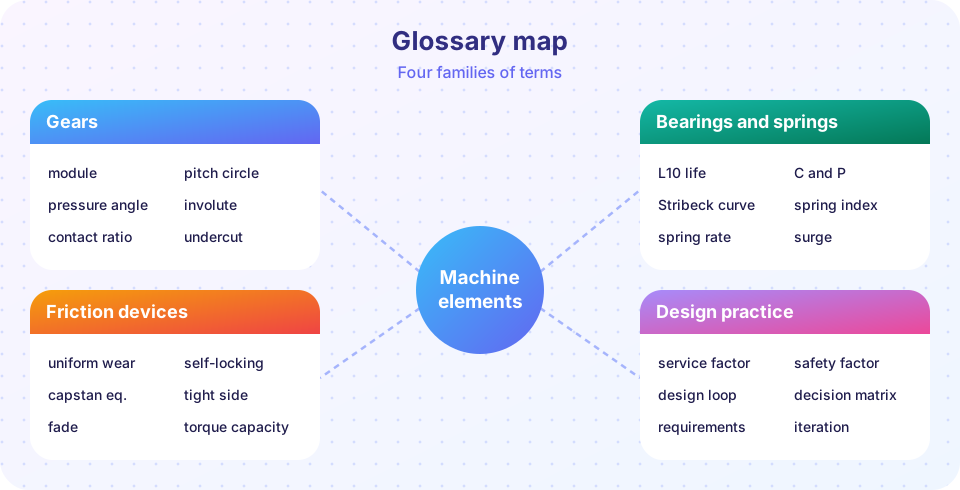
- Gear terms: pitch circle, module, pressure angle, involute, contact ratio, undercut, helix and lead angles.
- Bearing and spring terms:
C,P, L10, Stribeck curve, spring index, rate, active coils, surge. - Friction terms: uniform wear, self-energizing, self-locking, capstan equation, centrifugal tension, fade.
- Keep pitch versus lead,
CversusC0, and service versus safety factor distinct.
Next: Cheat sheet
Track your progress
Create a free account to tick off lessons and pick up where you left off on any device.
of Machine Design lessons completed