


















Lesson 14 of 46 · Fatigue and Failure
Endurance Limit and the Marin Factors
Correct the laboratory endurance limit for surface finish, size, load type, temperature and reliability with the Marin equation, with worked values for a steel shaft and a calculator.
The endurance limit Se′ ≈ 0.5 Sut comes from a polished 7.6 mm specimen tested in rotating bending at room temperature and with a reliability of about 50%. Your real part is not that specimen. It has a machined or forged surface, it is bigger, it may be loaded in tension or torsion instead of bending, it may be hot, and you need it to survive in 99% or more of units, not 50%. Each difference changes the endurance limit, usually lowering it.
In the 1960s the engineer Joseph Marin proposed a simple way to account for them: multiply the laboratory value by a series of correction factors, each between roughly 0.5 and 1. This lesson explains each factor, gives their formulas, and works a complete example. The result is the strength you must use in every fatigue calculation in the rest of the course.
What you will learn
- The Marin equation and the meaning of each factor.
- How to compute surface, size, load, temperature and reliability factors.
- Why a real part's endurance limit is often about half of the laboratory value.
- How to reduce the penalty by design: finishing, shot peening, smaller sections.
Key terms
- Marin equation:
Se = ka kb kc kd ke kf Se′. - Surface factor ka: accounts for the roughness and condition of the surface compared with the polished specimen.
- Size factor kb: accounts for the larger stressed volume of bigger parts.
- Load factor kc: adjusts for axial, bending or torsional loading.
- Reliability factor ke: adjusts the 50% median to the probability of survival you need.
The Marin equation
Se = ka · kb · kc · kd · ke · kf · Se′
Here Se′ is the laboratory endurance limit (0.5 Sut for steel up to 1,400 MPa), and Se is the endurance limit of your part in your conditions. Take the factors one by one.
Surface factor ka
Cracks start at the surface, so surface roughness matters. A fine polish is the best; a rough forging scale is the worst. The surface factor has the form ka = a Sut^b, with Sut in MPa:
| Surface finish | a (MPa) | b |
|---|---|---|
| Ground | 1.58 | −0.085 |
| Machined or cold-drawn | 4.51 | −0.265 |
| Hot-rolled | 57.7 | −0.718 |
| As-forged | 272 | −0.995 |
The exponents are negative: the penalty is larger for high-strength steels, which are more sensitive to surface flaws. For a machined steel with Sut = 630 MPa, ka = 4.51 × 630^(−0.265) = 0.82. An as-forged surface of the same steel gives ka = 272 × 630^(−0.995) = 0.45, which is why critical forged parts are machined or shot peened.
Size factor kb
Larger parts have more highly stressed material, so a flaw is more likely to exist, and the stress gradient is gentler. For a round rotating bar in bending or torsion with diameter d in millimeters:
kb = 1.24 d^(−0.107)     for 2.79 ≤ d ≤ 51 mm
kb = 1.51 d^(−0.157)     for 51 < d ≤ 254 mm
For a 30 mm shaft kb = 1.24 × 30^(−0.107) = 0.86. For axial loading kb = 1, because the stress is uniform and no size effect is observed. For non-round or non-rotating parts an equivalent diameter is used (for a non-rotating round section de = 0.37 d).
Load factor kc
The laboratory value is for bending. Other loadings give different fatigue limits:
| Loading | kc |
|---|---|
| Bending | 1 |
| Axial | 0.85 |
| Torsion | 0.59 |
The torsion value 0.59 is close to 1/√3 = 0.577, which is the von Mises relation between shear and normal stress. In practice, designers often use kc = 1 for combined loading and instead convert everything to a von Mises equivalent stress (as we do for shafts in chapter 4).
Temperature factor kd
For steels, strength is close to the room-temperature value up to about 250 °C, and then falls: about 0.9 at 400 °C and 0.77 at 500 °C. At room temperature kd = 1. At low temperatures the main danger is brittle fracture rather than fatigue.
Reliability factor ke
The laboratory value is a median, which means half of the specimens fail below it. For higher reliability the factor is lower. The scatter of endurance limits is roughly normal with a standard deviation of about 8% of the mean, giving:
| Reliability | ke |
|---|---|
| 50% | 1.000 |
| 90% | 0.897 |
| 95% | 0.868 |
| 99% | 0.814 |
| 99.9% | 0.753 |
| 99.99% | 0.702 |
Requiring 99.99% instead of 90% reduces the allowed stress amplitude by 22%.
Miscellaneous factor kf
This covers everything else: corrosion (which can remove the endurance limit altogether), electroplating (chromium plating can cut it considerably), residual stresses, and metal spraying. The factor is 1 when none apply. Shot peening and cold rolling put the surface into compressive residual stress and can increase fatigue strength, sometimes by 20 to 50%; designers rarely take credit for it without test data. Stress concentration is not in kf: we apply the fatigue concentration factor Kf to the stress instead.
A complete example
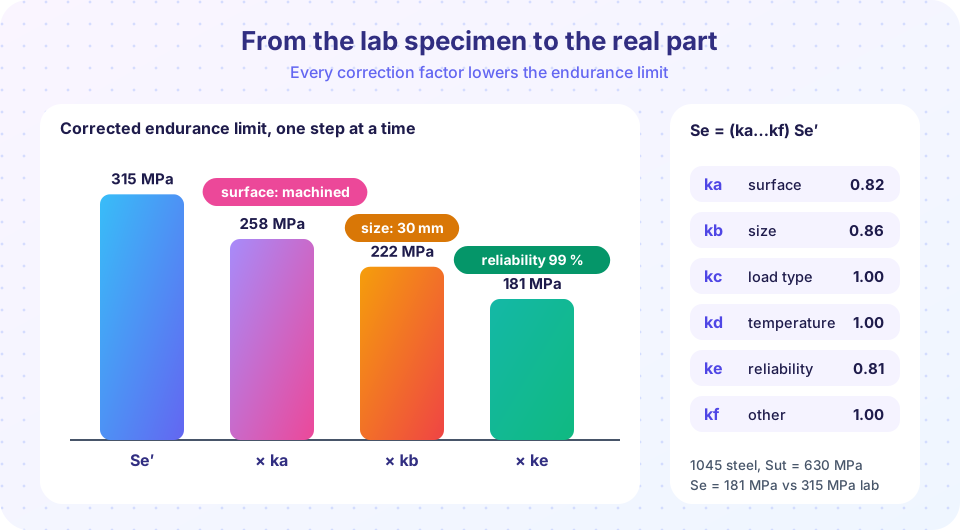
A shaft of 1045 cold-drawn steel (Sut = 630 MPa), 30 mm diameter, with a machined surface, loaded in bending, at room temperature, and required to have a reliability of 99%.
Se′ = 0.5 × 630 = 315 MPa.ka = 4.51 × 630^(−0.265) = 0.817.kb = 1.24 × 30^(−0.107) = 0.862.kc = 1,kd = 1,kf = 1.ke = 0.814for 99%.Se = 0.817 × 0.862 × 1 × 1 × 0.814 × 315 = 181 MPa.
The real part may sustain a completely reversed stress of only 181 MPa, 57% of the laboratory value. If the same shaft were as-forged instead of machined, Se would be only 0.55 times as large.
Press Run (or Ctrl + Enter) to see the result here.
Program input · what you'd type while the program runs
Type the answers before you press Run, one per line. Each time the program reads a line (with input()), it gets the next line from this box.
The plot shows why high-strength steels need good surfaces. For a hot-rolled surface, going from 400 MPa to 1,000 MPa steel buys very little extra endurance limit, because ka falls almost as fast as Sut rises. Strength costs money, and a rough surface wastes it.
Designing for a higher endurance limit
You cannot change the physics, but you can influence the factors.
- Improve the surface. Grinding or polishing the critical fillets gains 10 to 30% compared with a rough machined surface.
- Shrink the section where stress is high, or accept a larger size penalty with a larger, safer diameter.
- Choose the right reliability. A reliability of 99.99% on a non-critical part costs 22% of strength compared with 90%. Match the reliability to the consequence of failure.
- Use compressive residual stress. Shot peening, cold rolling of fillets and press fits.
- Protect against corrosion. Paint, plating (carefully chosen), or a stainless alloy.
Common misconceptions
- "Strong steel always gives a higher endurance limit." The surface factor falls as
Sutrises, so a rough part gains little from a stronger steel. - "The factors can be ignored for small shafts." Even a 10 mm polished shaft has
kb ≈ 0.97and the reliability factor still applies. - "Stress concentration goes into the Marin equation." It does not. It multiplies the stress through
Kf(see the stress concentration lesson), not the strength.
Check your understanding
Quick check · 5 questions
of 5 answered You scored / 5 · perfect!
-
1. Which statement about the size factor kb is correct?
Larger parts have more highly stressed material and gentler gradients, so kb falls with d. For axial loading kb = 1. -
2. A machined steel part has Sut = 500 MPa. What is its surface factor? (ka = 4.51 Sut^−0.265)
500^−0.265 = e^(−0.265 × 6.215) = 0.193, and 4.51 × 0.193 = 0.87. -
3. What is the reliability factor for 99%?
From the table, 99% corresponds to 0.814. -
4. Which of these is NOT included in the Marin equation?
Stress concentration is handled by Kf applied to the stress, not by a strength factor. -
5. A steel has Se′ = 250 MPa. With ka = 0.8, kb = 0.9, ke = 0.868 and the others equal to 1, what is Se?
Se = 0.8 × 0.9 × 0.868 × 250 = 156 MPa.
Summary
Se = ka kb kc kd ke kf Se′; the laboratory value is only the starting point.- Surface:
ka = a Sut^b; size:kb = 1.24 d^−0.107for rotating round bars; load: bending 1, axial 0.85, torsion 0.59; reliability: 99% is 0.814. - A real shaft often has half the endurance limit of the laboratory specimen.
- Improve the surface, protect against corrosion and use residual compressive stress; apply stress concentration to the stress, not the strength.
Track your progress
Create a free account to tick off lessons and pick up where you left off on any device.
of Machine Design lessons completed