


















Lesson 8 of 46 · Design Process and Loads
Stress Concentration
Understand why stress piles up at holes, fillets and notches, compute Kt for a plate with a hole, learn when to apply it to static and fatigue loading and how to design it away.
Pull on a rubber band with a small nick in the edge. It tears from the nick, not from somewhere else. Pull on a plate with a hole, and the material right beside the hole carries far more stress than the rest. Stress concentration is the local rise of stress where the shape of a part changes suddenly: at holes, grooves, keyways, threads, sharp corners and shoulders. It is one of the main reasons real machine parts break at loads that simple formulas say are safe.
In this lesson you will learn what the stress concentration factor Kt is, how to read it from standard formulas, how to use it correctly in static and fatigue design, and the design habits that reduce it.
What you will learn
- What
Ktmeans and where stress concentrations occur. - How to compute the peak stress at a hole in a plate.
- When to use
Ktfor static loads, and when to use the fatigue factorKf. - How to reduce stress concentration by design.
Key terms
- Nominal stress σnom: the stress calculated with the simple formula, ignoring the local feature (for a plate with a hole, force divided by the net area).
- Theoretical stress concentration factor Kt:
Kt = σmax / σnom, from elasticity theory, depends on geometry only. - Notch sensitivity q: a number from 0 to 1 that says how much of the theoretical concentration a material actually feels in fatigue.
- Fatigue stress concentration factor Kf:
Kf = 1 + q (Kt − 1). - Fillet: a rounded inside corner.
Why stress concentrates
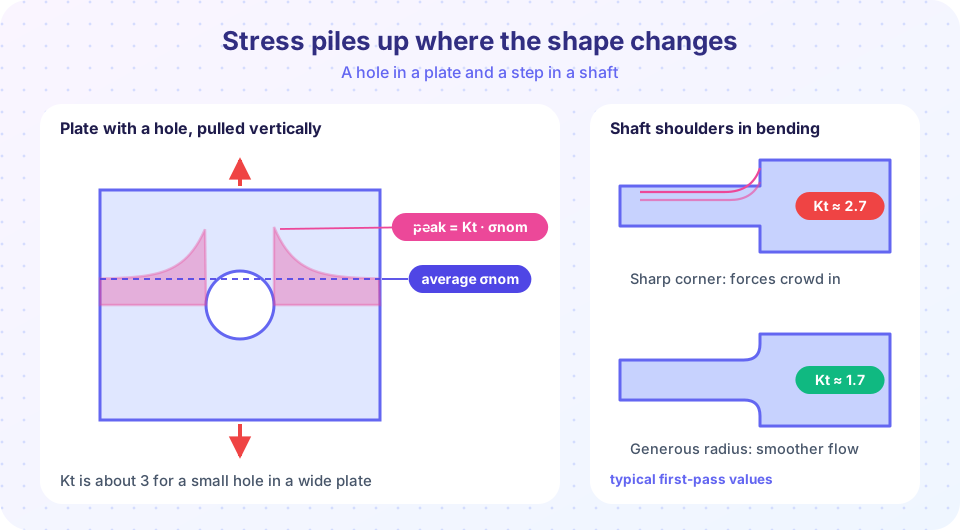
Think of the force in a loaded plate as lines of flow, like water in a river. Where the river is straight, the lines are parallel and evenly spaced. When a rock (the hole) blocks the way, the lines squeeze together around it. Where the lines are closest, the stress is highest. A sharp corner or a narrow groove is a bend that the lines cannot follow smoothly, so they bunch up.
The classical result goes back to the engineer Charles Inglis, who in 1913 solved the stress around an elliptical hole in a wide plate. For an ellipse of half-width a perpendicular to the load and half-height b along it, the peak stress at the end of the long axis is σ (1 + 2a/b). For a circle (a = b) this gives 3σ, the famous factor of three. A long thin slit across the load, with b small, gives an enormous factor, which is why cracks are so dangerous.
Two practical consequences follow.
- The sharpness matters more than the size. The factor depends on ratios such as radius to diameter, not on absolute size.
- The disturbance is local. Moving away from the feature by a few hole diameters, the stress is back to the nominal value (Saint-Venant's principle).
Computing Kt
Standard charts and formulas give Kt for common shapes. For a flat plate of width w and thickness t with a central circular hole of diameter d, loaded in axial tension F, the nominal stress is defined on the net section: σnom = F / ((w − d) t), and
Kt = 3.00 − 3.14 (d/w) + 3.667 (d/w)² − 1.527 (d/w)³
For d/w near zero this is 3. As the hole gets larger relative to the plate, Kt falls, but the net area is smaller, so the nominal stress rises.
Example. A plate 60 mm wide and 5 mm thick has a 12 mm hole and carries 15 kN. Then σnom = 15,000 / (48 × 5) = 62.5 MPa, d/w = 0.2, Kt = 3.00 − 0.628 + 0.147 − 0.012 = 2.51, and σmax = 2.51 × 62.5 = 157 MPa. A designer who forgot the hole and used the gross area would have computed only 15,000 / 300 = 50 MPa, a threefold error.
Press Run (or Ctrl + Enter) to see the result here.
Program input · what you'd type while the program runs
Type the answers before you press Run, one per line. Each time the program reads a line (with input()), it gets the next line from this box.
For shafts, the common features have charts in the references. A useful set of first-pass values for a shaft in bending, before the exact dimensions are known, is about Kt ≈ 2.7 for a sharp shoulder fillet and 1.7 for a well-rounded one, about 2.1 for an end-milled keyseat and about 5 for a retaining-ring groove. For torsion the values are lower for the shoulder (2.2 and 1.5) and higher for the keyseat (3.0). Use these only for an early estimate; look up the exact factor once the radius and diameter ratios are fixed.
Using Kt correctly
Ductile material, static load. The material at the hole edge yields locally and the stress redistributes, so the part usually still carries nearly its nominal load. Most designers ignore Kt for static loads on ductile materials such as mild steel and aluminum alloys. You must still use the net section.
Brittle material, static load. Cast iron, glass and hardened tool steel cannot yield locally. Use Kt in full, because the part cracks where the peak occurs.
Fatigue loading. Cracks start at the peak, so concentrations always matter. But real materials are somewhat less sensitive than the elastic theory predicts, especially for small radii. The fatigue stress concentration factor corrects for this:
Kf = 1 + q (Kt − 1)
The notch sensitivity q is between 0 (no effect: the material ignores the notch) and 1 (full theoretical effect). Large radii and high-strength steels have q near 1; small radii and soft materials have lower values. For Kt = 2.5 and q = 0.8, Kf = 1 + 0.8 × 1.5 = 2.2. Never use q to claim that a sharp notch is harmless: use real chart values from a reference, and when in doubt take q = 1, which is conservative.
Press Run (or Ctrl + Enter) to see the result here.
Program input · what you'd type while the program runs
Type the answers before you press Run, one per line. Each time the program reads a line (with input()), it gets the next line from this box.
Reducing stress concentration
The best way to handle a concentration is to remove it.
- Increase the radius. A generous fillet at every inside corner is the cheapest improvement. A fillet radius of at least 10% of the smaller diameter is a sound rule on shafts.
- Make transitions gradual. A taper or several small steps beats one big step.
- Add relief. An undercut groove next to a shoulder lets the force flow ease around the corner and allows a larger radius where a bearing needs a sharp seat.
- Place holes carefully. Keep holes away from the highest-stress region, and line up several small holes to create a smooth stress flow rather than one large hole.
- Avoid sharp keyway ends and thread runouts in high-stress regions.
- Improve the surface. Polishing, shot peening and cold rolling of fillets raise fatigue strength (more on this in chapter 3).
Common misconceptions
- "A hole makes the part weaker only by the area removed." The hole also raises the local stress by about three times for a small hole.
- "Kt is a material property." It depends only on geometry (and the load type), not on the material. Notch sensitivity
qis the part that depends on material. - "Drilling a small hole at the end of a crack is useless." A stop-hole blunts the crack tip, replacing a sharp slit by a hole with
Ktnear 3.
Check your understanding
Quick check · 5 questions
of 5 answered You scored / 5 · perfect!
-
1. What is Kt for a very small circular hole in a wide plate under uniform tension?
Inglis's elasticity solution gives 3 for a circle, because 1 + 2a/b = 3 when a = b. -
2. A plate 80 mm wide, 5 mm thick, has a 20 mm hole and carries 24 kN. What is the nominal (net-section) stress?
σnom = F / ((w − d) t) = 24,000 / (60 × 5) = 80 MPa. -
3. For a mild-steel part under a static load, what is normal practice?
Ductile materials relieve the peak by local yielding. Brittle materials and fatigue loading need Kt (or Kf). -
4. Kt = 2.2 and q = 0.5. What is Kf?
Kf = 1 + 0.5 × (2.2 − 1) = 1.6. -
5. Which change reduces the stress concentration at a shaft shoulder?
A larger radius lets the force flow bend gradually, which lowers Kt.
Summary
- Stress concentrates where the shape changes;
Kt = σmax / σnom. - A small circular hole gives
Kt ≈ 3; use the net area for nominal stress. - Ignore
Ktfor static loads on ductile materials; use it for brittle materials; for fatigue useKf = 1 + q (Kt − 1). - Fix concentrations by design: big radii, gradual transitions, relief grooves.
Track your progress
Create a free account to tick off lessons and pick up where you left off on any device.
of Machine Design lessons completed