


















Lesson 16 of 46 · Fatigue and Failure
Chapter 3 Review: Fatigue and Failure
Review chapter 3 of Machine Design: von Mises and Tresca criteria, fatigue crack stages, the S-N curve, Marin factors and the Goodman line, with a combined shaft check and a ten-question quiz.
Chapter 3 gave you the two central checks of machine design. Static failure theories turn a complicated stress state into one number that you compare with the yield strength. Fatigue methods take a polished laboratory limit, correct it for the real part, and compare it with the alternating and mean stress. Together they decide whether a part is safe.
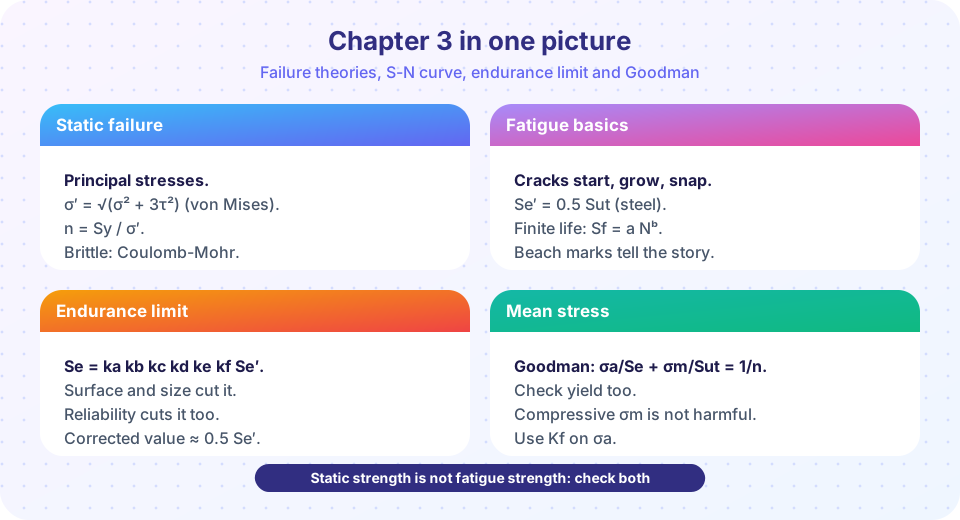
What you should now be able to do
- Compute principal stresses and apply von Mises, Tresca and Coulomb-Mohr.
- Describe how a fatigue crack starts, grows and fractures, and read an S-N curve.
- Correct the endurance limit with the Marin factors.
- Check a part with mean and alternating stress using Goodman and Langer.
Recap table
| Lesson | Key ideas | Formulas |
|---|---|---|
| Static failure theories | Combined stress, ductile and brittle criteria | σ′ = √(σ² + 3τ²), n = Sy/σ′; 1/n = σ1/Sut − σ3/Suc |
| Fatigue and the S-N curve | Three stages, endurance limit, finite life, Miner | Se′ = 0.5 Sut, Sf = a Nᵇ, D = Σ nᵢ/Nᵢ |
| Endurance limit and Marin factors | Real part vs polished specimen | Se = ka kb kc kd ke kf Se′ |
| Fluctuating stress and Goodman | Mean stress reduces allowed amplitude | 1/n = σa/Se + σm/Sut |
How the checks fit together
Every strength check in this chapter has the same structure: a stress (or an equivalent stress) is compared with a strength through a factor of safety. What changes from one check to the next is how each side is defined.
| Check | Stress side | Strength side |
|---|---|---|
| Static, ductile | von Mises equivalent σ′ of the maximum stresses |
Yield strength Sy |
| Static, brittle | Principal stresses σ1, σ3 |
Sut and Suc through Coulomb-Mohr |
| Fatigue, reversed | Alternating stress σa times Kf |
Corrected endurance limit Se |
| Fatigue, fluctuating | σa and σm, each as von Mises equivalents |
Goodman line through Se and Sut |
The process for a real part is the same each time. Find the critical section, compute the nominal stresses, apply concentration factors, compute equivalent stresses, correct the strengths, and then compare. If you get a factor below the design factor, trace back through the chain and ask which link you can improve most cheaply: a larger fillet, a better surface, a slightly larger diameter or a different steel.
Mistakes to avoid
- Mixing the laboratory endurance limit with a real part's stresses.
- Applying a stress concentration factor to the strength instead of to the stress.
- Forgetting the yield check after the fatigue check, or the other way round.
- Adding
σ + τinstead of combining them as√(σ² + 3τ²). - Using a compressive mean stress to claim extra margin in a first design.
A combined check
A rotating shaft of 1045 cold-drawn steel (Sut = 630 MPa, Sy = 530 MPa), diameter 30 mm, machined, carries a reversing bending moment of M = 150 N·m and a steady torque of T = 160 N·m at a shoulder with Kf = 1.7 (bending) and Kfs = 1.4 (torsion). The required reliability is 99%. Find the fatigue factor of safety by the Goodman line and the yield factor.
Press Run (or Ctrl + Enter) to see the result here.
Program input · what you'd type while the program runs
Type the answers before you press Run, one per line. Each time the program reads a line (with input()), it gets the next line from this box.
Fatigue governs, and the factor is close to 1.5, a reasonable value for well-known loads. If you change the surface to as-forged or raise the reliability, watch how fast the margin disappears.
Press Run (or Ctrl + Enter) to see the console output here.
No output.
Where this chapter leads
The next chapter applies everything here to two concrete elements. A shaft is the classic fatigue problem: a reversing bending stress, a steady torque, a shoulder with a stress concentration and a surface finish that sets the correction factors. A bolt is the opposite classic: a part whose mean stress is huge because of the preload, but whose alternating stress is tiny, so the Goodman line decides its life. If you can say, for each of these two parts, which side of the Goodman diagram it lives on and why, you have understood the chapter. Later chapters on gears and bearings add a third kind of failure, surface fatigue, but the habit of comparing a corrected strength with a stress that includes every concentration stays the same.
Common misconceptions
- "Static checks are enough for a shaft." A shaft that is safe statically can fail by fatigue at half the load.
- "Use the laboratory endurance limit for the real part." Always correct it with the Marin factors.
- "Mean stress is harmless if it is below yield." It lowers the allowed amplitude, linearly in the Goodman model.
Check your understanding
Quick check · 10 questions
of 10 answered You scored / 10 · perfect!
-
1. A shaft surface has σ = 90 MPa (bending) and τ = 40 MPa (torsion). What is the von Mises stress?
σ′ = √(90² + 3 × 40²) = √(8,100 + 4,800) = 113.6 MPa. -
2. Pure shear τ in a steel with Sy = 400 MPa yields at (von Mises)
τ = 0.577 × 400 = 231 MPa. -
3. Which part of a fatigue fracture surface is rough?
The final sudden fracture looks like an overload break. -
4. A steel with Sut = 700 MPa has Se′ =
Se′ ≈ 0.5 Sut = 350 MPa. -
5. Which factor does NOT appear in the Marin equation?
Stress concentration is applied to the stress with Kf. -
6. Se = 150 MPa, Sut = 600 MPa, σa = 50 MPa, σm = 100 MPa. What is the Goodman n?
1/n = 50/150 + 100/600 = 0.333 + 0.167 = 0.5, so n = 2.0. -
7. A block of reversed stress above Se is applied for twice as many cycles. By Miner's rule the damage from that block
Damage nᵢ/Nᵢ doubles when nᵢ doubles. -
8. Which criterion tends to give the largest fatigue factor of safety?
The Gerber parabola is the least conservative of the fatigue criteria. -
9. Which material typically has no true endurance limit?
Aluminum alloys keep losing fatigue strength with more cycles. -
10. A part loaded to 0.7 Sut completely reversed (steel, f = 0.9) survives about how many cycles?
With Se′ = 0.5 Sut and f = 0.9, Basquin's equation gives N ≈ 19,000 cycles.
Summary
- Use von Mises for ductile static checks and Coulomb-Mohr for brittle ones.
- Fatigue cracks start at surface stress raisers and propagate silently to sudden fracture.
- Correct
Se′with Marin factors; then use Goodman, with Langer for yield. - Combined bending and torsion are combined as von Mises equivalents of the alternating and mean parts.
Track your progress
Create a free account to tick off lessons and pick up where you left off on any device.
of Machine Design lessons completed