


















Lesson 37 of 46 · Design Projects
Chapter 8 overview: design projects
Learn the loop that every machine design follows (requirements, concept, calculation, checks, iteration) and preview three projects: a gear reducer, its bearings and a clutch.
Up to now you have learned machine elements one at a time: a gear tooth, a bearing, a spring, a brake. Real machines are not made of isolated elements. A gearbox needs gears and shafts and bearings and a housing, and the choice of one changes the others: a bigger gear makes a bigger shaft load, which needs a bigger bearing, which needs a bigger housing bore. Design is the art of making these choices fit together.
This chapter shows you how. You will run three small projects from a written requirement to a checked specification, using the formulas of the previous chapters. Along the way you will see the working habits that distinguish a design from a calculation: state the requirement, write down the assumptions, choose, check, and iterate. These habits matter as much as the formulas.
What you will learn
- The six steps of a design loop and what to write down at each step.
- How to choose between concepts with a weighted decision matrix.
- How to keep a calculation honest: units, assumptions and sanity checks.
- What the three projects of this chapter will teach you.
Key terms
- Requirement: a measurable statement of what the machine must do (power, speed, life, size, cost).
- Concept: a basic solution idea (for example, a V-belt drive versus a gear reducer).
- Safety factor
n: the ratio of the capacity (strength, rating) to the demand (stress, load). - Iteration: repeating calculation and check with new choices until all checks pass.
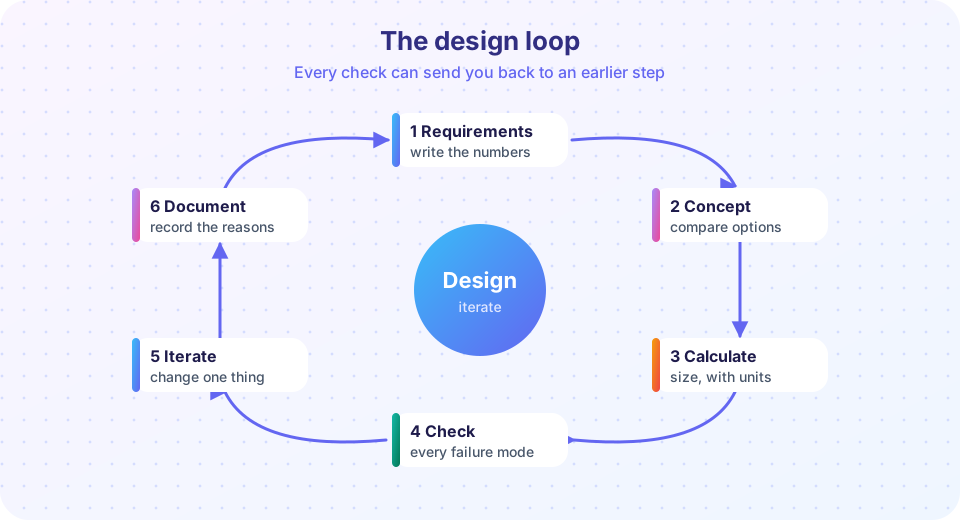
The design loop
- Requirements
- Concept
- Calculate
- Check
- Iterate, 6. Document
A design you cannot explain is not finished.
1. Requirements
Write the requirement in numbers: transmitted power, speeds, direction, required life, duty (hours per day, shock, starts per hour), environment (dust, temperature, washdown), space and cost limits. If a requirement is vague ("quiet", "long-lasting"), convert it: "below 75 dB(A) at 1 m", "20,000 hours at 90 percent reliability".
2. Concept
List at least three different ways to meet the requirement and compare them. The decision matrix below is a tool for this. Give each concept a score for each criterion, give each criterion a weight, and compute the weighted sum. The matrix does not give you the answer. It makes your reasoning visible, and it forces you to say what matters.
3. Calculate
Choose the first values from experience and standard sizes (modules, wire sizes, bearing series). Write every formula with units, and check dimensions. For a speed reducer with a motor of 7.5 kW at 1450 rpm and a ratio of 4, you already know from chapter 5 how to start: T = 9550 P / n = 49.4 N·m, and a pinion of 20 teeth and module 2.5 gives Wt = 1976 N.
4. Check
Every element needs its own check against its own failure mode: tooth bending and contact stress for gears, L10 life for bearings, fatigue for shafts, pressure and heat for friction devices, stress and surge for springs. For each check compute the safety factor and ask whether it is adequate. A factor of 1.2 to 1.5 is common for well-known loads with good material data. Use more when loads are uncertain or failure is dangerous.
5. Iterate
A failed check means a change, not a panic. Change one thing at a time, and think about which change helps most for the least cost. A tooth too weak in bending: raise the module or widen the face. A bearing with too short a life: a larger series or a lower load (move the gear closer to the bearing).
6. Document
Write down what you chose and why: the requirement, the assumptions (friction coefficient, service factor), the calculation results and the checks. If somebody asks in five years why the module is 2.5, the answer should be on paper.
The three projects
- A spur gear reducer: size the gear pair for 7.5 kW, 1450 rpm and a ratio of 4, check bending and contact, and write the specification.
- Shafts and bearings for the reducer: find the shaft loads and the bearing reactions and choose bearings for 20,000 hours.
- A spring-loaded disc clutch: size the friction discs and design the springs that clamp them.
- Chapter review: the three results side by side and ten questions.
Try it
The first TryIt is a weighted decision matrix for the choice of a speed reducer for a conveyor (1450 rpm to about 360 rpm, 7.5 kW). The scores from 1 to 5 are illustrative judgments, not data. Move the sliders to change the weights and watch which concept wins. Notice how easy it is to change the winner by changing what you care about.
The second TryIt is a checklist generator for the "document" step. It prints a design record from the numbers you give it and flags checks with a safety factor below a chosen minimum.
Press Run (or Ctrl + Enter) to see the result here.
Program input · what you'd type while the program runs
Type the answers before you press Run, one per line. Each time the program reads a line (with input()), it gets the next line from this box.
Check your understanding
Quick check · 4 questions
of 4 answered You scored / 4 · perfect!
-
1. What should you do first when starting a design?
Without numbers for power, speed, life and constraints you cannot check anything later. -
2. What is the purpose of a weighted decision matrix?
The matrix shows what criteria were used and how much each mattered, so others can challenge it. -
3. A bearing check gives a life of 10,000 h and the requirement is 20,000 h. What is the safety factor on life?
n = capacity / demand = 10,000 / 20,000 = 0.5, which is below 1. -
4. When a check fails, what is the best habit?
Changing one variable at a time shows what helped. Several changes at once hide the cause.
Summary
- Design is a loop: requirements, concept, calculate, check, iterate, document.
- Write requirements in numbers; use a decision matrix to compare concepts.
- Check each element against its own failure mode, and compute a safety factor.
- Change one thing at a time; keep a record of choices and reasons.
Next: A spur gear reducer
Track your progress
Create a free account to tick off lessons and pick up where you left off on any device.
of Machine Design lessons completed