


















Lesson 15 of 46 · Fatigue and Failure
Fluctuating Stress and the Goodman Line
Check parts under both a steady mean stress and an alternating stress using the Goodman, Soderberg, Gerber and Langer criteria, with worked factors of safety and a bending-plus-torsion shaft.
So far the fatigue stress has swung evenly about zero, like the bending stress on a rotating shaft. Many real parts do not behave like that. A bolt in a pressure joint is tightened to a high tension and then sees small changes on top of it. A spring is compressed from one force to another, never back through zero. A belt-driven shaft carries a steady torque and a reversing bending moment together. In each case the stress has a mean and an alternating part, and both affect the life.
A steady tensile stress makes a crack open and grow more easily, so a part with a high mean stress tolerates a smaller alternating stress. This lesson shows how to draw the boundary between safe and unsafe combinations, and how to read the factor of safety from it.
What you will learn
- How to plot a fatigue diagram with
σmandσaand read the failure line. - The Goodman, Soderberg, Gerber and Langer criteria and their formulas.
- How to compute the fatigue factor of safety and check yielding.
- How to handle combined bending and torsion, and stress concentration.
Key terms
- Mean stress σm and alternating stress σa: the average and half-range of the stress in each cycle.
- Goodman line: the straight line from
Seon the amplitude axis toSuton the mean-stress axis. - Soderberg line: the straight line from
SetoSy; more conservative. - Gerber parabola: the curve
σa/Se + (σm/Sut)² = 1; fits ductile test data best. - Langer line:
σa + σm = Sy, the check for yielding in the first cycle.
The fatigue diagram
Plot mean stress on the horizontal axis and alternating stress on the vertical axis. A completely reversed load (σm = 0) sits on the vertical axis, and fatigue failure occurs at σa = Se. A static load (σa = 0) sits on the horizontal axis, and failure occurs at σm = Sut. In between, experiments with ductile steels give points that fall on a curve between those two ends. Several lines were proposed to describe it.
| Criterion | Equation for factor of safety n | Comment |
|---|---|---|
| Soderberg | σa/Se + σm/Sy = 1/n |
Line to Sy; very safe, often too conservative |
| Modified Goodman | σa/Se + σm/Sut = 1/n |
Straight line to Sut; simple, safe, the usual choice |
| Gerber | n σa/Se + (n σm/Sut)² = 1 |
Parabola; fits test data best; for ductile materials |
| Langer (yield) | σa + σm = Sy/n |
First-cycle yielding check |
The Goodman line (named for the British engineer John Goodman, who proposed a similar line around 1899) lies below the scatter of most test points on ductile steels, so it is a safe estimate. It is also easy to use. The Gerber curve passes through the middle of the data and gives a larger factor; it is the best estimate of the average, but a designer who wants a margin for scatter uses Goodman. Brittle materials follow the Goodman line more closely. The Soderberg line is the old standard and is still used where yielding must be prevented absolutely, such as in some precision components.
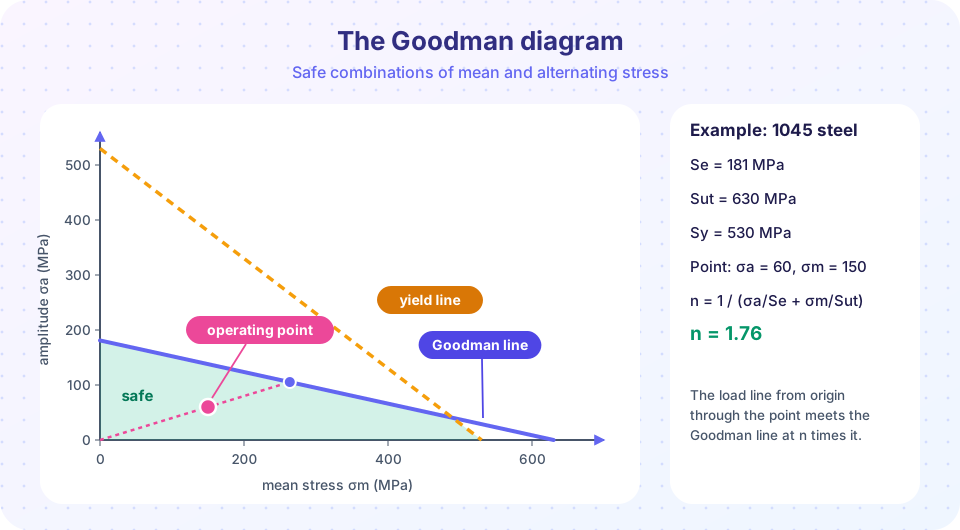
Always check both fatigue and yield. A design might satisfy the Goodman line and still yield on the very first cycle if σm + σa exceeds Sy. The Langer line, σa + σm ≤ Sy/n, is added to the diagram as the dashed line in the picture.
Compressive mean stress
A compressive mean stress closes cracks and slightly improves fatigue life. Experimental data show a flat or rising trend for σm < 0. For safety, designers do not take credit: with a compressive mean stress they use σm = 0, and the check reduces to σa ≤ Se / n.
Worked example: the shaft
The shaft from the previous lessons has Sut = 630 MPa, Sy = 530 MPa and a corrected Se = 181 MPa. At a critical section the nominal stresses are σa = 60 MPa and σm = 150 MPa.
Goodman: 1/n = 60/181 + 150/630 = 0.331 + 0.238 = 0.570, so n = 1.76.
Gerber: solving n × 60/181 + (n × 150/630)² = 1 gives about n = 2.19.
Langer yield check: n = 530 / (60 + 150) = 2.52.
The smallest factor governs, so the design has a fatigue factor of safety 1.76 (Goodman). Notice what the mean stress did: with σm = 0, the fatigue factor would have been 181/60 = 3.0. The steady stress has cut it by more than 40%.
The factor of safety is measured along a load line through the origin and the operating point, if the ratio σa/σm stays constant as the load grows. If instead the mean stress is fixed (for example, a bolt preload) and only the alternating part grows, the failure point is different, and the formula must be derived for that path. The simple Goodman formula above assumes the proportional load line.
Press Run (or Ctrl + Enter) to see the result here.
Program input · what you'd type while the program runs
Type the answers before you press Run, one per line. Each time the program reads a line (with input()), it gets the next line from this box.
Soderberg is the lowest line at the right end and Gerber the highest; Goodman lies between. The fatigue factors follow the same order.
Stress concentration and combined loading
When the part has a notch, the alternating stress is magnified by the fatigue concentration factor: σa = Kf σa,nom. For the mean stress, a ductile material at the notch yields locally and relieves the steady stress, so many designers take σm = σm,nom when Kf σmax,nom would exceed Sy, and σm = Kf σm,nom otherwise. A simple, safe rule for a first design is to apply Kf to both.
For combined bending and torsion (a typical shaft), convert the alternating and mean stresses to von Mises equivalents first:
σ′a = √( (Kf σa,b)² + 3 (Kfs τa,t)² )
σ′m = √( (Kf σm,b)² + 3 (Kfs τm,t)² )
and use σ′a and σ′m in the Goodman equation. A shaft that is bent while rotating with a constant torque has σm,b = 0 and τa,t = 0, so σ′a = Kf σa,b and σ′m = √3 Kfs τm,t. This is the idea behind the shaft formula in chapter 4.
Press Run (or Ctrl + Enter) to see the result here.
Program input · what you'd type while the program runs
Type the answers before you press Run, one per line. Each time the program reads a line (with input()), it gets the next line from this box.
Common misconceptions
- "If the peak stress is below yield, fatigue is not a problem." A cycle with a small alternating part but a peak far below yield can still fail the Goodman check, and a peak below yield may still crack in fatigue.
- "The mean stress only matters when it is large." Even moderate mean stress reduces the allowed amplitude; with
σm = Sut/2the allowed amplitude is halved by Goodman. - "A compressive mean stress is as bad as a tensile one." It is helpful or neutral; do not take credit for it in a first design.
Check your understanding
Quick check · 5 questions
of 5 answered You scored / 5 · perfect!
-
1. Se = 200 MPa, Sut = 600 MPa, σa = 50 MPa, σm = 150 MPa. What is the Goodman factor of safety?
1/n = 50/200 + 150/600 = 0.25 + 0.25 = 0.5, so n = 2.0. -
2. Which criterion gives the largest factor of safety for the same data?
The Gerber parabola lies above the Goodman and Soderberg lines, so it is the least conservative. -
3. Why do we also check the Langer line?
A design can satisfy the fatigue line yet exceed Sy when σa + σm is added. -
4. A rotating shaft with constant torque and reversing bending: which stresses are zero?
Bending reverses fully (mean zero), while the steady torque gives a mean shear with no alternating part. -
5. What should you do with a compressive mean stress in a first fatigue design?
It is neutral to beneficial, so using zero is a safe simplification.
Summary
- Fluctuating stress has
σmandσa; the mean stress reduces the allowed amplitude. - Goodman:
1/n = σa/Se + σm/Sut; Soderberg usesSy; Gerber is a parabola; Langer checks yield withσa + σm = Sy/n. - Use the smallest factor; apply
Kfto the alternating stress; for combined loads use von Mises equivalents ofσaandσm. - Take no credit for compressive mean stress.
Next: Chapter 3 Review
Track your progress
Create a free account to tick off lessons and pick up where you left off on any device.
of Machine Design lessons completed