


















Lesson 32 of 46 · Brakes, Clutches and Belts
Chapter 7 overview: brakes, clutches and belts
A map of chapter 7: how clutches, brakes and belts use friction to transmit torque, why heat limits them, and how the lessons fit together.
Think of the last time you pressed the brake pedal, let out a clutch, or heard the squeal of a belt. Each of these moments is a battle between friction and motion. A clutch uses friction to connect two shafts. A brake uses it to stop one. A belt uses it to carry power across a gap. The three devices look different, but they are governed by the same law: the friction force between two surfaces is at most μ N, the friction coefficient times the normal force pressing them together.
That sounds too simple to fill a chapter, but the details matter. Where is the normal force applied, and over what area? Does friction help the brake close itself, or oppose it? How much of a belt is in contact with the pulley? And, always lurking in the background, where does the heat go? Every friction device converts motion to heat, and many fail not because they are too weak but because they get too hot.
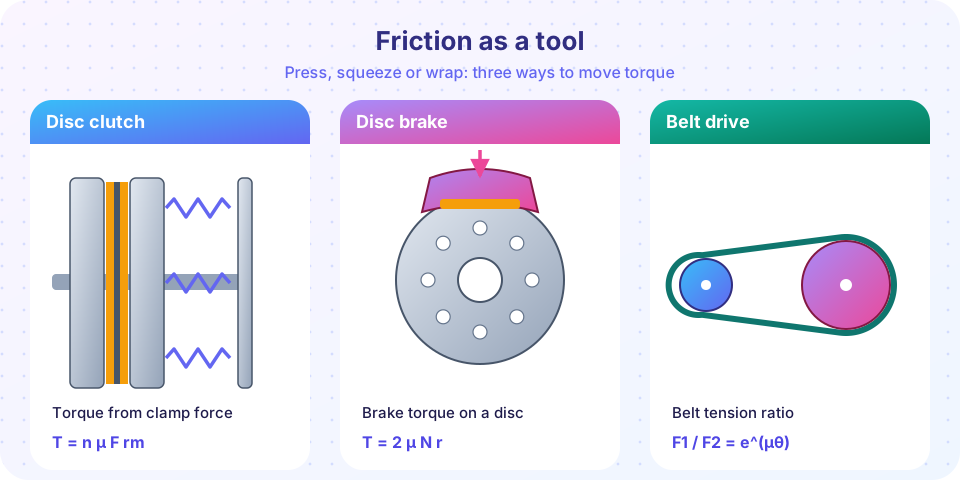
What you will learn
- How clutches, brakes and belts share one friction model and where they differ.
- Why geometry (mean radius, wrap angle, lever arms) decides the torque.
- Why the energy and the temperature rise are central to every friction device.
- How the four lessons that follow fit together.
Key terms
- Friction coefficient
μ: the ratio between the friction force and the normal force. - Torque capacity: the largest torque that a clutch or brake can transmit without slipping (clutch) or that it can apply (brake).
- Wrap angle: the angle of a pulley or drum that is covered by a belt or band.
- Fade: the loss of friction at high temperature.
The chapter in five slides
One law
Clutches
Brakes
Belts
The check
Then iterate.
What each lesson covers
- Disc clutches and disc brakes: uniform pressure and uniform wear, the best lining radii, engagement energy and disc brake heating.
- Drum brakes and band brakes: the short-shoe brake, self-energizing and self-locking, the capstan equation and the lever force of a band brake.
- Belt drives: geometry, tensions, centrifugal effect, the V-belt wedge and the speed for maximum power.
- Chapter review: a recap table, a heat check simulation and ten mixed questions.
Friction coefficients to carry in your head
The coefficient μ is not a property of one material but of a pair, a surface condition and a temperature. Dry organic linings on cast iron or steel are around 0.25 to 0.4; sintered metal linings in brakes are similar; wet clutch plates in oil are much lower, 0.05 to 0.15, which is why oil-bath clutches need more plates; leather or rubber belts on cast iron pulleys are about 0.3; a rope on a rusty iron bollard may reach 0.4. Oil, water or dust on a dry brake can halve the friction, which is why a wet brake feels so different. These are typical values for orientation; use the value from the manufacturer's data for a design, and test it.
The widget below shows the most surprising consequence of the friction law, the capstan effect. A rope wraps a post. Choose the number of turns and the friction coefficient to see how much force you need to hold a given load. The model is the exact capstan equation, drawn as a simple picture.
Try it
The second tool lists typical orders of magnitude, so that you can sanity check the results of your own calculations later in the chapter.
Press Run (or Ctrl + Enter) to see the result here.
Program input · what you'd type while the program runs
Type the answers before you press Run, one per line. Each time the program reads a line (with input()), it gets the next line from this box.
Check your understanding
Quick check · 4 questions
of 4 answered You scored / 4 · perfect!
-
1. What is the maximum friction force between two surfaces pressed together with a normal force of 500 N and μ = 0.3?
F = μ N = 0.3 × 500 = 150 N. -
2. Which problem is common to clutches, brakes and belts?
All three transmit force through friction, so slip and sliding produce heat that has to be managed. -
3. A rope wraps a post by two full turns. How does the tension ratio compare with one turn?
The ratio is e^(μθ). Doubling θ squares e^(μθ). -
4. Which brake type uses the wrap of a flexible lining around a drum?
A band brake wraps a flexible band around a drum and benefits from the capstan effect.
Summary
- Friction force is limited by
μ N; geometry sets the torque. - Clutches and disc brakes use mean radius, bands and belts use wrap angle and the capstan equation.
- Energy turns to heat; always check the temperature.
- Next: disc devices, then drum and band brakes, then belts.
Track your progress
Create a free account to tick off lessons and pick up where you left off on any device.
of Machine Design lessons completed