


















Lesson 34 of 46 · Brakes, Clutches and Belts
Drum brakes and band brakes
Design block (shoe) brakes and band brakes: derive the capstan equation F1/F2 = e^(mu theta), find torque, lever force, self-energizing and self-locking, with worked numbers.
Disc brakes squeeze flat surfaces together. A second family of brakes presses friction material against a cylinder: a drum. This family includes the shoes inside the rear drum of many cars, the block brakes on railway wheels, and the band brake found on hoists, winches, chain saws and the parking brake of some vehicles. They are simple, cheap, easy to build into a machine and can deliver a very large braking torque for a small applying force. They also have a trap: depending on the geometry, friction can help you or work against you, and in the worst case the brake grabs by itself.
This lesson covers two models. The short block (shoe) brake, where a lever presses one small shoe on a drum, introduces the moment balance that shows where self-energizing comes from. The band brake introduces the capstan equation, one of the most useful formulas in mechanical engineering, because the same equation governs belts, ropes on a bollard and cable drives.
What you will learn
- Compute the braking torque of a short-shoe brake and explain self-energizing and self-locking.
- Derive the capstan equation
F1/F2 = e^(μθ). - Calculate the tensions, the lining pressure and the lever force of a band brake.
- Estimate the energy to be absorbed and the temperature rise of the drum.
Key terms
- Normal force
N: the force with which the shoe or band is pressed on the drum. - Self-energizing: the friction force on the shoe helps to press it harder against the drum, so less applying force is needed.
- Self-locking: the brake grabs and stays applied even without an applying force.
- Tight side
F1/ slack sideF2: the high and low tensions of the band. - Wrap angle
θ: the angle of drum covered by the band, in radians.
The short-shoe block brake
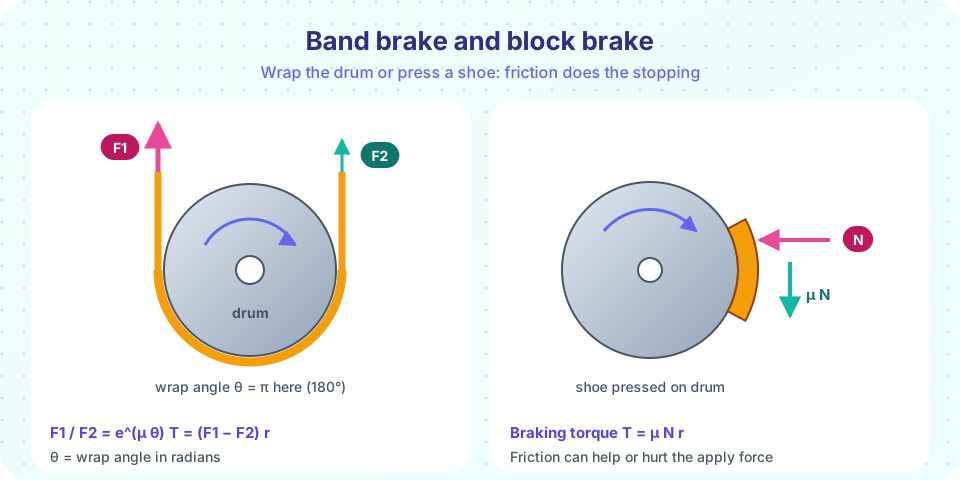
A block (the shoe) is pressed on the outside of a drum of radius r by a lever. The shoe presses on the drum with a normal force N, and the drum drags it with a friction force μ N. The braking torque is simply
T = μ N r
How big must the applying force Fa be? Take the moment of all the forces on the lever about its pivot O. The applying force acts at a distance a from the pivot. The normal force acts with an arm b, and the friction force acts with an arm c (the perpendicular distance from the pivot to the line of the friction force). The friction force has a moment about the pivot too. Depending on the drum's direction of rotation, that moment either adds to the effect of Fa or opposes it:
Fa · a = N (b − μ c)     friction helps (self-energizing)
Fa · a = N (b + μ c)     friction opposes
Look at the first line. When b = μ c, the right side is zero, so the brake needs no applying force: the shoe pulls itself onto the drum. If b < μ c, the brake is self-locking: it grabs by itself and needs a pull to release. That is dangerous in a vehicle or a hoist, so most designs keep b comfortably larger than μ c (a safety factor of 2 or more), or put the pivot so that c = 0 (a pivot on the line of the friction force) and the friction has no effect on the lever.
Self-energizing can also be useful. The leading shoe of a car's drum brake is self-energizing, which gives a strong braking effect from a modest pedal force, while the trailing shoe works against its own friction, but is more stable. Combining them gives a good compromise.
Worked example: block brake
A drum of radius r = 0.20 m must be braked with T = 250 N·m. The friction coefficient is μ = 0.35, and the lever dimensions are a = 500 mm, b = 200 mm and c = 50 mm.
- Required normal force:
N = T / (μ r) = 250 / (0.35 × 0.20) = 3571 N. - If friction opposes the applying force:
Fa = N (b + μ c) / a = 3571 × (200 + 17.5) / 500 = 1553 N. - If friction helps (the other direction of rotation):
Fa = 3571 × (200 − 17.5) / 500 = 1303 N.
The brake works in both directions, but it takes 19 percent more force in one direction than in the other.
The band brake and the capstan equation
A band brake wraps a flexible band, lined with friction material, around a drum. When the drum turns, friction drags the band with it, and the tension is higher on the side the drum drags it towards. Call the high tension F1 (tight side) and the low tension F2 (slack side).
Derivation. Take a small piece of band covering an angle dθ. Its two ends have tensions F and F + dF. The normal force from the drum is N, which balances the radial component of the tensions: N = F dθ (for small angles). The tangential balance says the difference of the tensions is equal to the friction force: dF = μ N = μ F dθ. Separating the variables and integrating from the slack end (θ = 0) to the tight end (θ):
dF / F = μ dθ → F1 / F2 = e^(μ θ)
This is the capstan equation (Euler–Eytelwein). It says the tension grows exponentially with the wrap angle. A sailor holding a heavy boat on a bollard with three turns of rope needs only a tiny pull. For μ = 0.3, one full wrap (θ = 2π) gives a ratio of 6.6, and three wraps (θ = 6π) give about 286.
The braking torque is the net friction force times the drum radius:
T = (F1 − F2) r
The pressure between band and drum is highest at the tight end, where the tension is highest: p_max = F1 / (w r), with w the band width. It must stay below the allowable pressure of the lining.
Lever force
Connect the band to a lever with pivot O. If the lever acts on the slack end (distance b from the pivot), then Fa · a = F2 · b, so Fa = F2 b / a. Only the small tension F2 is applied by hand. If you turn the drum the other way, the end connected to the lever becomes the tight end, so the same brake needs Fa = F1 b / a, which is larger by the factor e^(μθ). A simple band brake is therefore directional: it works best in one direction.
A differential band brake attaches the two ends on opposite sides of the pivot, at distances b1 (tight end) and b2 (slack end). The lever balance is Fa · a = F2 b2 − F1 b1: the tight side now helps to apply the brake. If F1 b1 ≥ F2 b2, that is e^(μθ) ≥ b2 / b1, the brake is self-locking. Differential bands give very large braking torque for a small force and are used in winches, but only with a safe margin against self-locking.
Worked example: band brake
A drum has r = 0.25 m. The band has a width w = 50 mm and wraps the drum by 270° (θ = 4.712 rad). With μ = 0.3 the brake must give T = 800 N·m. The lever has a = 500 mm and b = 100 mm, and the slack end is attached to the lever.
F1 − F2 = T / r = 800 / 0.25 = 3200 N.F1 / F2 = e^(0.3 × 4.712) = e^1.414 = 4.11.F2 = 3200 / (4.11 − 1) = 1029 NandF1 = 4.11 × 1029 = 4229 N.- Pressure at the tight end:
p_max = 4229 / (0.050 × 0.25) = 0.34 MPa, well within the range of ordinary linings. - Applying force:
Fa = F2 b / a = 1029 × 0.1 / 0.5 = 206 N.
A lever force of about 206 N, which is the weight of a 21 kg mass, produces a braking torque of 800 N·m.
Energy, heat and fade
Any brake must absorb the kinetic energy of the load. Suppose the drum is on a shaft with a flywheel of inertia I = 50 kg·m² turning at 300 rpm (ω = 31.4 rad/s). The energy is ½ I ω² = ½ × 50 × 31.4² = 24.7 kJ. With a constant braking torque of 800 N·m, the stopping time is t = I ω / T = 50 × 31.4 / 800 = 1.96 s. If the drum has a mass of 30 kg and a specific heat of 460 J/(kg·K) (cast iron), one stop heats it by only 24,700 / (30 × 460) = 1.8 K. The danger comes from repeated braking: a winch lowering a heavy load continuously must dissipate power all the time, P = T ω, which here would be 800 × 31.4 = 25 kW, and needs a drum with large surface area, cooling fins or water cooling. Overheated linings lose friction (fade), and the brake torque falls just when it is most needed.
Common misconceptions
- "A band brake works equally well in both directions." A simple band brake is directional: the applying force is much larger when the lever end is the tight one.
- "Self-energizing is always a defect." It is a design tool. Leading shoes use it deliberately, but with a safety margin against self-locking.
- "The tight side tension is just the friction force." The friction force is the difference
F1 − F2; both tensions are larger than that. - "Doubling the wrap angle doubles the ratio." The ratio is exponential: it is squared when the wrap angle is doubled.
Try it
The first TryIt is a band brake calculator. It also checks a differential band brake for self-locking. Change the friction coefficient and the wrap angle.
Press Run (or Ctrl + Enter) to see the result here.
Program input · what you'd type while the program runs
Type the answers before you press Run, one per line. Each time the program reads a line (with input()), it gets the next line from this box.
The second TryIt plots the capstan equation for several friction coefficients and shows how quickly wraps multiply the holding force.
Press Run (or Ctrl + Enter) to see the result here.
Program input · what you'd type while the program runs
Type the answers before you press Run, one per line. Each time the program reads a line (with input()), it gets the next line from this box.
Check your understanding
Quick check · 5 questions
of 5 answered You scored / 5 · perfect!
-
1. A band wraps a drum by 180 degrees with μ = 0.25. What is F1/F2?
F1/F2 = e^(μθ) = e^(0.25 π) = e^0.785 = 2.19. -
2. A band brake has F1 = 3000 N, F2 = 1000 N and a drum radius of 0.3 m. What is the braking torque?
T = (F1 − F2) r = 2000 × 0.3 = 600 N·m. -
3. A short shoe brake is self-locking when:
From Fa a = N (b − μ c), Fa becomes zero or negative when b ≤ μ c. -
4. Where is the pressure between a band and the drum highest?
The normal force per unit length is proportional to the local tension, which is highest at the tight end. -
5. Why does a simple band brake need much more force when the drum turns the other way?
Reversing rotation swaps tight and slack sides. The lever then carries F1 instead of F2.
Summary
- Block brake:
T = μ N r;Fa a = N (b ∓ μ c). Self-locking ifb ≤ μ cin the self-energizing direction. - Capstan equation:
F1 / F2 = e^(μθ), braking torqueT = (F1 − F2) r, pressurep_max = F1 / (w r). - A simple band brake is directional; a differential band brake can lock itself when
e^(μθ) ≥ b2 / b1. - Brake energy
½ I ω²and powerT ωdecide the heat load. Check the drum temperature and fade.
Next: Belt drives
Track your progress
Create a free account to tick off lessons and pick up where you left off on any device.
of Machine Design lessons completed