


















Lesson 36 of 46 · Brakes, Clutches and Belts
Chapter 7 review: brakes, clutches and belts
Review chapter 7: torque of disc clutches and brakes, band and shoe brakes, the capstan equation, belt tensions and the heat check, with ten mixed questions.
Clutches, brakes and belts look different but share one idea: friction transmits force, and the amount is μ times a normal force. Everything else in this chapter is geometry (where is the normal force applied, over how large an area, with what wrap) plus one important practical limit: the heat that the friction produces. Whenever you design a friction device, ask two questions. Does it give enough torque? And can it get rid of the heat?
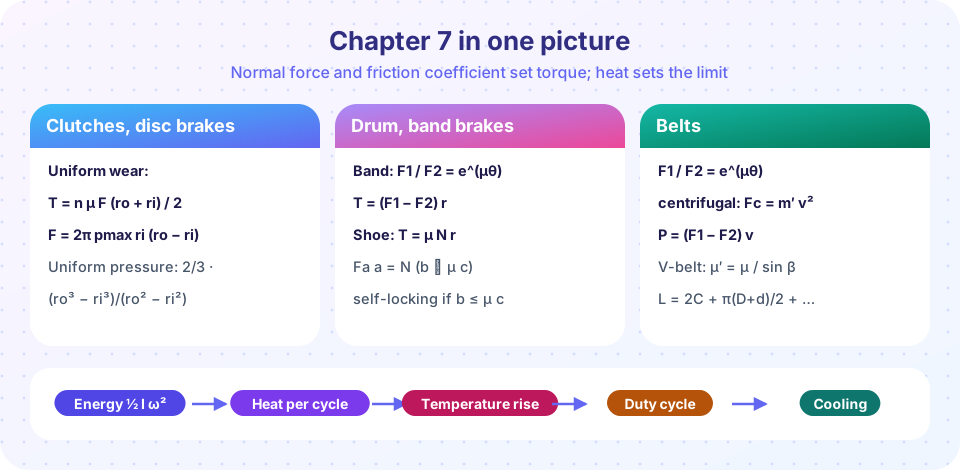
The chapter in a table
| Device | Torque or force relations | Key facts |
|---|---|---|
| Disc clutch (uniform wear) | T = n μ F (ro + ri) / 2, F = 2π pmax ri (ro − ri) |
Best ri = ro / √3; use the wear model for design |
| Disc clutch (uniform pressure) | T = n (2/3) μ F (ro³ − ri³)/(ro² − ri²) |
About 2 % higher than wear; new linings |
| Disc brake | T = 2 μ F rm |
Heat soaks into the disc; fade at high temperature |
| Short-shoe brake | T = μ N r, Fa a = N (b ∓ μ c) |
Self-locking if b ≤ μ c |
| Band brake | F1 / F2 = e^(μθ), T = (F1 − F2) r, p_max = F1 / (w r) |
Directional; differential type can self-lock |
| Belt | P = (F1 − F2) v, (F1 − Fc)/(F2 − Fc) = e^(μθ), Fc = m′ v² |
Check the small pulley; v_opt = √(F1/(3 m′)) |
| V-belt | μ′ = μ / sin β |
Less pretension, less shaft load |
| Heat | E = ½ I ω², ΔT = E / (m c), power = T ω |
Frequent cycles limit size |
How the pieces connect
All three devices use the same recipe. First, find the torque or power that they must transmit, including a service factor for shock and frequent starts. Second, choose a geometry and a material (μ, allowable pressure) and compute the torque capacity. Third, find the energy that is turned into heat and check the temperature. Belt and band brakes add a fourth step: an exponential tension ratio, which tells you how much belt tension or applying force is needed, and which direction is safe.
A worked mixed problem
A hoist drum of radius 0.15 m lifts a 500 kg load. A band brake on a brake drum of radius 0.25 m must hold the load. The band wraps the drum by 270° with μ = 0.3, and the band is 60 mm wide.
- Holding torque. The load torque at the hoist drum is
500 × 9.81 × 0.15 = 736 N·m. If the brake is on the same shaft as the hoist drum, it must give at least this torque, and with a safety factor it should give more. - Tensions.
F1 − F2 = T / r = 736 / 0.25 = 2943 N. The ratio ise^(0.3 × 4.712) = 4.11, soF2 = 2943 / 3.11 = 946 NandF1 = 3889 N. - Lining pressure.
p_max = F1 / (w r) = 3889 / (0.06 × 0.25) = 0.26 MPa, which is acceptable for a typical lining. - Applying force. With the slack end on a lever of ratio
b/a = 0.1/0.6,Fa = 946 × 0.1 / 0.6 = 158 N: easy for a person or a small spring. - Warning. The brake is directional. If the load were to drive the drum the other way, the end on the lever would become the tight end and the same brake would need
3889 × 0.1 / 0.6 = 648 N. A hoist brake must therefore be designed for both directions, or be a double-acting type.
Where the heat goes
Every device in this chapter turns work into heat. A clutch does it during engagement, a brake during every stop, and a belt slowly, through creep and bending. A quick estimate of the energy and a check of the temperature rise should become a habit. If the temperature rise per event is small, check the duty cycle: ten events per minute may be far more demanding than one per hour. If the rise is large, the design needs more mass, cooling or a different friction material.
Try it
The first TryIt is a heat check for a brake. Given the inertia, the speed and the braking torque, it prints the stopping time, the energy, the temperature rise of one stop and of a repeated duty cycle with some cooling between stops. Change the numbers to see when a brake starts to overheat. The cooling model is a simple exponential decay toward room temperature with an assumed time constant, which is a teaching model and not a thermal design.
Press Run (or Ctrl + Enter) to see the result here.
Program input · what you'd type while the program runs
Type the answers before you press Run, one per line. Each time the program reads a line (with input()), it gets the next line from this box.
The second TryIt is a quick drill covering the formulas of the chapter. Try each by hand first.
Press Run (or Ctrl + Enter) to see the result here.
Program input · what you'd type while the program runs
Type the answers before you press Run, one per line. Each time the program reads a line (with input()), it gets the next line from this box.
Check your understanding
Quick check · 10 questions
of 10 answered You scored / 10 · perfect!
-
1. A clutch with n = 2, μ = 0.3 and mean radius 90 mm is pressed with 5000 N. What torque does it transmit?
T = n μ F rm = 2 × 0.3 × 5000 × 0.090 = 270 N·m. Forgetting the number of surfaces n gives 135 N·m. -
2. For a lining with allowable pressure pmax, which inner radius gives the most torque for a fixed outer radius (uniform wear)?
Maximizing ri (ro² − ri²) gives ri = ro / √3, about 0.58 ro. -
3. What is the ratio F1/F2 for a belt with μ = 0.35 and a 150 degree wrap (no centrifugal tension)?
θ = 150° = 2.618 rad, μθ = 0.916, e^0.916 = 2.50. -
4. A short-shoe brake has b = 120 mm, c = 400 mm and μ = 0.35. In the self-energizing direction the brake is:
μ c = 140 mm is larger than b = 120 mm, so Fa a = N (b − μ c) is negative: the brake grabs by itself. -
5. Why is a V-belt drive usually installed with less initial tension than a flat belt?
μ′ = μ / sin β is several times larger than μ, so less tension is needed. -
6. A flywheel of 20 kg·m² turns at 100 rad/s. How much energy must the brake absorb to stop it?
E = ½ I ω² = ½ × 20 × 100² = 100,000 J. -
7. How does a simple band brake behave when the drum direction is reversed?
The tight and slack sides swap, so the lever must carry F1 instead of F2. -
8. Which pulley governs slip in an open belt drive?
The small pulley has the smaller wrap angle and therefore the smaller tension ratio. -
9. A 40 kg brake drum (c = 460 J/(kg·K)) absorbs 36.8 kJ in one stop. What is the temperature rise, assuming all the heat goes into the drum?
ΔT = E / (m c) = 36,800 / (40 × 460) = 2.0 K. -
10. What is the main limit on the frequency of clutch engagements?
Each engagement turns kinetic energy into heat, so frequent engagement overheats the plates.
Summary
- Friction devices follow
friction force = μ × normal force; geometry sets the lever arm. - Disc devices use the mean radius; band brakes and belts use the exponential capstan factor
e^(μθ). - Self-energizing helps the designer but must never become self-locking by accident.
- Every friction device needs an energy and temperature check.
Track your progress
Create a free account to tick off lessons and pick up where you left off on any device.
of Machine Design lessons completed