


















Lesson 11 of 46 · Fatigue and Failure
Fatigue and Failure: The Big Picture
Chapter 3 overview: why parts fail by yielding, fracture, fatigue and wear, how failure theories predict yielding under combined stress, and how fatigue life is estimated.
In 1842 a train on the railway from Paris to Versailles derailed when the front axle of its locomotive snapped. Many passengers died in the fire that followed. The axle had carried its load for a long time without trouble; then, with no warning, it broke. Investigators, among them the Scottish engineer William Rankine, concluded that cracks had slowly grown from the sharp shoulders of the axle until what remained could no longer carry the load. A few years later August Wöhler began the first systematic tests of how metals behave under repeated loading. Today we call this failure fatigue, and it remains the main reason that machine parts break.
This chapter teaches you to predict failure, in two parts. First, static failure: how to combine a complicated state of stress into one number that you can compare with the yield strength. Then fatigue: how to estimate whether a part survives millions of cycles at stresses well below yield.
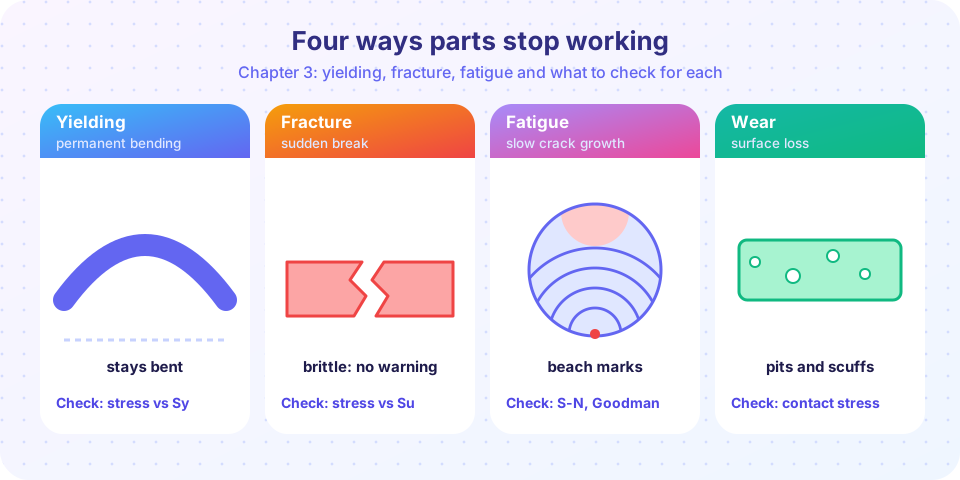
The big picture
- Yielding is permanent deformation. A part that yields no longer fits or works. We predict it with a failure theory: for ductile metals, the distortion-energy (von Mises) criterion is the standard, and the maximum shear (Tresca) criterion is a simpler, slightly more cautious alternative.
- Fracture is a break. Brittle materials fracture with no warning, so they use different criteria (maximum normal stress, Coulomb-Mohr).
- Fatigue is cracking from repeated loading. It needs its own tools: the S-N curve, the endurance limit, correction factors and the Goodman line.
- Wear and surface failure (pitting, scuffing) belongs to the chapters on gears and bearings.
Four failure modes
Combined stress
The S-N curve
Correct the lab value
Mean stress matters
What each lesson covers
| Lesson | What you can do afterwards |
|---|---|
| Static failure theories | Find principal stresses, apply von Mises and Tresca, treat brittle materials |
| Fatigue and the S-N curve | Explain how fatigue cracks grow, read an S-N curve and estimate a life in cycles |
| Endurance limit and the Marin factors | Correct the laboratory endurance limit for surface, size, load, temperature and reliability |
| Fluctuating stress and the Goodman line | Check a part with both mean and alternating stress |
| Chapter review | Test yourself on the whole chapter |
Two questions, two toolkits
Chapter 3 answers two different questions. The first is: will this part yield under the worst load it will ever see? That is a static question, and the toolkit is the failure theories. You find the stresses at the critical point, combine them into one equivalent stress with the von Mises formula, and compare it with the yield strength from the tensile test. The second question is: will this part survive the millions of cycles it will see in service? That is a fatigue question, and it needs a different toolkit. The strength is no longer the yield strength but the endurance limit, corrected for surface, size, load type and reliability, and the stress is no longer a single value but a pair of a mean and an alternating part.
A good designer asks both questions and takes the smaller factor of safety. For a rotating shaft fatigue almost always governs, but a part that is loaded once and stays still, such as a bracket holding a tank, may be governed by yielding or by fracture of a brittle material.
History shows how costly it is to ask only the first question. In the 1950s the first jet airliners, the de Havilland Comet, suffered a series of accidents. Investigators found that fatigue cracks had started at the corners of window cut-outs in the pressurized fuselage, where the stress concentration was highest, and that the repeated pressurization of each flight had slowly grown them until the skin tore. The structure had been checked for strength; it had not been checked for fatigue at its stress raisers. Rounded window corners and crack-aware inspection followed, and every modern airliner is designed with fatigue in mind. The same lesson applies to a bolt, a spring or a shaft.
Why fatigue dominates rotating machinery
A shaft turning at 1,500 rpm completes 1,500 × 60 × 24 × 365 = 788 million revolutions in a year of continuous running. Each revolution takes each surface fiber through one complete bending cycle. If the stress is enough to start a microscopic crack, even a very small growth per cycle adds up to a break within months.
Press Run (or Ctrl + Enter) to see the result here.
Program input · what you'd type while the program runs
Type the answers before you press Run, one per line. Each time the program reads a line (with input()), it gets the next line from this box.
At 1,500 rpm the 10⁶ cycles used in many fatigue tests is reached in under 12 hours. Any machine that turns for years is in the regime where only stresses below the endurance limit survive.
Press Run (or Ctrl + Enter) to see the console output here.
No output.
Check your understanding
Quick check · 4 questions
of 4 answered You scored / 4 · perfect!
-
1. Which failure is the most common cause of broken parts in rotating machines?
Rotating parts see reversing stress every turn, so cracks form and grow slowly, then the part breaks suddenly. -
2. Roughly how many revolutions does a shaft at 1,500 rpm make running continuously for a year?
1,500 × 60 × 24 × 365 ≈ 7.9 × 10⁸. -
3. Which criterion is the standard yield criterion for ductile metals under combined stress?
Von Mises matches test data for ductile metals better than the other criteria. -
4. Brittle materials under static load are usually checked against which kind of criterion?
They fracture without yielding, so normal-stress-based criteria are used.
Summary
- Parts fail by yielding, fracture, fatigue or wear; each has a matching check.
- Static failure theories reduce a combined stress state to one comparable number.
- Fatigue needs the S-N curve, corrected endurance limits and mean-stress theories.
- A shaft completes hundreds of millions of cycles a year, so fatigue is usually the governing check.
Next: Static Failure Theories
Track your progress
Create a free account to tick off lessons and pick up where you left off on any device.
of Machine Design lessons completed