


















Lesson 21 of 46 · Shafts and Fasteners
Chapter 4 Review: Shafts and Fasteners
Review chapter 4 of Machine Design: DE-Goodman shaft sizing, key shear and bearing, critical speed, bolt preload and joint constant, with a combined problem and a ten-question quiz.
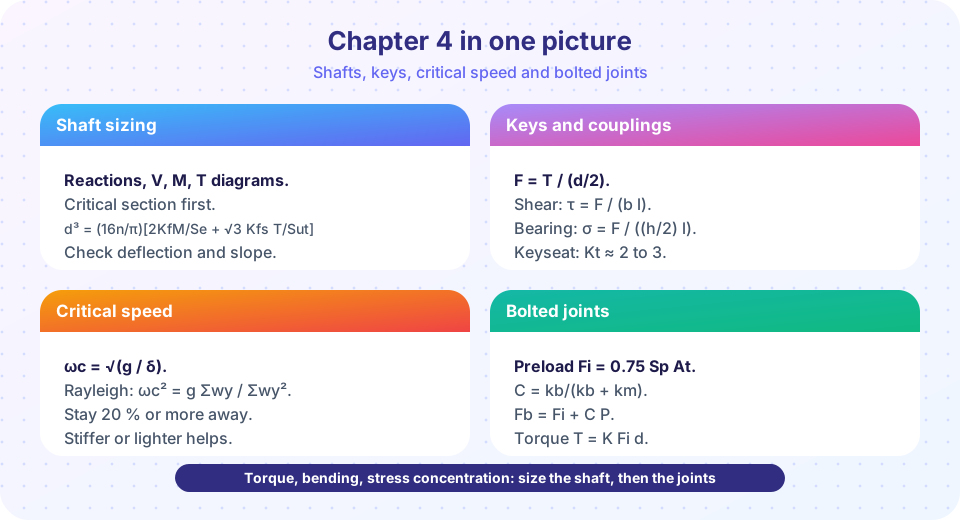
Chapter 4 turned the theory of chapters 2 and 3 into working design methods. A rotating shaft is sized by fatigue, then checked for yield, deflection and speed. A key is sized by its length. A bolted joint is sized by preload and checked three ways. This review gathers the formulas, runs one combined problem across all three topics, and finishes with a longer quiz.
What you should now be able to do
- Find the critical section of a shaft and size it with the DE-Goodman formula.
- Select a standard key and compute its length from shear and bearing stress.
- Estimate a critical speed and decide whether the running speed is safe.
- Compute preload, joint constant, bolt force, separation load and fatigue factor.
Recap table
| Lesson | Key ideas | Formulas |
|---|---|---|
| Shaft design | Bending reverses, torque is steady; iterate on d |
d = {(16n/π)[2KfM/Se + √3 Kfs T/Sut]}^(1/3) |
| Keys and critical speed | Bearing usually governs the key; stay away from resonance | F = 2T/d, σb = 2F/(hl), ωc = √(g/δ) |
| Bolted joints | Preload makes the bolt feel only C of the load | Fi = 0.75 At Sp, C = kb/(kb+km), Fb = Fi + C P |
How the checks interlock
The three topics of this chapter are tied together by the same idea: a part must be strong enough, and it must also be stiff enough and tight enough. Shaft strength comes from the fatigue formula, but the shaft must also be stiff enough for the bearings and gears (slope), stiff enough to keep the critical speed away from the running speed, and fitted with a key whose keyway does not ruin the fatigue strength. A bolt must be strong enough, but it must also be tightened enough so that the joint does not separate, because separation is what turns a harmless small load cycle into a large bolt stress cycle.
When a design fails one of these checks you rarely have only one remedy. If the critical speed is too low, you can increase the diameter, which also lowers the shaft stress and the slope, but raises the bearing size and the cost. If the key bearing stress is too high you can lengthen the key, use two keys at 120 degrees, or switch to a spline, which removes the notch. If a joint separates you can raise the preload, add bolts, or stiffen the members (which lowers C). Choose the remedy that fixes the most problems at once.
Self-check list
- Can you sketch the shear and moment diagrams of a shaft with one gear and find the critical section?
- Can you state the DE-Goodman formula and explain why it must be iterated?
- Can you compute a key length from torque, diameter and material strength?
- Can you explain why a preloaded bolt feels only a fraction of the external load?
A combined problem
A 30 mm steel shaft (Sut = 630 MPa, Sy = 530 MPa) carries a steady torque of 120 N·m through a key into a hub. The shaft is 450 mm between bearings with a 10 kg flywheel at the middle. The flywheel bolts to a flange with four M8 class-8.8 bolts. Check (a) the key, (b) the first critical speed against a running speed of 1,500 rpm, and (c) the preload and tightening torque of one M8 bolt.
Press Run (or Ctrl + Enter) to see the result here.
Program input · what you'd type while the program runs
Type the answers before you press Run, one per line. Each time the program reads a line (with input()), it gets the next line from this box.
The key needs only about 12 mm length, so a standard 25 mm key in a 30 mm hub is ample. The shaft's first critical speed is far above 1,500 rpm, so it is safely subcritical. The M8 bolt should be tightened to about 26 N·m for a preload of 16.5 kN.
Press Run (or Ctrl + Enter) to see the console output here.
No output.
Common misconceptions
- "Size the shaft for torque and add a safety factor." Reversing bending, stress concentration and the Marin factors give a much larger shaft.
- "The key transmits torque by shear only." Both shear along the interface and bearing on the side matter, and bearing usually governs.
- "More preload is always better." Above
0.75 Fpto0.9 Fpthe bolt may yield; and the mean stress reduces the fatigue margin.
Check your understanding
Quick check · 10 questions
of 10 answered You scored / 10 · perfect!
-
1. A shaft transmits 7.5 kW at 750 rpm. The torque is about
T = 9,549 × 7.5 / 750 = 95.5 N·m. -
2. Why is the shaft diameter calculation iterative?
kb = 1.24 d^−0.107, so Se changes as d changes. -
3. T = 300 N·m on a 50 mm shaft. The force on the key is
F = 2T/d = 2 × 300,000 / 50 = 12,000 N. -
4. Which stress usually governs the length of a standard key?
The contact area on the side is only (h/2) × l. -
5. A shaft sags 0.04 mm under its flywheel. Its critical speed is about
ωc = √(9,810 / 0.04) = 495 rad/s. -
6. How can you raise the critical speed of a shaft?
ωc depends on stiffness over mass, not strength. -
7. M8 class 8.8 (At = 36.6 mm², Sp = 600 MPa). The recommended preload for a reusable joint is about
Fp = 36.6 × 600 = 22.0 kN, Fi = 0.75 × 22.0 = 16.5 kN. -
8. kb = 300 kN/mm and km = 1,200 kN/mm. What fraction of an external load does the bolt carry?
C = 300/1,500 = 0.2. -
9. With Fi = 30 kN and C = 0.25, at what external load does the joint separate?
P0 = Fi/(1 − C) = 30/0.75 = 40 kN. -
10. What happens to the bolt's fatigue loading if the preload is lost and the joint separates?
After separation the bolt carries the whole load, and the amplitude jumps from C P/(2At) to P/(2At).
Summary
- Shafts are sized for fatigue with
d = {(16n/π)[2KfM/Se + √3 Kfs T/Sut]}^(1/3), iterated, then checked for yield, deflection and speed. - Keys:
F = 2T/d; bearing usually governs; keyways are stress raisers. - Critical speed:
ωc = √(g/δ); stay 20 to 30% away. - Bolts:
Fi = 0.75 Fp,C = kb/(kb + km),Fb = Fi + C P,P0 = Fi/(1 − C); check proof, separation and fatigue.
Track your progress
Create a free account to tick off lessons and pick up where you left off on any device.
of Machine Design lessons completed