


















Lesson 4 of 46 · Getting Started
Chapter 1 Review: Getting Started
Review chapter 1 of Machine Design: the design loop, consistent SI units, torque from power, stress-strain curves and material comparison, with a ten-question quiz.
You have met the vocabulary, the mindset and the material data that every later chapter depends on. This review pulls it onto one page, lets you run a short end-to-end calculation, and then tests you with a longer quiz that mixes the lessons.
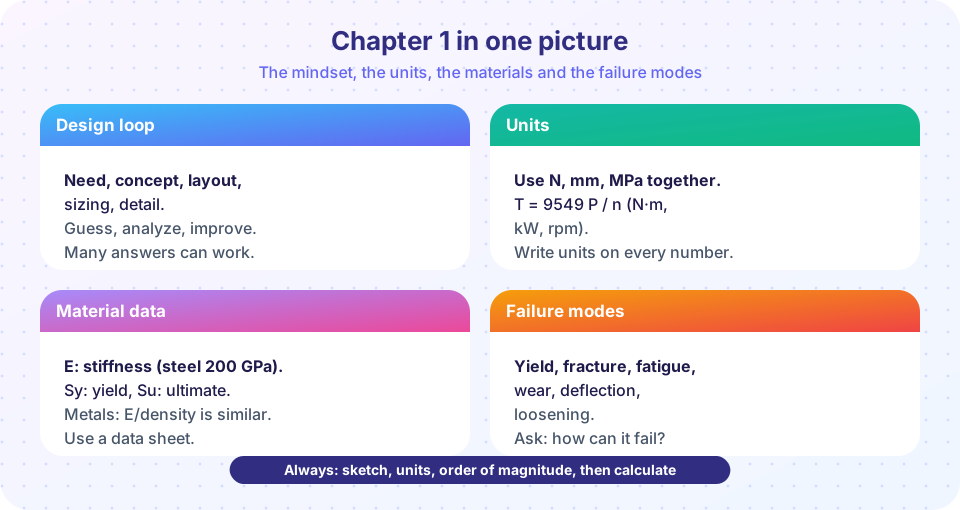
What you should now be able to do
- Explain how design differs from analysis, and name the five stages of a design.
- Work in N, mm and MPa without conversion errors, and compute torque from power and speed.
- Read a stress-strain curve and say what E, Sy, Su and elongation mean.
- Compare materials by strength and stiffness per unit mass.
- Name the main failure modes and say which one to worry about first.
Recap table
| Lesson | Key idea | Formula or fact to remember |
|---|---|---|
| Course map | Nine chapters from mindset to complete projects | T = 9,549 P / n (N·m, kW, rpm) |
| What is machine design? | Design is open-ended; analysis checks a given part | Five stages: need, concept, layout, sizing, detail |
| Units and materials | N, mm, MPa form a consistent set | σ = E ε; E/density is nearly equal for steel, aluminum and titanium |
Three habits link the lessons. Estimate before you calculate, so a wrong order of magnitude shows up at once. Carry units on every number. Ask how it can fail before you pick a formula.
How the three lessons connect
The first chapter is short, but it carries a whole way of working. The course map showed you what a machine is made of and how the rest of the course is organized. The second lesson explained that design starts from a need and loops through concept, layout, sizing and detail, which is why later chapters keep asking you to guess a size, check it and adjust. The third lesson gave you the tools for that checking: a unit system in which stress comes out in megapascals without conversion factors, the relation between power, speed and torque, and the material properties that every strength formula reads from a table.
Read the three lessons as a single sentence. A machine designer chooses parts to meet a need, checks each part with consistent units against the strength of a known material, and thinks first about how the part can fail. Everything that follows in chapters 2 to 4 is a more detailed version of one clause of that sentence: loads and failure checks, fatigue, and the shafts and bolts that make the sentence concrete.
Study tips before moving on
- Redo the end-to-end calculation below with your own numbers: a different power, a different speed and a different shaft diameter. Predict the direction of each change before you run it.
- Write down, from memory, the yield strength, ultimate strength and modulus of three materials. Orders of magnitude are what matter: steel is about 200 GPa, aluminum about 70 GPa.
- Pick a machine you know, such as a bicycle or a drill, and list five elements in it and how each one could fail. That habit is the seed of every design check in the course.
An end-to-end mini calculation
A motor delivers 5.5 kW at 960 rpm to a solid steel shaft of 25 mm diameter. What are the torque, the shear stress and the factor of safety against yielding, if Sy = 370 MPa? First the torque: T = 9,549 × 5.5 / 960 = 54.7 N·m. The shear stress in a solid round shaft is τ = 16 T / (π d³), with T in N·mm and d in mm. And the shear yield strength is about 0.577 Sy = 213 MPa.
Press Run (or Ctrl + Enter) to see the result here.
Program input · what you'd type while the program runs
Type the answers before you press Run, one per line. Each time the program reads a line (with input()), it gets the next line from this box.
The shaft is very safe against static yielding. Static torque is only part of the story: bending from gears and pulleys, and fatigue, usually decide the final size. That is what chapters 3 and 4 are about.
Press Run (or Ctrl + Enter) to see the console output here.
No output.
Common misconceptions
- "The motor power fixes the torque." Only at a given speed. The same power gives a higher torque at a lower speed.
- "More strength means more stiffness." Heat treatment raises strength but leaves E almost unchanged.
- "If the static safety factor is large, the part is safe." Static checks do not detect fatigue. Rotating parts need the fatigue check as well.
Check your understanding
Quick check · 9 questions
of 9 answered You scored / 9 · perfect!
-
1. A shaft transmits 10 kW at 500 rpm. Approximately what is the torque?
T = 9,549 × 10 / 500 = 191 N·m. -
2. Which unit set gives stress directly in MPa?
1 N/mm² equals 1 MPa, so force in N and length in mm gives MPa without conversion. -
3. What defines yield strength by the offset method?
The 0.2% offset line is drawn parallel to the elastic part, starting at strain 0.002; its intersection with the curve gives Sy. -
4. Which stage of design usually decides the success of a design most?
A poor concept cannot be rescued by careful sizing. -
5. Steel has E ≈ 200 GPa and density 7,850 kg/m³. Aluminum has E ≈ 70 GPa and density 2,700 kg/m³. How do their stiffness-to-weight ratios compare?
200/7,850 ≈ 0.0255 and 70/2,700 ≈ 0.0259 (in GPa per kg/m³), so the ratios are almost the same. -
6. A bar with a cross-section of 50 mm² carries 20 kN. What is the stress?
20 kN = 20,000 N, and 20,000 / 50 = 400 MPa. Forgetting the kN to N conversion would give 0.4. -
7. Which failure mode is most common in rotating machinery?
Stresses reverse each revolution, so cracks start and grow slowly, then the part breaks suddenly. -
8. A designer rounds a calculated diameter of 13.1 mm down to 12.5 mm to match a standard size. What is wrong with that?
Round up for strength; rounding down reduces the margin below the target. -
9. Which statement about brittle materials is correct?
Gray cast iron, for example, has a much higher compressive than tensile strength and breaks without much stretching.
Summary
- Design is a loop: need, concept, layout, sizing, detail.
- Use N, mm, MPa; carry units; estimate first.
- The tensile test gives E, Sy, Su and ductility.
- Torque from power:
T = 9,549 P / n. - Think in failure modes, and round sizes up.
Track your progress
Create a free account to tick off lessons and pick up where you left off on any device.
of Machine Design lessons completed