


















Lesson 7 of 46 · Design Process and Loads
Loads and Load Paths
Classify machine loads as static, cyclic, impact or thermal, compute gear and impact forces, find stress amplitude and mean, and trace a force through a machine to the ground.
You cannot size a part until you know what it carries. In textbooks the loads are given. In real design you must find them: from the power the motor delivers, from the weight and acceleration of moving masses, from the teeth of the gears, from the pull of a belt. Then you must follow each force through the machine, part by part, until it reaches the ground. Miss one load, or one link in the chain, and the calculation protects the wrong thing.
This lesson gives you a vocabulary for loads, the formulas for the most common sources, and a method for tracing a load path.
What you will learn
- How to classify loads as static, cyclic, impact or thermal, and why it matters.
- How to compute stress amplitude, mean stress and the stress ratio of a cycle.
- How to find gear forces, inertia forces and impact loads.
- How to trace a load path with free-body diagrams.
Key terms
- Static load: constant, or changing so slowly that inertia is negligible.
- Stress amplitude σa and mean stress σm: half the range, and the average of the maximum and minimum stress in a cycle.
- Stress ratio R:
R = σmin / σmax;R = −1is completely reversed. - Impact (dynamic) load: a load applied suddenly or with velocity, creating a larger force than the same weight applied slowly.
- Load path: the sequence of parts through which a force travels.
Four kinds of loads
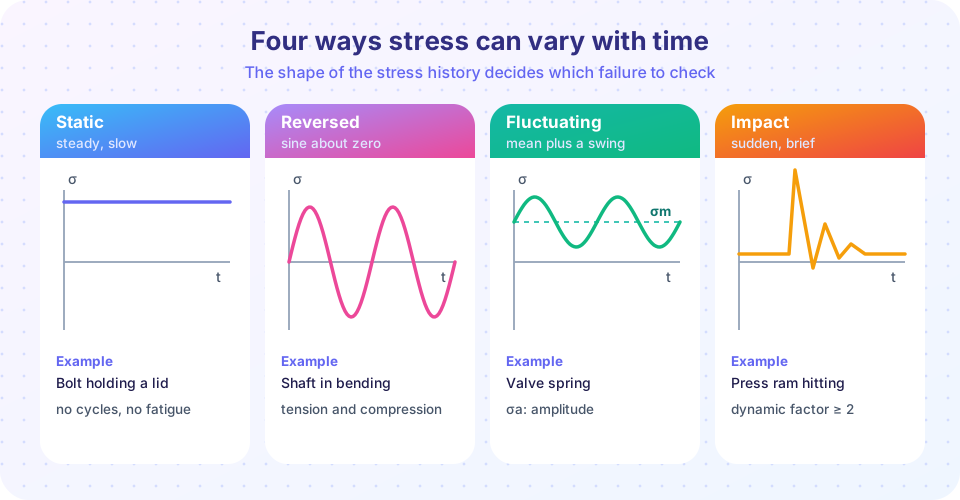
Static loads do not change, or change so slowly that accelerations do not matter. A bolt that clamps a lid, a shelf bracket carrying books, a column under a tank: static failure (yielding or fracture) is the thing to check.
Cyclic loads repeat. A rotating shaft carrying a constant sideways load sees each surface fiber go from tension to compression and back once per revolution: the load is constant, but the stress is cyclic. This is the most important idea in the chapter on fatigue. A part can carry a load for years and then break at a stress far below the yield strength.
Impact loads are applied suddenly: a hammer, a press, a car hitting a pothole, a crane starting a lift with a slack rope. The force can be much larger than the weight alone.
Thermal loads appear when a part is heated or cooled but cannot expand freely. A steel rod held rigidly between two walls and heated by ΔT develops a compressive stress σ = E α ΔT, where α is the coefficient of thermal expansion (about 12 × 10⁻⁶ /K for steel). For ΔT = 50 K that is 200,000 MPa × 12 × 10⁻⁶ × 50 = 120 MPa, a large stress from nothing but a temperature change.
Describing a cycle
When stress varies in a regular cycle between σmax and σmin, we describe it with four numbers.
σm = (σmax + σmin) / 2         mean stress
σa = (σmax − σmin) / 2         stress amplitude
R  = σmin / σmax               stress ratio
A rotating shaft in bending has σmax = +80 MPa and σmin = −80 MPa, so σm = 0, σa = 80 MPa and R = −1: completely reversed. A spring that is compressed between 60 and 100 MPa has σm = 80, σa = 20 and R = 0.6: fluctuating. A part loaded from zero to a maximum and back has R = 0: repeated. These numbers feed directly into the fatigue methods in chapter 3.
Where loads come from
Most machine loads come from only a few sources, and each has a formula.
Power transmission. A shaft that transmits power P at speed n carries torque T = 9,549 P / n (N·m, kW, rpm). A gear of pitch diameter d then receives a tangential force Ft = 2T / d. For a spur gear with the standard 20° pressure angle, the teeth also push radially with Fr = Ft tan 20° = 0.364 Ft. A 100 mm gear carrying 100 N·m gets Ft = 2 × 100 / 0.1 = 2,000 N and Fr = 728 N. These forces bend the shaft, in addition to twisting it.
Weight and inertia. A rotating mass m at radius r with speed ω has a centripetal force F = m ω² r. An unbalanced 2 kg wheel with its center of mass 1 mm off the axis, at 3,000 rpm (ω = 314 rad/s), pulls on the bearings with 2 × 98,700 × 0.001 = 197 N. A trifling imbalance becomes a rotating load which, at higher speeds, grows with the square of speed.
Belts and chains. The tight and slack sides differ in tension by F1 − F2 = T / r. The sum acts on the shaft as a sideways load, which you will compute in the lesson on belts.
Operating conditions. Starting, stopping, jams and misuse. A motor's start-up torque may be two to three times its rated torque. Designers cover these with a service factor that multiplies the nominal load: for example 1.0 for a smooth electric motor driving a fan, 1.5 for light shocks and 2 or more for heavy shocks.
Press Run (or Ctrl + Enter) to see the result here.
Program input · what you'd type while the program runs
Type the answers before you press Run, one per line. Each time the program reads a line (with input()), it gets the next line from this box.
Impact loads
When a weight W falls through a height h onto a part with stiffness k, the part deflects δst = W / k under a slowly applied W. The kinetic energy released is absorbed by the spring; the maximum deflection and force follow from energy balance:
δmax = δst · (1 + √(1 + 2h / δst))
Fmax = W  · (1 + √(1 + 2h / δst))
The factor in parentheses is the impact factor. With h = 0, a load applied suddenly but not dropped, it equals 2: the load produces twice the static deflection and stress. If you drop a weight from a height equal to ten times the static deflection, the impact factor is 1 + √21 = 5.6.
Press Run (or Ctrl + Enter) to see the result here.
Program input · what you'd type while the program runs
Type the answers before you press Run, one per line. Each time the program reads a line (with input()), it gets the next line from this box.
Tracing a load path
Take any force and ask: where does it go next? Draw a free-body diagram of the first part that receives it. Find the reactions. Those reactions are the loads on the next part, with the directions reversed. Repeat until the force reaches the ground (or the frame that is assumed rigid).
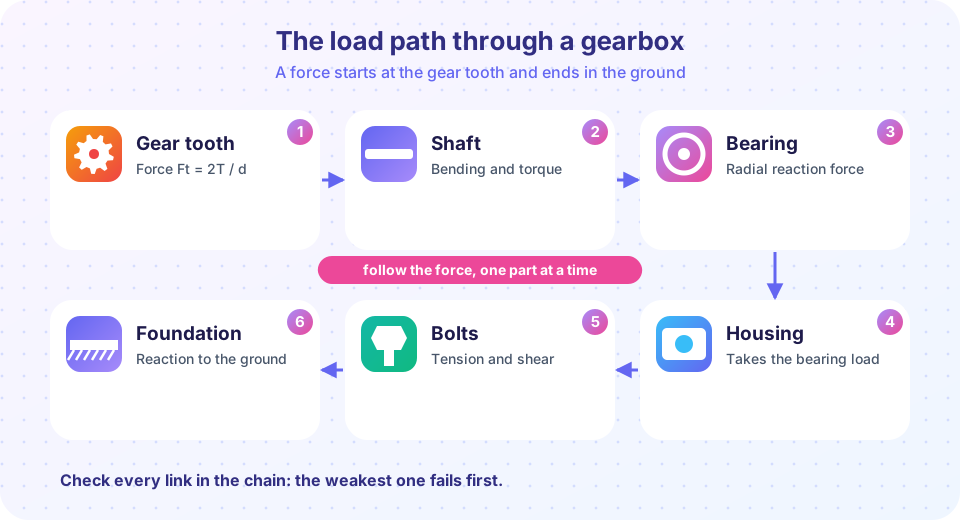
For a gear shaft with Ft = 2,000 N and Fr = 728 N acting midway between two bearings, each bearing carries half of each force: 1,000 N and 364 N, a resultant of 1,064 N. That is the load for the bearing selection in chapter 6. The bearing passes the same force to the housing; the housing passes it to the bolts; the bolts pass it to the foundation. At each step the stresses, the stiffness and the fastening must be checked.
A load path also tells you where not to waste material. A part that does not lie on a load path carries almost no load, and it can be thin. A part that lies on a load path with a sharp corner is where you should spend your attention.
Common misconceptions
- "A constant load gives a constant stress." Not in a rotating part. A constant sideways force on a rotating shaft produces a stress that reverses once per revolution.
- "Weight is the only load." Inertia, imbalance, belt pull, gear forces and thermal expansion are often larger than the weight.
- "A load applied suddenly is the same as a static load." It can double the stress, and a drop multiplies it more.
Check your understanding
Quick check · 5 questions
of 5 answered You scored / 5 · perfect!
-
1. A rotating shaft carries a constant sideways load. How does the bending stress at a surface fiber vary?
As the shaft turns, the fiber moves from the tension side to the compression side. The load is constant; the stress is completely reversed. -
2. σmax = 120 MPa and σmin = 40 MPa. What are σa and σm?
σa = (120 − 40)/2 = 40 MPa and σm = (120 + 40)/2 = 80 MPa. -
3. A spur gear (20° pressure angle) of pitch diameter 200 mm transmits 200 N·m. What is the tangential force?
Ft = 2T/d = 2 × 200 N·m / 0.2 m = 2,000 N. -
4. A weight is applied suddenly (without being dropped) to a linear elastic part. By what factor does the maximum stress exceed the static value?
From energy balance with h = 0 the impact factor is 1 + √1 = 2. -
5. What is the thermal stress in a fully restrained steel bar (E = 200 GPa, α = 12×10⁻⁶ per K) heated by 100 K?
σ = E α ΔT = 200,000 × 12×10⁻⁶ × 100 = 240 MPa.
Summary
- Loads are static, cyclic, impact or thermal; the type decides the check.
- For a cycle:
σm = (σmax + σmin)/2,σa = (σmax − σmin)/2,R = σmin/σmax. - Gear loads:
Ft = 2T/d,Fr = Ft tan φ. Imbalance force:m ω² e. - A suddenly applied load doubles the stress; a drop multiplies it by
1 + √(1 + 2h/δst). - Trace the load path with free-body diagrams from the source to the ground.
Next: Stress Concentration
Track your progress
Create a free account to tick off lessons and pick up where you left off on any device.
of Machine Design lessons completed