


















Lesson 30 of 46 · Bearings and Springs
Helical compression springs
Design a helical compression spring: spring rate k = G d^4 / (8 D^3 Na), shear stress with correction factors, end types, solid length, buckling and surge, with a worked design.
A spring is a machine element that deflects under load and returns to its shape when the load is removed. It stores energy as elastic deformation. Valve springs close engine valves thousands of times a minute, the springs in a car suspension carry the body weight over bumps, a ballpoint pen has one, and so does almost every latch, clutch and brake in this book. The most common type by far is the helical compression spring: a wire wound into a coil, which gets shorter when you push on its ends.
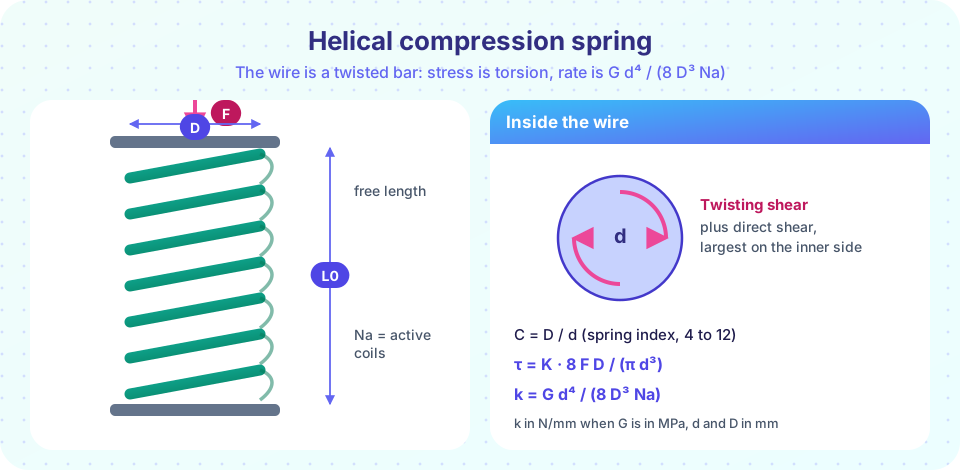
The key insight that makes spring design easy is that the wire of a helical spring is loaded in torsion, not in bending. When you press down on a coil spring, each short piece of wire is twisted like a tiny shaft. Everything you know about twisting round bars (shear stress, angle of twist, G the shear modulus) carries over directly.
What you will learn
- Derive the spring rate and the stress from the torsion of the wire.
- Use the spring index and the stress correction factors
Ks,K_BandK_W. - Find solid length, free length and active coils for common end types.
- Check a spring for yielding, buckling and surge, and complete a worked design.
Key terms
- Wire diameter
dand mean coil diameterD: measured to the center of the wire,D = outside diameter − d. - Spring index
C = D / d: the main shape parameter; 4 to 12 is the normal range. - Active coils
Na: the coils that really deflect. End coils that are squashed against the plate do not count. - Spring rate
k: force per unit deflection, in N/mm. - Solid length
Ls: the length when all coils touch.
Rate: from wire twist to spring stiffness
Imagine the force F acting along the axis of a spring with mean coil diameter D. It acts at a distance D/2 from the wire, so each section of wire carries a torque T = F D / 2. From the theory of torsion, a round bar of diameter d has the maximum shear stress τ = 16 T / (π d³), which gives
τ = 8 F D / (π d³)
The wire is π D Na long and twists by an angle θ = T L / (G J) with J = π d⁴ / 32. The coil's axial deflection follows from the twist times the lever arm D/2, which gives, after simplifying, the deflection y = 8 F D³ Na / (G d⁴) and the spring rate
k = F / y = G d⁴ / (8 D³ Na)
Two proportions stand out. The rate depends on d to the fourth power: a 10 percent thicker wire makes the spring 46 percent stiffer. And it depends on D³: doubling the coil diameter makes the spring eight times softer. More active coils make a softer spring in direct proportion.
The units work out neatly in N and mm: with G in MPa (N/mm²) and d, D in mm, k is in N/mm. For steel, G is about 79 to 82 GPa (music wire 81.7 GPa, stainless steel about 69 GPa).
Stress and the correction factors
The simple stress formula neglects two effects. The load also causes a direct shear F / A across the wire, and the curvature of the coil makes the shear stress larger on the inside of the coil, where the wire is stretched more. Both are captured by a correction factor K on the nominal stress:
τ = K · 8 F D / (π d³)
| Factor | Formula | Use |
|---|---|---|
Ks (direct shear) |
1 + 0.5 / C |
Static loads in ductile springs |
K_W (Wahl) |
(4C − 1) / (4C − 4) + 0.615 / C |
Fatigue; includes curvature |
K_B (Bergsträsser) |
(4C + 2) / (4C − 3) |
Fatigue; within about 1 % of Wahl |
For a static load on a ductile wire, local yielding of the inner side relieves the curvature effect, so Ks is enough. For a spring that cycles many times, use K_B or K_W. For C = 8, Ks = 1.0625 and K_B = 1.172, a difference of about 10 percent in stress, which is why fatigue needs more care. Springs with a very small index (C < 4) are hard to wind and carry high stress; springs with a large index (C > 12) tangle, buckle and are less accurate.
Material strength
Spring wire is drawn through dies, which makes it very strong, and the strength depends strongly on the wire diameter. For common materials, the tensile strength follows a fit Sut = A / d^m. For music wire (ASTM A228), A = 2211 MPa·mm^m and m = 0.145 (with d in mm), which gives Sut ≈ 2000 MPa at d = 2 mm and ≈ 1885 MPa at d = 3 mm. For static design, the yield strength in shear of cold-drawn wire is about Ssy ≈ 0.45 Sut. A spring that is pre-set (compressed to solid at the factory so that it yields slightly in a favorable pattern) can have its working limit raised toward 0.6 to 0.7 Sut, but it must never be loaded further than the set load.
Ends, lengths and active coils
The way the ends are finished decides how many coils are active and how long the spring is when pressed solid.
| End type | Total coils Nt |
Solid length Ls |
|---|---|---|
| Plain | Na |
(Nt + 1) d |
| Plain and ground | Na + 1 |
Nt d |
| Squared (closed) | Na + 2 |
(Nt + 1) d |
| Squared and ground | Na + 2 |
Nt d |
Squared and ground ends sit flat on the plates and are best for good alignment. The free length L0 must leave a small gap at the highest working load, so that the coils never close completely in service. A common rule is a clash allowance of 10 to 15 percent of the working deflection: L0 = Ls + (1 + ξ) y_max with ξ ≈ 0.15.
Buckling and surge
A long, slender spring can buckle sideways like a column. As a quick rule, a squared-and-ground spring between flat plates with a free length less than about 4 times its mean diameter is safe from buckling; a longer one should be guided by a rod or tube, or checked against the buckling chart in a handbook.
A second danger is surge, a resonance of the coils themselves. A spring carries waves along its length just like a long rubber tube. If the spring is cycled at a frequency near its natural frequency, the coils can clash and the stress can exceed the design stress by a large amount. For a spring with both ends fixed:
fn = (1/2) √(k / m_s) with spring mass m_s = ρ (π d² / 4)(π D Na)
The usual guideline is that the natural frequency should be at least 13 to 15 times the operating frequency (so the 13th to 15th harmonic of the forcing does not cause resonance). Valve springs fight surge by being very light, with a progressive pitch or two springs one inside another.
Combining springs
For two springs in parallel (side by side, sharing the load) the rates add: k = k1 + k2. For springs in series (end to end, sharing the deflection) the compliances add: 1/k = 1/k1 + 1/k2, so the combination is softer than the softest spring.
Worked example: a design
A spring must carry F = 200 N at its working length and have a rate of about 10 N/mm. Use music wire with d = 3 mm and D = 24 mm, squared and ground ends.
- Index
C = 24/3 = 8, within the normal range. - Active coils:
Na = G d⁴ / (8 D³ k) = 81700 × 81 / (8 × 13824 × 10) = 5.98, so useNa = 6andk = 9.97 N/mm. - Deflection at 200 N:
y = 200 / 9.97 = 20.1 mm. - Stress:
Ks = 1.0625, soτ = 1.0625 × 8 × 200 × 24 / (π × 27) = 481 MPa. - Strength:
Sut = 2211 / 3^0.145 = 1885 MPa,Ssy = 0.45 × 1885 = 848 MPa. Safety factor848 / 481 = 1.76. - Lengths:
Nt = 8,Ls = 8 × 3 = 24 mm,L0 = 24 + 1.15 × 20.1 = 47.1 mm. The working length is47.1 − 20.1 = 27.0 mm. - At solid height, the force would be
9.97 × (47.1 − 24) = 230 Nand the stress 553 MPa, which is still belowSsy(safety factor 1.53), good, because accidental overload to solid does not yield the spring. - Buckling:
L0 / D = 47.1 / 24 = 1.96, far below 4. - Surge: the spring mass is about 25 g, so
fn = ½ √(9970 / 0.0251) = 315 Hz. The spring can be operated safely up to about315 / 13 ≈ 24 Hz.
If this spring is cycled many times, add a fatigue check with K_B = 1.17, which raises the corrected stress to about 530 MPa at the top of the cycle, and compare with the endurance data for the wire.
Common misconceptions
- "Springs fail in bending." In a helical compression spring the wire is in torsion, so the failure surface runs at 45 degrees to the wire axis, as in a twisted bar.
- "All the coils deflect." The end coils are dead coils. Using the total coil count in the rate formula gives a spring that is too soft.
- "A thicker wire gives a slightly stiffer spring." The rate goes with
d⁴, so a small change in the wire diameter makes a big change. - "If the stress is below yield, the spring is fine forever." Cyclic loading needs a fatigue check with the Bergsträsser or Wahl factor, and surge needs a frequency check.
Try it
The first TryIt is a spring designer. It computes the rate, stress, safety factor, lengths and surge frequency, and flags problems. Change the wire diameter, the coil diameter or the number of coils and watch the safety factor and the clash allowance.
Press Run (or Ctrl + Enter) to see the result here.
Program input · what you'd type while the program runs
Type the answers before you press Run, one per line. Each time the program reads a line (with input()), it gets the next line from this box.
The second TryIt shows the force-deflection line of the worked example with its working region and the solid point, and compares the three stress correction factors as a function of the spring index.
Press Run (or Ctrl + Enter) to see the result here.
Program input · what you'd type while the program runs
Type the answers before you press Run, one per line. Each time the program reads a line (with input()), it gets the next line from this box.
Check your understanding
Quick check · 5 questions
of 5 answered You scored / 5 · perfect!
-
1. Which loading acts in the wire of a helical compression spring?
The force at the coil radius twists each wire section. The failure is a shear failure, not a bending one. -
2. A spring has wire diameter 4 mm. If the wire is changed to 5 mm with everything else equal, the spring rate becomes about:
k is proportional to d⁴, and (5/4)⁴ = 2.44. -
3. A spring has k = 20 N/mm. What is the rate when two such springs are placed in series?
In series 1/k = 1/20 + 1/20 = 1/10, so k = 10 N/mm. -
4. Why do we count only active coils Na in the rate formula?
Squared end coils touch the plate and are not free to deflect, so only the active ones take part. -
5. What is spring surge?
Waves travel along the coil. If the load repeats near the spring's natural frequency, the coils vibrate strongly and the stress increases.
Summary
- The wire of a helical spring is in torsion:
τ = K · 8 F D / (π d³)andk = G d⁴ / (8 D³ Na). - Spring index
C = D / dfrom 4 to 12; useKsfor static loads andK_BorK_Wfor fatigue. - Music wire:
Sut = 2211 / d^0.145(MPa, d in mm); shear yield about0.45 Sut. - Squared and ground ends:
Nt = Na + 2,Ls = Nt d; allow about 15 percent clash allowance forL0. - Check buckling (
L0 / D < 4guideline), surge (fnat least 13 times the operating frequency) and fatigue.
Track your progress
Create a free account to tick off lessons and pick up where you left off on any device.
of Machine Design lessons completed