


















Lesson 27 of 46 · Bearings and Springs
Chapter 6 overview: bearings and springs
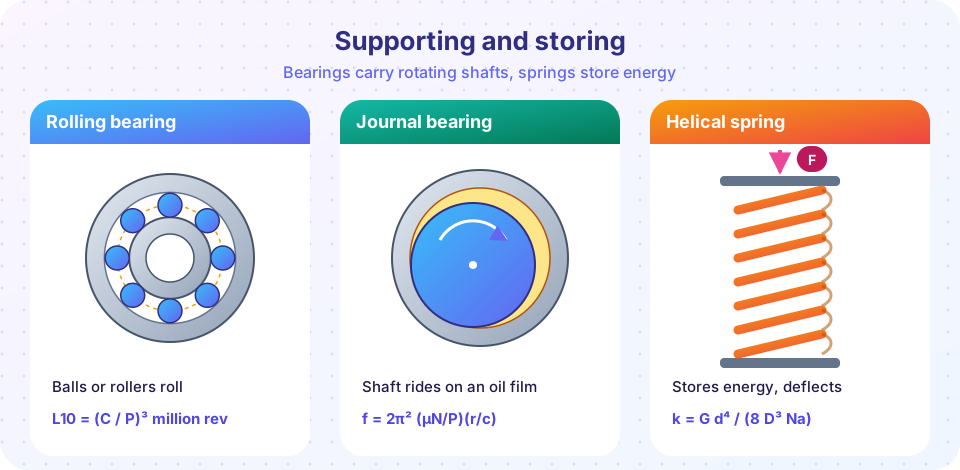
A map of the bearings and springs chapter: rolling bearings and their L10 life, journal bearings and oil films, and helical springs for load and energy storage.
Two kinds of machine elements appear in almost every design and are often chosen last, with unhappy results. The first are bearings, which let a shaft turn while carrying load. The second are springs, which store energy or provide a force that changes with position. A shaft with perfect gears but poor bearings will fail in weeks; a clutch with a badly chosen spring will slip or never release.
The two subjects share a mindset. In both cases you start from a known load, pick a standard component from a catalog or a handbook, and then check that it will last. Neither is something you design from raw metal: you select bearings by their rating and you design springs around standard wire sizes. The difference lies in the failure mechanisms: rolling bearings fail by fatigue of the contact surfaces, journal bearings by loss of the oil film, springs by torsional fatigue or yielding of the wire.
What you will learn
- The difference between rolling and sliding bearings, and when each is the better choice.
- Where the key formulas come from: L10 life, the Petroff equation and the spring rate.
- How this chapter uses the shaft loads you found from the gear forces.
- What you will be able to do at the end: select a bearing for a life requirement and design a spring for a force and a rate.
Key terms
- Rolling bearing: a bearing in which balls or rollers carry the load between two rings.
- Journal bearing: a bearing in which the shaft slides on an oil film inside a sleeve.
- Spring rate
k: the force needed per unit of deflection. - Life rating: the number of revolutions that a stated fraction of identical bearings survive.
The chapter in five slides
Why bearings?
Rolling bearings
Journal bearings
Springs
Your routine
Then iterate.
What each lesson covers
- Rolling bearing life and selection: bearing types, the L10 life formula, equivalent load, reliability and a complete selection example.
- Journal bearings and lubrication: the oil wedge, the Stribeck curve, Petroff friction and the heat that a film bearing creates.
- Helical compression springs: spring rate, shear stress and correction factors, end types, solid length, buckling and surge.
- Chapter review: the whole chapter on one page, a recap table and ten mixed questions.
Where the loads come from
The input to every calculation in this chapter is a load. For a gear shaft that load comes from the previous chapter: the tangential, radial and axial components of the tooth force act on the shaft, and the two bearings carry the reactions. A spur gear pair with a 7.5 kW drive at 1450 rpm, for instance, puts about 2.0 kN tangentially and 0.7 kN radially on the pinion shaft. The distance between the bearings and the gear then decides the reaction at each bearing, by a simple moment balance. Once you have the reactions, you look at the speed and the required hours and choose the bearing; the spring design needs the force at its working position.
The widget below connects the three numbers that control bearing life. Change the rating C, the equivalent load P and the speed, and see the L10 life in revolutions and in hours. It is a calculator built on the formula L10 = (C / P)³, so it only represents ball bearings.
Try it
The second tool compares the three element types on the property that matters most for each: what limits their life.
Press Run (or Ctrl + Enter) to see the result here.
Program input · what you'd type while the program runs
Type the answers before you press Run, one per line. Each time the program reads a line (with input()), it gets the next line from this box.
Check your understanding
Quick check · 4 questions
of 4 answered You scored / 4 · perfect!
-
1. Which bearing type relies on an oil film generated by the shaft's own rotation?
In a hydrodynamic journal bearing the rotation drags oil into a wedge and builds the film pressure. -
2. What does the rolling bearing L10 life refer to?
L10 is the life at which 10 percent have failed, so 90 percent reach or exceed it. -
3. In a helical compression spring the wire mainly experiences:
The axial force twists the wire sections. The stress is a torsional shear stress. -
4. Which input do all calculations in this chapter need first?
Every check starts from the force on the bearing or spring.
Summary
- Bearings let shafts turn and locate them; springs store energy and give a position-dependent force.
- Rolling bearings are chosen by life rating, journal bearings by film conditions, springs by rate and stress.
- Loads from gears and belts feed directly into these selections.
- The next three lessons give you the formulas; the review checks them together.
Track your progress
Create a free account to tick off lessons and pick up where you left off on any device.
of Machine Design lessons completed