


















Lesson 42 of 46 · Projects and Practice
Practice problems: gears, bearings, springs and friction devices
Thirteen practice problems on gears, bearings, springs, clutches, brakes and belts, with hints, a worked-answer script and an interactive answer checker.
You learn machine design by solving problems, not by reading about them. This lesson gives you thirteen problems that follow the order of the chapters you have just finished: gears first, then bearings and springs, then clutches, brakes and belts, and finally a problem that joins several elements. Each problem is short and has one main idea. The numbers are chosen so that you can check your work with a pocket calculator.
Try each problem on paper before you look at any answer. The solution script below prints worked answers with the intermediate values, and the answer checker lets you type your result and see whether it is within 2 percent. If your answer is wrong, do not just correct the number: find the step where your reasoning went wrong, because that step is the one you will repeat in the exam or in a real design.
What you will learn
- How to apply the formulas of chapters 5, 6 and 7 to short numerical problems.
- A repeatable five-step routine for solving problems with fewer errors.
- How to check your own answers by magnitude and by units.
- Which mistakes are the most common, and how to avoid them.
Key terms
- Sanity check: a quick test that an answer has the right size and units.
- Free body diagram: a sketch of one part with all forces on it, used to write equilibrium equations.
- Order of magnitude: the rough size of a number, for example "tens of newtons".
The routine
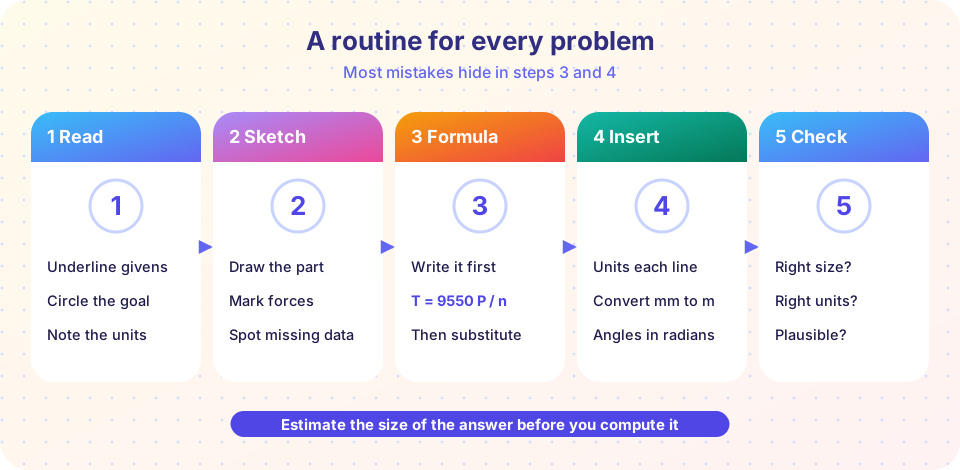
- Read twice. Underline the given values, and circle what you are asked to find. Note the units.
- Sketch. A picture of the gear, the shaft, the band or the belt, with forces and dimensions marked, shows missing information.
- Write the formula first. For example
T = 9550 P / n, before inserting any number. - Substitute with units. Write every number with its unit and convert millimeters to meters before using a formula in SI.
- Check. Is the answer the right size? Does a 1 kW motor give 5000 N·m? Is a safety factor of 40 plausible?
Gears
Problem 1: geometry. A pinion has 24 teeth and module 3 mm. It drives a gear of 72 teeth at an input speed of 1800 rpm. Find the pitch diameters, the center distance, the gear ratio and the output speed.
Problem 2: forces. A 15 kW motor turns at 970 rpm and drives a pinion of 90 mm pitch diameter. Find the torque, the tangential force and the radial force (20° pressure angle).
Problem 3: bending. For the pinion of problem 2, the module is 3 mm (so it has 30 teeth, Y = 0.359), the face width is 40 mm and the application factor is 1. Compute the Lewis bending stress with the Barth velocity factor Kv = (6.1 + v)/6.1. Hint: find the pitch-line velocity first.
Problem 4: helical gear. A helical gear carries Wt = 2500 N with a helix angle of 25° and a normal pressure angle of 20°. Find the radial force and the axial thrust.
Problem 5: worm. A single-start worm has a pitch diameter of 40 mm and an axial pitch of 12.566 mm (axial module 4 mm). The friction coefficient is 0.04 and the normal pressure angle 20°. Find the lead angle and the efficiency, and decide whether the drive is self-locking (it locks when μ ≥ cos φn tan λ).
Bearings and springs
Problem 6: L10 life. A ball bearing has C = 25 kN and carries P = 3 kN at 1200 rpm. Find L10 in millions of revolutions and in hours.
Problem 7: selection. A ball bearing carries P = 4 kN at 900 rpm and must last 15,000 hours. What dynamic rating C is required?
Problem 8: journal bearing. A journal bearing has r = 20 mm, l = 40 mm, radial clearance c = 0.02 mm, and carries W = 1.6 kN at 1200 rpm. The oil viscosity is 0.015 Pa·s. Use the Petroff equation to find the bearing pressure, the friction coefficient, the friction torque and the power loss.
Problem 9: spring. A music wire spring has d = 2 mm, D = 16 mm and 8 active coils (G = 81.7 GPa). Find the spring rate, the force at a deflection of 20 mm, the shear stress with the factor Ks, and the safety factor against the yield strength in shear Ssy = 0.45 × 2211 / d^0.145.
Clutches, brakes and belts
Problem 10: clutch. A dry clutch has two friction surfaces with ro = 90 mm, ri = 50 mm, μ = 0.25 and an allowable pressure of 0.7 MPa. Use uniform wear to find the clamp force and the torque capacity.
Problem 11: band brake. A band wraps a drum of radius 0.2 m by 240°, with μ = 0.25. The brake must give 500 N·m. Find F1 and F2.
Problem 12: belt. A flat belt transmits 3 kW at 9 m/s. The wrap angle is 160° and μ = 0.3. Neglecting centrifugal tension, find F1 and F2.
Problem 13: stopping a flywheel. A flywheel with I = 12 kg·m² turns at 600 rpm. A brake must stop it in 3 s with constant torque. Find the energy, the braking torque and the temperature rise of a 15 kg cast iron drum (c = 460 J/(kg·K)) if it absorbs all of the energy.
Frequent mistakes
- Millimeters and meters.
d = 90 mmgoes intoWt = 2T/das0.090 m. - rpm and rad/s. The factor 9550 is for kilowatts and rpm; with watts and rad/s, use
T = P / ω. - Pressure on the wrong area. Bearing pressure uses the projected area
2 r l, not the full circumference. - Degrees in radians. In
e^(μθ)the angle must be in radians (240° is 4.19 rad). - Forgetting the number of surfaces. A single disc has two friction surfaces.
Try it
The first TryIt prints worked answers for all thirteen problems. Cover the output and solve a problem first; then reveal the answer line by line.
Press Run (or Ctrl + Enter) to see the result here.
Program input · what you'd type while the program runs
Type the answers before you press Run, one per line. Each time the program reads a line (with input()), it gets the next line from this box.
The second TryIt is an interactive answer checker for six of the problems. Type your answers into the boxes and press Check. A box turns green if your answer is within 2 percent of the right one. The checker computes the right values itself, so changing the numbers in the code changes the problem.
Check your understanding
Quick check · 4 questions
of 4 answered You scored / 4 · perfect!
-
1. Which step of the routine do most careless errors come from?
Unit mistakes, especially millimeters versus meters, produce answers off by factors of 1000. -
2. A bearing check gives a life of 0.5 hours for a machine that must run 20,000 h. What is the most likely cause?
A unit mismatch of 1000 in C/P gives a factor of 10⁹ in life. Always check units and order of magnitude. -
3. A clutch answer of 3,000,000 N·m for a 5 kW drive suggests:
A 5 kW drive at modest speed has a torque of order 10 to 100 N·m. A number a million times larger fails the sanity check. -
4. In e^(μθ), θ must be expressed in:
The derivation of the capstan equation integrates over the angle in radians.
Summary
- Use the five-step routine: read, sketch, formula, substitute with units, sanity check.
- Typical errors: units, rpm versus rad/s, wrong area, degrees versus radians, forgetting the number of surfaces.
- Compare the answer with an order of magnitude before moving on.
- Keep a list of the mistakes you make most often and check for them first.
Track your progress
Create a free account to tick off lessons and pick up where you left off on any device.
of Machine Design lessons completed