


















Lesson 22 of 46 · Gears
Chapter 5 overview: gears
A map of the gears chapter: why machines use gears, the four main gear families, and how geometry, tooth forces and stress checks fit together.
Almost every machine that turns has a gear somewhere inside it. A car gearbox, a wind turbine, a wristwatch, a cordless drill and a crane hoist all use toothed wheels to do one of three jobs: change speed, change torque, or change the direction or axis of rotation. Belts and chains can do the same, but a gear pair is positive (the teeth cannot slip), compact and, when well made, can transmit power at efficiencies above 98 percent per mesh.
This chapter takes you from the shape of a single tooth to a complete, checked gear pair. We start with geometry, because every other calculation depends on diameters and tooth sizes. Then we find the force a tooth carries, and finally we ask the question a designer must answer: will the tooth survive millions of load cycles?
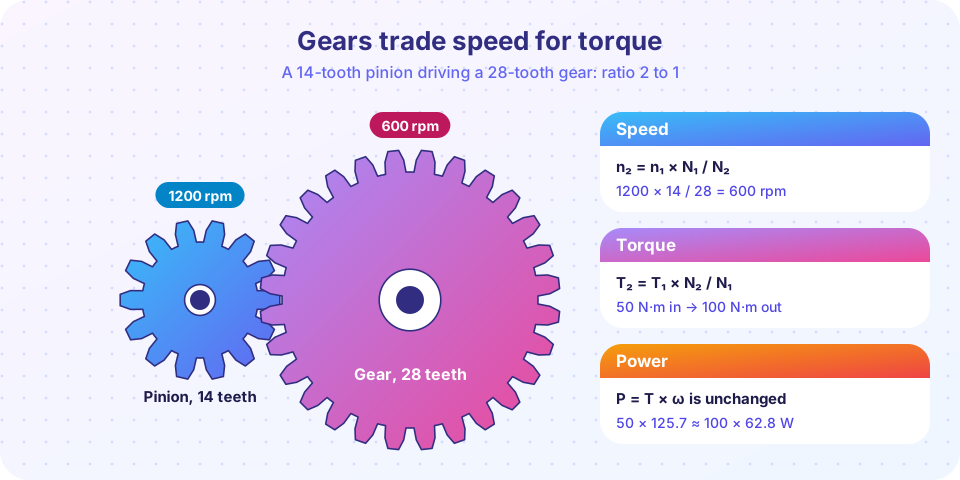
What you will learn
- Why gears exist and which job (speed, torque, direction) each gear family does best.
- How the five lessons of this chapter fit together into one design routine.
- The vocabulary you will meet: pinion, gear, module, pressure angle, contact ratio.
- A quick way to estimate output speed and torque of any gear pair.
Key terms
- Pinion: the smaller of two meshing gears. The larger one is simply called the gear.
- Module
m: the tooth size in millimeters,m = d / N. Two gears can mesh only if they share the same module. - Gear ratio: teeth on the gear divided by teeth on the pinion.
- Pitch circle: the imaginary circle on which two gears roll against each other without slipping.
The chapter in five slides
Why gears?
Teeth cannot slip.
Four families
Geometry first
Then forces
Finally, strength
Check both.
What each lesson covers
- Gear geometry and ratios: the involute tooth, module, pressure angle, contact ratio, minimum tooth count and gear trains. You will size a first pair from a required speed.
- Tooth forces and bending strength: how torque becomes tooth force, the Lewis beam model for bending, and the Hertz stress for surface fatigue.
- Helical, bevel and worm gears: extra thrust forces, cone angles, lead angle and the surprising efficiency of a worm drive.
- Chapter review: a recap table, a one-page picture and ten mixed questions.
A first estimate you can already make
Suppose a motor turns at 1450 rpm and delivers 7.5 kW, and a conveyor needs about 360 rpm. The speed ratio is 1450 / 360 ≈ 4. A pinion with 20 teeth and a gear with 80 teeth gives exactly 4, so the gear turns at 1450 / 4 = 362.5 rpm. The torque rises by the same factor, minus a small loss in the mesh. The widget below lets you try other tooth counts and watch the gears turn. The animation is a drawing built from the tooth counts you choose; it is a demonstration of the ratio, not a precise tooth profile.
How to use this chapter
Read the lessons in order the first time, because each one needs the numbers of the previous one: geometry gives the diameters, the diameters give the forces, and the forces give the stresses. On a second reading, work from the review lesson backwards and ask for each formula where it comes from. Try the calculators with your own numbers, such as the motor and speed of a machine you know. A gearbox that turns out impossible (a tooth count of 5, a safety factor of 0.3) is a good sign that you have understood the limits.
Try it
The second tool is a plain calculator for the first estimate in the paragraph above. Try other standard tooth counts and see how close you can get to the 360 rpm target.
Press Run (or Ctrl + Enter) to see the result here.
Program input · what you'd type while the program runs
Type the answers before you press Run, one per line. Each time the program reads a line (with input()), it gets the next line from this box.
Check your understanding
Quick check · 4 questions
of 4 answered You scored / 4 · perfect!
-
1. A pinion with 15 teeth drives a gear with 45 teeth. What is the gear ratio?
Ratio is gear teeth divided by pinion teeth: 45 / 15 = 3. The driven gear turns three times slower. -
2. Ignoring losses, what happens to torque when a gear pair reduces speed by a factor of 4?
Power equals torque times angular speed and is unchanged, so one quarter of the speed means four times the torque. -
3. Which statement about two meshing spur gears is required?
Teeth only fit into each other if their size (module) and flank angle (pressure angle) match. Tooth counts and diameters differ whenever the ratio is not 1. -
4. Which two failure modes does a complete gear check cover?
A tooth can break at its root (bending) or have its surface pitted (contact stress). Both are checked.
Summary
- Gears change speed, torque or axis direction without slipping.
- A gear pair keeps power (almost) constant: lower speed means proportionally higher torque.
- The design routine is geometry, then forces, then strength checks for bending and surface contact.
- Four families cover most needs: spur, helical, bevel and worm.
Next: Gear geometry and ratios
Track your progress
Create a free account to tick off lessons and pick up where you left off on any device.
of Machine Design lessons completed