


















Lesson 28 of 46 · Bearings and Springs
Rolling bearing life and selection
Choose a ball or roller bearing from a catalog: basic load rating C, the L10 life formula, equivalent dynamic load, reliability factors and a worked selection.
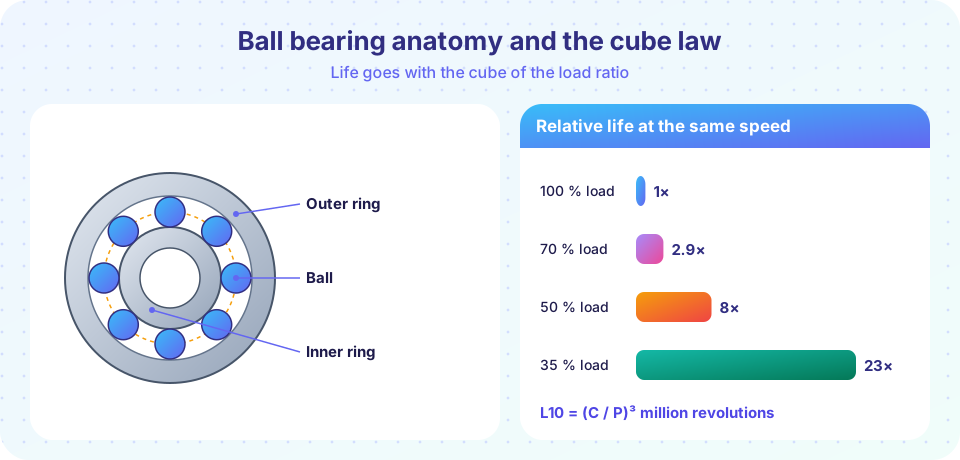
Every rotating shaft has to be held in place and allowed to turn, and the most common way to do it is a rolling bearing. Balls or rollers roll between an inner ring on the shaft and an outer ring in the housing. Rolling replaces the sliding friction of a plain bearing by a much smaller rolling resistance, so a good rolling bearing starts easily, runs cool and needs little attention.
Rolling bearings do not last forever. Each ball or roller passes over the same small area of the raceway millions of times, and sooner or later a tiny crack grows under the surface and flakes off a piece of metal. This is subsurface fatigue, and it is the normal way a well-lubricated, well-mounted bearing ends its life. The designer's job is not to prevent it but to make it happen after the required number of hours. You do that by choosing a bearing from a catalog with enough load rating for the load and the speed.
What you will learn
- Name the parts and the common types of rolling bearings and what loads each can carry.
- Use the basic dynamic load rating
Cand the L10 life formula. - Combine radial and axial loads into an equivalent dynamic load
P. - Adjust the life for reliability and pick a bearing for a required number of hours.
Key terms
- Basic dynamic load rating
C: the constant radial load that a group of identical bearings can endure for one million revolutions with 90 percent of them surviving (ISO 281). It is listed in the catalog. - L10 life: the life reached or exceeded by 90 percent of a group of bearings. Also called the basic rating life.
- Equivalent dynamic load
P: the single radial load that would give the same life as the real combination of radial and axial loads. - Static load rating
C0: the load that produces a small permanent dent in the raceway; it matters at rest and at very low speed.
Types and what they carry
| Type | Radial load | Axial load | Typical use |
|---|---|---|---|
| Deep groove ball | Good | Moderate, both directions | Electric motors, gearboxes, general machinery |
| Angular contact ball | Good | High, one direction (pairs: both) | Spindles, pumps, helical gear shafts |
| Cylindrical roller | Very high | None (or small with ribs) | Heavy radial load, high speed |
| Tapered roller | Very high | High, one direction | Wheel hubs, bevel and worm gear shafts |
| Spherical roller | Very high | Moderate | Misalignment, heavy industrial equipment |
| Thrust ball / roller | None | High, one direction | Vertical shafts, hooks, cranes |
Balls touch the rings at a point, which gives low friction and high speed capability. Rollers touch along a line, so they carry far more load for the same size, but they are more sensitive to misalignment. Use the table together with the gear forces from the previous chapter: a helical gear shaft has an axial thrust, so a pair of angular contact or tapered roller bearings is usual; a spur gear shaft with only radial load may use plain deep groove bearings.
The L10 life equation
Fatigue tests on thousands of bearings show that the life is spread widely: identical bearings under identical loads can fail at times that differ by a factor of ten or more. So life is quoted as a probability. The L10 life is the number of revolutions (in millions) that 90 percent of the bearings reach. With the load P and the catalog rating C:
L10 = (C / P)^p (millions of revolutions)
where p = 3 for ball bearings and p = 10/3 for roller bearings. The life in hours at a constant speed n (rpm) is
L10h = 10⁶ × L10 / (60 n)
The cube law is the most important thing in this lesson. Reduce the load by 20 percent and the life roughly doubles; halve the load and the life increases eightfold. A small overload is costly: an extra 26 percent in the load halves the life (since 1.26³ ≈ 2). It also explains why careful alignment, balancing and shaft stiffness pay off.
Equivalent load
Catalog rating C refers to a pure radial load. When the bearing also carries an axial load Fa (for example from helical gears), convert the combination into an equivalent radial load:
P = X Fr + Y Fa
For a deep groove ball bearing, compute Fa / C0 and look up the factors e and Y. If Fa / Fr ≤ e, the axial load is small and P = Fr. If Fa / Fr > e, use X = 0.56 and the tabulated Y. Typical values for deep groove ball bearings (take exact numbers from your catalog):
Fa / C0 |
0.014 | 0.028 | 0.056 | 0.084 | 0.11 | 0.17 | 0.28 | 0.42 | 0.56 |
|---|---|---|---|---|---|---|---|---|---|
e |
0.19 | 0.22 | 0.26 | 0.28 | 0.30 | 0.34 | 0.38 | 0.42 | 0.44 |
Y |
2.30 | 1.99 | 1.71 | 1.55 | 1.45 | 1.31 | 1.15 | 1.04 | 1.00 |
Shocks, vibration and uneven loading add to the real load. A factor of 1.0 to 1.5 on the load for light to moderate shock, and more for heavy shock, is a common allowance; follow the guidance for your machine type.
Reliability and required life
The L10 life has a 10 percent chance of failure, which is too high for some machines. For other reliabilities the ISO 281 life modification factor a1 is
| Reliability | 90 % | 95 % | 96 % | 97 % | 98 % | 99 % |
|---|---|---|---|---|---|---|
a1 |
1 | 0.64 | 0.55 | 0.47 | 0.37 | 0.25 |
so Ln = a1 L10. How many hours should you ask for? That depends on the machine and is a matter of experience and the standard for the industry. As rough guidance, a machine used a few hours a day may need 8,000 to 20,000 hours, an eight-hour-a-day industrial machine 20,000 to 30,000 hours and a continuously operating machine 40,000 to 60,000 hours or more. Always check your application's specific requirements.
Worked example: choosing a bearing
A shaft turns at 1450 rpm. One bearing carries a radial load Fr = 2.5 kN and an axial load Fa = 0.6 kN. The required L10h is 20,000 hours. A candidate deep groove ball bearing has C = 32 kN and C0 = 18 kN (illustrative catalog numbers).
Fa / C0 = 0.6 / 18 = 0.033, so by interpolatione ≈ 0.23andY ≈ 1.94.Fa / Fr = 0.24, which is abovee, soP = 0.56 × 2.5 + 1.94 × 0.6 = 2.56 kN.L10 = (32 / 2.56)³ ≈ 1950million revolutions.L10h = 1950 × 10⁶ / (60 × 1450) ≈ 22,400 h, which meets the 20,000 h requirement.
To work backward, the required C for a target life is C = P (L10)^(1/p). For 20,000 h at 1450 rpm, L10 = 20000 × 60 × 1450 / 10⁶ = 1740 million revolutions, and C = 2.56 × 1740^(1/3) = 30.8 kN. Choose the next catalog size above that.
Mounting, lubrication and what really kills bearings
Catalog life assumes a clean, well-lubricated bearing, correctly mounted, running within its speed limit. Many bearings die early because of errors outside the L10 equation: dirt and water getting in, too little or too much grease, rough handling (hammering a bearing onto a shaft dents the raceways), misalignment, or electrical current passing through the bearing. Fit the ring that rotates relative to the load tightly (an interference fit, so it cannot creep) and the stationary ring more loosely. Sealed or shielded bearings with a lifetime fill of grease are common in small machinery. For larger machines, the grease must be topped up on a schedule.
Common misconceptions
- "L10 is the average life." It is the life reached by 90 percent of bearings. The median life is about five times L10 for ball bearings, so some bearings last much longer and about one in ten fails earlier.
- "A bearing rated at C can carry C continuously." The rating is the load for a life of one million revolutions. At a load equal to
Cthe bearing lasts only minutes at motor speed. - "More speed has no effect on life in revolutions." L10 in revolutions does not depend on the speed, but life in hours does, and high speed limits lubrication and heating.
- "Axial load matters little." It matters a great deal for a deep groove ball bearing when
Fa / Frexceedse.
Try it
The first TryIt is a bearing selector. It looks up e and Y, finds P, and prints life in revolutions and hours for several reliability levels. Edit the loads and the catalog ratings.
Press Run (or Ctrl + Enter) to see the result here.
Program input · what you'd type while the program runs
Type the answers before you press Run, one per line. Each time the program reads a line (with input()), it gets the next line from this box.
The second TryIt plots life against load for ball and roller bearings on a logarithmic scale, so that you can see the cube law (and the 10/3 power for rollers) as straight lines.
Press Run (or Ctrl + Enter) to see the result here.
Program input · what you'd type while the program runs
Type the answers before you press Run, one per line. Each time the program reads a line (with input()), it gets the next line from this box.
Check your understanding
Quick check · 5 questions
of 5 answered You scored / 5 · perfect!
-
1. A ball bearing has C = 20 kN and carries P = 5 kN. What is its L10 life in millions of revolutions?
L10 = (C / P)³ = (20 / 5)³ = 4³ = 64 million revolutions. -
2. The load on a ball bearing is reduced by 50 percent. By what factor does the L10 life change?
Life varies with the inverse cube of the load, so half the load gives 2³ = 8 times the life. -
3. What does L10 mean?
L10 is the basic rating life with 90 percent reliability. Ten percent of bearings fail earlier. -
4. A bearing at 1000 rpm must last 30,000 h. How many million revolutions is that?
L10 = 30,000 × 60 × 1000 / 10⁶ = 1800 million revolutions. -
5. To reach 99 percent reliability instead of 90 percent, the rated life is multiplied by about:
ISO 281 gives a1 = 0.25 at 99 percent, so the life with 99 percent reliability is a quarter of L10.
Summary
- Rolling bearings fail by subsurface fatigue; the L10 life is reached by 90 percent of a group.
L10 = (C / P)^pwithp = 3for balls and10/3for rollers;L10h = 10⁶ L10 / (60 n).- The equivalent load is
P = X Fr + Y Fa; use cataloge,X,Y. - Life depends on the cube of the load, so small load reductions give large gains.
- Reliability above 90 percent reduces life by
a1(0.25 at 99 percent). Mounting, lubrication and cleanliness decide real life.
Track your progress
Create a free account to tick off lessons and pick up where you left off on any device.
of Machine Design lessons completed