


















Lesson 20 of 46 · Shafts and Fasteners
Bolted Joints and Preload
Understand why a bolt needs preload, compute bolt and member stiffness and the joint constant C, find bolt and clamp forces under external load, and check proof, separation and fatigue.
A bolted joint seems simple: a screw, a nut, two plates. Yet bolted joints are involved in more failures than almost any other machine element. The reason is that the bolt does not work the way it looks. The bolt is tightened so that it stretches and clamps the plates together. When the joint is loaded, most of the external force does not go through the bolt at all; it simply reduces the clamping force on the plates. A well-designed joint therefore keeps the bolt load almost constant, and that is why bolts survive fatigue loads that would break a much larger bar.
This lesson explains preload, the springs-in-parallel model of a joint, and the checks that make sure a joint holds, never separates and survives its cycles.
What you will learn
- What preload is, how large it should be and how torque relates to it.
- How to compute bolt and member stiffness and the joint constant
C. - How to find bolt and clamp force under an external load.
- How to check proof strength, joint separation and fatigue.
Key terms
- Preload Fi: the tension created in the bolt by tightening, balanced by compression in the clamped members.
- Proof strength Sp: the stress up to which the bolt returns to its original length when unloaded, close to the yield strength.
- Tensile stress area At: the effective area used to compute bolt stress, a little smaller than the shank area.
- Joint constant C:
C = kb / (kb + km), the fraction of external load carried by the bolt. - Property class: the strength grade of a metric bolt, such as 8.8 or 10.9.
The bolt and its properties
A metric bolt is named by its nominal diameter and pitch, such as M10 × 1.5: 10 mm major diameter and 1.5 mm between thread crests. The stress in a threaded bolt is computed on the tensile stress area At, which accounts for the thread root. For common coarse threads:
| Size | M6 | M8 | M10 | M12 | M16 | M20 | M24 |
|---|---|---|---|---|---|---|---|
| At (mm²) | 20.1 | 36.6 | 58.0 | 84.3 | 157 | 245 | 353 |
The property class is written as two numbers, for example 8.8. The first multiplied by 100 is the minimum ultimate strength in MPa (800), and the second multiplied by the first and by 10 gives the yield strength (0.8 × 800 = 640 MPa). The proof strengths used for design are (typical values) 225 MPa for 4.6, 380 for 5.8, 600 for 8.8, 830 for 10.9 and 970 for 12.9. Higher classes are more expensive and more sensitive to hydrogen embrittlement and notches, so grade 8.8 is the general-purpose choice.
Why preload
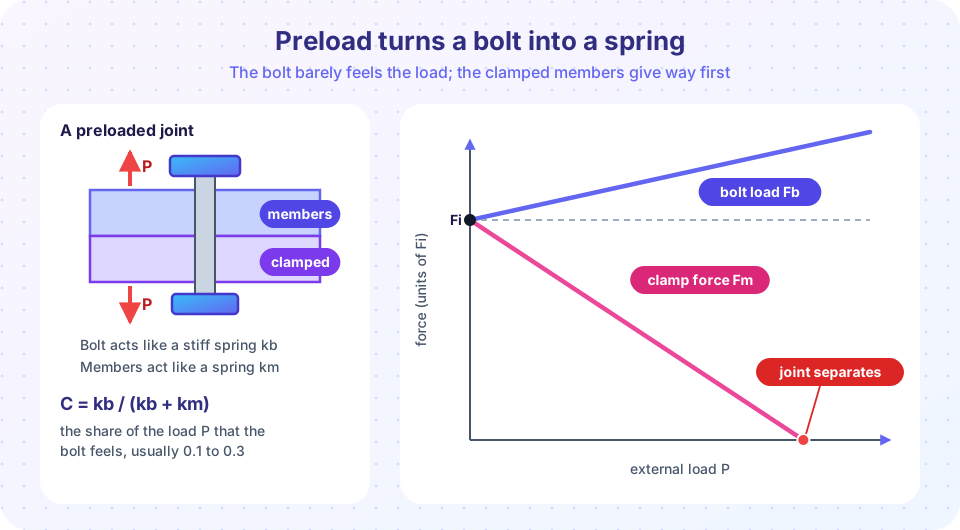
Imagine a bolt that is merely snug. When the external load P pulls the plates apart, the bolt carries all of it, and its stress cycles from zero to P/At. Now tighten the bolt hard, to a high preload Fi. The bolt is stretched, the plates are compressed, and the external load now has to first take the compression off the plates before it can add to the bolt force. The result: the bolt carries only a small part of the load.
Three benefits follow. The joint resists separation and leaks. The fatigue stress amplitude in the bolt is small. And the nut resists loosening because the clamped surfaces are held by friction.
How much preload? The standard practice is to aim at a large fraction of the proof load Fp = At Sp:
Fi = 0.75 Fp      for reusable (non-permanent) joints
Fi = 0.90 Fp      for permanent joints
For an M10 bolt of class 8.8: Fp = 58 × 600 = 34.8 kN, and Fi = 0.75 × 34.8 = 26.1 kN for a reusable joint.
Tightening torque. The preload is created by turning the nut. The empirical relation is
T = K Fi d
with the nut factor K ≈ 0.2 for plain steel threads (about 0.15 when lubricated). For the example, T = 0.2 × 26,100 × 10 mm = 52.2 N·m. Most of this torque (about 90%) overcomes friction, so small changes in friction change the preload a lot: the real preload from a given torque scatters by about ±25%. For critical joints designers measure the bolt stretch, use tension-indicating washers, or turn the nut through a measured angle.
The joint as two springs
The bolt is a spring in tension; the clamped plates are a spring in compression; they share the load like parallel springs.
Bolt stiffness. The bolt has an unthreaded part of length ld (area Ad = π d²/4) and a threaded part of length lt (area At) within the grip l:
kb = Ad At E / (Ad lt + At ld)
Member stiffness. The clamped material is compressed in a bulb of conical shape around the bolt. A common approximation with a 30° cone half-angle gives, for two steel plates with the same modulus E and total grip l:
km = 0.5774 π E d / ( 2 ln[ 5 (0.5774 l + 0.5 d) / (0.5774 l + 2.5 d) ] )
Joint constant. The fraction of the external load carried by the bolt is
C = kb / (kb + km)
The bolt is much softer than the members (it is thinner), so C is normally 0.1 to 0.3. Any increase in the stiffness of the members, such as a metal gasket instead of a soft one, further reduces C.
Forces under external load
When an external tensile load P per bolt acts on the joint:
Fb = Fi + C P              bolt force
Fm = Fi − (1 − C) P        clamp force remaining in the members (positive = compression)
P0 = Fi / (1 − C)          load at which the members separate (Fm = 0)
After separation the bolt carries the whole load, and the joint leaks, loosens and fatigues quickly. A well-designed joint has a separation factor n0 = P0/P = Fi / ((1 − C) P) of 2 or more.
Example. An M10 class-8.8 bolt, preload Fi = 26.1 kN, grip l = 30 mm of two steel plates, bolt length 35 mm with thread length LT = 2d + 6 = 26 mm. Then ld = 35 − 26 = 9 mm, lt = 30 − 9 = 21 mm, Ad = 78.5 mm², E = 207 GPa. The stiffnesses are kb ≈ 434 kN/mm and km ≈ 1,936 kN/mm, so C = 434/(434 + 1,936) = 0.18. For P = 8 kN per bolt: bolt force Fb = 26.1 + 0.183 × 8 = 27.6 kN, a rise of only 1.5 kN; the clamp force falls from 26.1 to 26.1 − 0.817 × 8 = 19.6 kN, and separation would need P0 = 26.1/0.817 = 32 kN.
Press Run (or Ctrl + Enter) to see the result here.
Program input · what you'd type while the program runs
Type the answers before you press Run, one per line. Each time the program reads a line (with input()), it gets the next line from this box.
Checking the joint
Three checks are standard.
- Proof (yield) check. The maximum bolt stress
(Fi + C P)/Atmust stay belowSp. The proof factor isnp = (Sp At − Fi) / (C P). For the example it is 5.9, comfortable. - Separation check.
n0 = Fi / ((1 − C) P) ≥ 2or more for leak-tight joints. In the example, 4.0. - Fatigue check. If the load varies between
PminandPmax, the bolt sees a stress cycle with
σa = C (Pmax − Pmin) / (2 At)
σm = C (Pmax + Pmin) / (2 At) + Fi / At        (the preload stress σi = Fi / At is the mean)
For a bolt with constant preload, the Goodman line gives the fatigue factor
nf = Se (Sut − σi) / ( Sut σa + Se (σm − σi) )
The endurance limit of a bolt is far lower than that of a plain bar, because of the thread root notch: for rolled threads, the fully corrected endurance strengths (typical values) are about 129 MPa for class 8.8, 140 for 9.8, 162 for 10.9 and 190 for 12.9. Note how little improvement a stronger class gives, and that cut threads are worse than rolled threads. For the example, load cycling from 0 to 8 kN gives σa = 12.6 MPa, σm = 462.6 MPa, σi = 450 MPa, and, with Sut = 800 MPa for class 8.8, nf = 129 × (800 − 450) / (800 × 12.6 + 129 × 12.6) ≈ 3.8 (run it below).
Press Run (or Ctrl + Enter) to see the result here.
Program input · what you'd type while the program runs
Type the answers before you press Run, one per line. Each time the program reads a line (with input()), it gets the next line from this box.
The curve falls as preload rises: in the Goodman model a higher mean stress costs fatigue margin, because the amplitude stays at 12.6 MPa as long as the joint remains clamped. Preload is still worth having, since it prevents separation (after which the bolt would feel the full load) and resists loosening; 0.75 Fp is the usual compromise. Without any preload the amplitude would be P/(2At) = 69 MPa, more than five times larger.
Loosening and other practical points
Vibration and cyclic sideways movement can make a nut turn back. Remedies: high preload, locknuts with a nylon insert or deformed thread, thread-locking compound, wedge-locking washers, or safety wire and split pins for critical joints. Ordinary spring washers contribute little at high preload. Use hardened washers under the nut or head to keep the bearing surface from embedding, which would relax the preload. Tighten bolts in a pattern, in several stages, so the plates seat evenly; and reuse of high-strength bolts that were tightened to yield should be avoided.
When a bolt must carry shear load, either rely on the friction between the plates (a slip-resistant joint: force μ Fi per interface) or on the shank bearing against the hole walls, with the shank, not the threads, in the shear plane.
Common misconceptions
- "The bolt carries the full external load." In a properly preloaded joint it carries only
C P, typically 10 to 30% of it. - "A tighter bolt is a stronger joint." Over-tightening beyond the proof load stretches the bolt permanently and loses preload.
- "Torque gives an exact preload." Friction scatter makes the preload uncertain by ±25% or more.
- "A stronger bolt class always lasts longer in fatigue." The endurance limit of rolled threads rises only slightly from class 8.8 to 12.9.
Check your understanding
Quick check · 5 questions
of 5 answered You scored / 5 · perfect!
-
1. What is the main reason a bolted joint is preloaded?
With preload the clamped members absorb most of the load change, so the bolt stress amplitude is small. -
2. M12 bolt, class 8.8 (Sp = 600 MPa, At = 84.3 mm²). What is the recommended preload for a reusable joint?
Fp = 84.3 × 600 = 50.6 kN, and Fi = 0.75 × Fp = 38 kN. -
3. kb = 400 kN/mm and km = 1,600 kN/mm. What is C?
C = kb/(kb + km) = 400/2,000 = 0.2. -
4. Fi = 20 kN, C = 0.2, P = 10 kN. What is the bolt force?
Fb = Fi + C P = 20 + 0.2 × 10 = 22 kN. -
5. At what external load does the joint separate if Fi = 20 kN and C = 0.2?
P0 = Fi / (1 − C) = 20 / 0.8 = 25 kN.
Summary
- Preload
Fi = 0.75 Fp(reusable) or0.9 Fp(permanent) withFp = At Sp; torqueT = K Fi d,K ≈ 0.2, with a large scatter. - The bolt and members act as springs;
C = kb/(kb + km)is the bolt's share of the external load. Fb = Fi + C P,Fm = Fi − (1 − C) P, separation atP0 = Fi/(1 − C).- Check proof, separation and fatigue; the endurance limit of a bolt is limited by the thread notch.
Next: Chapter 4 Review
Track your progress
Create a free account to tick off lessons and pick up where you left off on any device.
of Machine Design lessons completed