


















Lesson 33 of 46 · Brakes, Clutches and Belts
Disc clutches and disc brakes
Calculate the torque capacity of disc clutches and brakes with the uniform pressure and uniform wear models, find the best lining radii, and estimate engagement heat.
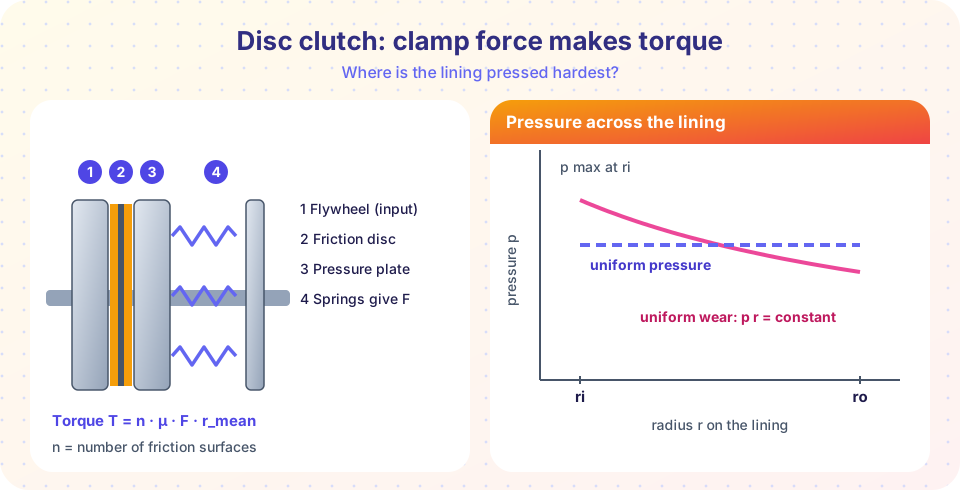
A clutch connects two shafts so that torque flows from one to the other, and can disconnect them again, even while they turn. A brake does the opposite job: it connects a rotating shaft to the ground and removes its kinetic energy as heat. The disc clutch and the disc brake are almost the same machine. In both, flat friction surfaces are squeezed together by an axial force, and the torque they transmit comes from the friction between them.
That shared physics is good news. Once you can find the torque of one friction disc, you can size a car clutch, a motorcycle brake, a crane brake or a machine tool clutch. In this lesson you will derive the torque equations for the two standard models of how the pressure is distributed, find out which radii give the most torque, and then look at what happens to the energy during engagement, because the heat is usually the limiting factor.
What you will learn
- Derive and apply the torque equations for uniform pressure and for uniform wear.
- Find the maximum axial force from an allowable lining pressure.
- Choose the inner radius that gives the best torque for a given outer radius.
- Estimate the energy and the temperature rise of the plates during one engagement.
Key terms
- Friction coefficient
μ: ratio of the friction force to the normal force at the lining. About 0.25 to 0.4 for dry organic linings; much lower (0.05 to 0.15) in oil. - Uniform pressure model: the pressure is the same everywhere on the lining (true for new, rigid parts).
- Uniform wear model: the lining has worn to a steady state where the wear is the same everywhere, which makes the product
p · rconstant. - Service factor: a multiplier on the torque for shocks and frequent starts.
Torque from friction on an annulus
The lining is a flat ring with an inner radius ri and an outer radius ro. Press the surfaces together with a total axial force F. A small element at radius r with width dr has area 2π r dr. If the pressure there is p, the normal force on it is dF = 2π p r dr, the friction force is μ dF, and the torque of the element is r μ dF = 2π μ p r² dr. We add the elements up. The result depends on how p varies with r.
Uniform pressure (new lining)
If p is constant, then F = π p (ro² − ri²) and the torque of one friction surface is
T = (2/3) μ F (ro³ − ri³) / (ro² − ri²)
Uniform wear (worn-in lining)
A real lining does not stay flat for long. The material wears fastest where the sliding speed times the pressure is highest. The sliding speed is ω r, so the outer part wears faster. As it does, the pressure there falls and the inner part takes more load, until the wear rate is the same everywhere, which happens when p r is constant. The pressure is highest at the inner radius: p r = pmax ri. Then
F = 2π pmax ri (ro − ri)
T = μ F (ro + ri) / 2
The torque equals the friction force times the mean radius (ro + ri) / 2, which is a simple and pleasant result. For the same total force F, the uniform wear torque is always a little lower than the uniform pressure torque (about 2 percent lower in our example). Since a clutch must still work when worn, designers use the uniform wear equations. They are also the conservative choice.
If the clutch has n friction surfaces (a single disc with a lining on both sides has n = 2, and a multi-plate clutch has n equal to the number of contacting pairs), the total torque is n times the single-surface value.
Which inner radius is best?
Fix ro and the allowable pressure pmax. Then, using the uniform wear equations, the torque of one surface is T = π μ pmax ri (ro² − ri²). Setting the derivative with respect to ri to zero gives ro² = 3 ri², so
ri = ro / √3 ≈ 0.577 ro
That ratio gives the most torque from a given size of lining. A lining that is a narrow ring (large ri) has little area; one that is almost a full disc (tiny ri) has a lot of area, but most of it is near the center where the lever arm is small. Practical clutches use ratios of about 0.6 to 0.8, because the best value is quite flat and a wider ring cools better.
Worked example: single-plate clutch
A dry clutch with a lining on both sides (n = 2) has ro = 100 mm and ri = 60 mm. Assume μ = 0.3 and an allowable maximum pressure of pmax = 0.8 MPa (these are assumed values for the exercise).
- Axial force:
F = 2π × 0.8 × 10⁶ × 0.060 × 0.040 = 12,064 N. - Torque of each surface:
T = 0.3 × 12,064 × 0.080 = 289.5 N·m. - Both surfaces:
T = 2 × 289.5 = 579 N·m.
For the same force, the uniform pressure model gives 591 N·m, about 2 percent more, which shows the two models agree closely. A clutch for an engine producing 250 N·m with a service factor of 1.5 needs a capacity of 375 N·m, so this clutch has comfortable margin.
Engagement heat
During engagement the two sides of the clutch slip against each other until they reach the same speed. All the work done against friction becomes heat. Suppose the input side is held at ω1 by a large engine and a load of inertia I is accelerated from rest to ω1 by the clutch. The kinetic energy that the load gains is ½ I ω1², and the energy dissipated in the clutch during slip is the same amount (the clutch dissipates as much as it transfers, when the load torque is small). With I = 2 kg·m² and ω1 = 150 rad/s (1432 rpm), E = ½ × 2 × 150² = 22.5 kJ. If the load also pulls back with a steady torque, the clutch has to slip longer and the heat is larger: the second TryIt below, with a 20 N·m load torque, gives about 28 kJ.
If this all goes into plates of mass m and specific heat c (steel: about 500 J/(kg·K)) over the short time of one engagement, then ΔT = E / (m c). For m = 2 kg, ΔT = 22,500 / (2 × 500) = 22.5 K for each engagement. That is easy for one start, but not for ten starts per minute. Frequent engagement needs bigger, cooler plates, oil cooling or a larger safety margin on temperature. The slip time is t = I ω1 / (Tc − TL), with Tc the clutch torque and TL the load torque; a more powerful clutch engages faster, with less heat in total only if the pedal and load allow it, but with a more violent shock.
Disc brakes
A disc brake works with the same equations, with a twist: the friction material is made into small pads that clamp a rotating disc between them. If one pad on each side is pressed with force F, the friction force at the mean radius rm of the pad is μ F on each side, so
T = 2 μ F rm
Example. A car brake has pads with effective radius rm = 115 mm, μ = 0.4 and a clamping force of F = 10 kN, so T = 2 × 0.4 × 10,000 × 0.115 = 920 N·m. On a tire of rolling radius 0.30 m this gives a braking force at the road of 920 / 0.30 = 3067 N per wheel. If all four wheels did the same, a 1500 kg car would decelerate at 4 × 3067 / 1500 = 8.2 m/s² (about 0.84 g). Real cars apportion more braking to the front wheels because the weight shifts forward.
Stopping a car from 100 km/h (27.8 m/s) removes ½ × 1500 × 27.8² = 579 kJ of kinetic energy in a few seconds. If four cast iron discs of 8 kg each absorb all of it (c ≈ 460 J/(kg·K)), the temperature rises by 579,000 / (4 × 8 × 460) = 39 K in one stop. Repeating the stop many times in a row (a mountain descent) does not leave time for cooling. The pad friction coefficient falls at high temperature, the brake fades, and the driver needs more pedal force. That is why brake discs are ventilated and why the heat-absorbing mass matters.
Common misconceptions
- "Torque is
μ F ro." The friction acts over a ring, so the effective radius is the mean radius, not the outer radius. Usingrooverestimates the torque. - "A clutch that has
μ = 0.3is held by 30 percent of the force." The friction coefficient is a ratio,friction force = μ × normal force. The clamp force is 3.3 times the friction force that results. - "A bigger clutch is always better." More inertia in the plates, more drag when disengaged and more heat generation at engagement can outweigh the extra torque.
- "A new clutch and a worn-in clutch carry the same torque." The two pressure models differ by a small amount, and the wear model is the safe design basis.
Try it
The first TryIt computes the torque by both models for any radii, and then plots the torque against ri / ro at fixed ro and pmax to show where the optimum is.
Press Run (or Ctrl + Enter) to see the result here.
Program input · what you'd type while the program runs
Type the answers before you press Run, one per line. Each time the program reads a line (with input()), it gets the next line from this box.
The second TryIt integrates an engagement. The input side runs at a constant 150 rad/s and the clutch drags a load of inertia 2 kg·m² and a small steady load torque up to speed. The plot shows both speeds and the heat generated.
Press Run (or Ctrl + Enter) to see the result here.
Program input · what you'd type while the program runs
Type the answers before you press Run, one per line. Each time the program reads a line (with input()), it gets the next line from this box.
Check your understanding
Quick check · 5 questions
of 5 answered You scored / 5 · perfect!
-
1. A friction disc has ro = 80 mm and ri = 40 mm. What is its mean radius for the uniform wear equation?
rm = (ro + ri) / 2 = (80 + 40) / 2 = 60 mm. -
2. A clutch with n = 2 surfaces, μ = 0.25, F = 4000 N and rm = 70 mm transmits what torque?
T = n μ F rm = 2 × 0.25 × 4000 × 0.070 = 140 N·m. -
3. Under the uniform wear model, where is the lining pressure highest?
Wear is equal everywhere when p·r is constant, so p is largest at the smallest radius. -
4. For maximum torque at a given outer radius and allowable pressure, ri should be about:
Setting the derivative of ri (ro² − ri²) to zero gives ri = ro/√3 = 0.577 ro. -
5. What is the main reason a clutch overheats when it is engaged many times per minute?
The energy transferred during slip is dissipated as heat, and the plates have little time to cool between engagements.
Summary
- Friction torque on a ring: uniform pressure
T = (2/3) μ F (ro³ − ri³)/(ro² − ri²); uniform wearT = μ F (ro + ri)/2withF = 2π pmax ri (ro − ri). - Multiply by the number of friction surfaces
n; use the uniform wear model as the design basis. - The best inner radius at fixed
roisri = ro/√3. - Disc brake torque
T = 2 μ F rm. - Engagement or braking energy is
½ I ω²(or½ m v²), and the temperature riseE / (m c)often decides the size.
Track your progress
Create a free account to tick off lessons and pick up where you left off on any device.
of Machine Design lessons completed